For two years running, sweepstakes casinos have been the most talked-about way to enter the US market without a gaming license — and the most controversial. In 2025 the model reportedly generated somewhere between $6.9 billion (Eilers & Krejcik) and $14.3 billion (KPMG’s upper estimate), which is more than the entire licensed US online casino market combined. But in 2026 the fairy tale started to crack: states are banning the model one after another. Let me walk you through what it actually is, who it still makes sense for, and how to build a platform that a single bill won’t kill overnight.
What a sweepstakes casino is — and why it runs without a license
The model is built on a dual-currency mechanic. Players hold two types of coins: Gold Coins (GC), a purely-for-fun currency with no real value, and Sweeps Coins (SC), a promotional currency that can be redeemed for prizes, gift cards or cash after playthrough. Officially the user buys GC packages “for entertainment” and receives SC as a bonus. The crucial detail: SC can always be obtained for free too — through daily bonuses or a postal request, the so-called AMOE (alternative method of entry).
That is exactly what breaks the “gambling triad” of prize, chance and consideration. If a player never has to pay for SC, the consideration element legally disappears — so on paper this is a promotion, not gambling. Hence the commercial appeal: for years the model operated in 45-plus states with no gaming license, no multi-year approvals and no seven-figure licensing deposits.
Why everyone piled in
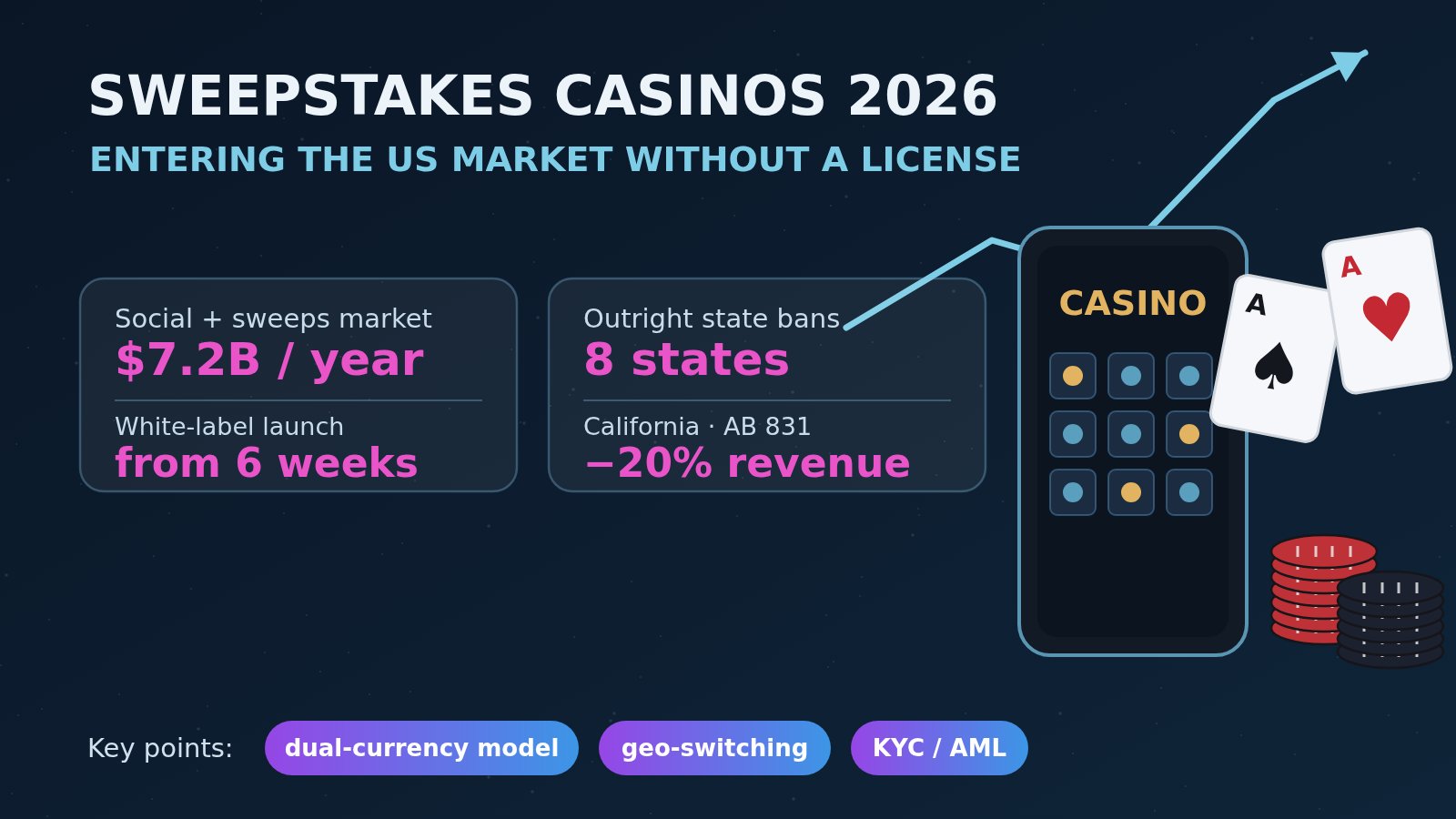
The answer is money and speed. In early 2026 analysts sized the combined US social and sweepstakes casino market at roughly $7.2 billion in annual consumer spending. Yet the barrier to entry is far lower than licensed iGaming: a ready-made white-label platform aggregating 3,000-plus games from 80-plus providers can go live in as little as six weeks. Compare that to a full license in a regulated US state, which takes years and burns budgets no startup can absorb.
The 2026 legal reality: a wave of bans
Now the honest part that box-solution vendors won’t tell you. In 2026 regulators went on the offensive. By mid-year, outright bans are in force in eight states.
The heaviest blow came from California. Governor Newsom signed AB 831 in October 2025, and from 1 January 2026 any dual-currency sweepstakes platform is illegal in the state. Analysts estimate that single ban wiped out roughly 20% of all US sweepstakes revenue, simply because California’s population dwarfs every other closed market. Indiana followed (from 1 July), then Maine (mid-July), along with New York, Louisiana and Tennessee. Active bills are now moving through Florida, Oklahoma, Virginia, Iowa and Mississippi.
Together, the six states that enacted bans in 2026 could strip $2.1–2.5 billion in annual consumer spending out of the market. That is why the “pure” sweepstakes segment has already been revised down to about $3.6 billion from an earlier $4.6 billion. The takeaway is blunt: you can no longer build a nationwide business, and any strategy has to assume a shrinking map of coverage.
Who the model still fits in 2026
Sweepstakes still makes sense for operators who want to test US traffic without a license, and for brands with a strong media or affiliate channel that can drive registrations cheaply. Who it does not fit: anyone chasing a “set it and forget it” scheme. The model demands constant geo-configuration, state-by-state legal support and living, breathing compliance. This is an operational business, not passive income.
How to launch a platform that survives the bans
The core technical lesson of 2026: the platform has to be flexible. Betting everything on sweepstakes today means betting on an asset a legislator can zero out with a stroke of the pen. The right architecture lets you switch off SC redemption in individual states via geo-fencing and instantly fall back to a pure free-to-play social model wherever sweeps are banned. That toggle is your survival kit — which is why we recommend baking it in during
turnkey development rather than bolting it on later.
If you need a fast start, the optimal route pairs a ready-made back office with built-in KYC and a payment module — a
White Label solution covers that in weeks, not months. Content is a separate matter: you cannot retain a player over time without a deep library, so
game integrations from dozens of providers are a baseline requirement, not a luxury. On top of that: reliable processing for GC package sales and prize payouts, strict AML/KYC, a genuinely working AMOE, and responsible-gaming tooling.
The risks — and how to cut them down
Regulatory risk is the big one. Bans are accelerating, and the only real hedge is a flexible platform plus geo diversification beyond the US: the Canadian market and parts of the EU remain open to social casinos. Payment risk is just as real — banks and acquirers are jittery about the segment’s reputation, so line up multiple processing providers from day one. And reputational risk: lawsuits and state attorney-general investigations hit operators whose terms are box-ticking and whose AMOE exists only on paper. Transparent terms and a genuinely usable free entry method aren’t a formality — they’re a shield.
The sober bottom line: in 2026, sweepstakes is not a forever gold mine but a 12-to-24-month window plus a bridge to a durable free-to-play social model. Operators who build with that in mind will make money. Those who buy a “whole-of-US box” risk being left holding an asset that’s outlawed in half the country by next quarter.
FAQ
Do you need a gaming license for a sweepstakes casino?
Formally, no — the model is engineered to fall outside the definition of gambling. But that doesn’t remove the need for state-by-state legal review: rules differ, and what is legal in one state is banned in another.
Which states have already banned sweepstakes?
By mid-2026, outright bans are in force in at least eight states, including California, Indiana, Maine, New York, Louisiana and Tennessee. The list is growing, with bills pending in several more.
How much does it cost to launch?
The range is wide: from a fast white-label start in a few weeks to full custom development. The final figure depends on functionality, the number of integrations and your compliance requirements.
How is sweepstakes different from a regular social casino?
A social casino runs on Gold Coins only and offers no payouts — it’s pure entertainment. Sweepstakes adds Sweeps Coins that can be redeemed for prizes and cash. That redemption is what creates the commercial upside and, at the same time, the regulatory risk.
Can you switch to a social model if sweeps get banned?
Yes — but only if the platform was designed with that toggle from the start. Retrofitting it is expensive and slow, so build the flexibility in on day one.
This article is for informational purposes only and is not legal advice. Before launching in any specific jurisdiction, consult a qualified attorney.
Read also