


Updated 29 September 2026. Author: Gambling Soft team.
Short answer: To open an online casino in Peru you need a MINCETUR licence under Law No. 31557: a local company with a resident legal representative, a platform and games certified by an accredited laboratory, and a guarantee of 600 UIT (PEN 3,210,000 in 2025) or 3% of annual net revenue, whichever is higher. The gaming tax is 11.7% of GGR, plus 1% ISC on every wager from 1 July 2025, and the total entry budget starts from about $1 million. The software is a small part of that: a Gambling Soft ready casino costs $8,500 (Violet) to $47,500 (Velvet); see prices.
 Peru, alongside Brazil and Colombia, has established a transparent and strictly regulated market. For an entrepreneur planning to buy a casino and legalize operations in this region, the country offers some of the clearest entry conditions in Latin America. However, behind its apparent attractiveness lie high capital and technical requirements.
In this article, we examine how the Peruvian market transformed after the adoption of Law No. 31557, the cost of market entry, and which launch model (a turnkey casino or building a platform from scratch) is the most rational approach.
Peru, alongside Brazil and Colombia, has established a transparent and strictly regulated market. For an entrepreneur planning to buy a casino and legalize operations in this region, the country offers some of the clearest entry conditions in Latin America. However, behind its apparent attractiveness lie high capital and technical requirements.
In this article, we examine how the Peruvian market transformed after the adoption of Law No. 31557, the cost of market entry, and which launch model (a turnkey casino or building a platform from scratch) is the most rational approach.
Peru Market Context: Figures and Characteristics
Peru ranks third in Latin America in terms of iGaming traffic after Brazil and Mexico. A key feature of the local market is the high level of digitalization among the population. Approximately 80% of adults have access to smartphones, making mobile gambling the dominant segment.Player Behavior and Preferences
Peruvian players demonstrate strong loyalty to localized brands. If you decide to purchase a ready-made online casino software solution, you must ensure the platform supports not only Castilian Spanish but also regional slang and local payment habits. A professional gambling software provider or igaming software provider should offer full localization and payment integration.- Sports betting: Approximately 60% of turnover comes from sports wagering.
- Casino games: Classic high-volatility slots and Live Casino formats (roulette, blackjack) are particularly popular.
- Esports: Peru has one of the strongest fan bases for Dota 2 and CS worldwide, creating a significant niche for specialized casino platform solutions.
Audience Snapshot:
- Core audience: Men aged 25-45.
- Devices: 85% mobile traffic.
- Average ticket (ARPU): Demonstrates steady annual growth of 5-7% driven by the strengthening national currency (sol).
Player Activity
82% of Peruvian players reported engaging in online gambling within the past six months, the highest figure among countries participating in the Playtech study. High enthusiasm for wagering, particularly in mobile sports betting, is observed alongside a low level of channel cannibalization.| Indicator | Value (2025) |
| Population | 33+ million |
| Internet users | 27.3 million (79.5%) |
| Mobile connections | 39.4 million (115% of population) |
| Online GGR forecast | $350+ million |
| Total market turnover | $2.5 billion |
Related topic: Where to Launch an Online Casino in Latin America

Regulation and Legal Environment
Until 2022, online gambling in Peru operated in a regulatory “grey zone.” This changed with the adoption of Law No. 31557 (and subsequent amendments under Law No. 31806), which required all operators to obtain a local license. Today, any casino software or igaming software used for operations must comply with national technical standards.Who Regulates the Market?
The main supervisory authority is MINCETUR (Ministry of Foreign Trade and Tourism). The agency not only issues licenses but also monitors the technical compliance of each casino platform and online casino platform. Official information on the operator registry and regulatory framework can be found on the MINCETUR website. In addition to MINCETUR, operators interact with:- SUNAT: National Customs and Tax Administration (tax obligations)
- SBS: Superintendence of Banking, Insurance and Pension Funds (AML supervision)
- UIF-Peru: Financial Intelligence Unit of Peru (suspicious transaction monitoring)
Current Legislative Framework
Peru’s legal system is based on several key regulatory acts:| Document | Date | Description |
| Law No. 31557 | August 2022 | Established the first comprehensive legal framework for online gambling and sports betting |
| Law No. 31806 | June 2023 | Introduced amendments and clarifications, particularly regarding licensing procedures, tax obligations, and the inclusion of foreign operators within the regulatory scope |
| Supreme Decree No. 005-2023-MINCETUR | October 2023 | Defines detailed regulations for implementing Law No. 31557, including technical, operational, and compliance requirements for remote gaming and betting activities |
Key Restrictions:
- Prohibition on the use of cryptocurrencies as a direct deposit method (allowed only through fiat gateways).
- Mandatory player verification (KYC) at registration.
- Strict responsible gambling requirements (self-exclusion mechanisms).

Online Casino Licensing in Peru
Peru is one of the few countries in the region where a foreign investor may own 100% of a local company applying for a license. However, the procedure requires substantial financial investment and full compliance with technical standards for online casino software and casino software.Requirements for Foreign Operators
To legally offer services, a company must:- Register a legal entity in Peru.
- Appoint a legal representative (a resident of the country).
- Host servers locally or provide the regulator with real-time access to operational data through certified gateways.

Financial Guarantees
The required guarantee equals 3% of the operator’s annual net revenue or 600 UIT (equivalent to PEN 3,210,000 in 2025), whichever amount is higher.Required Documentation Package
The application must include:- Company registration and incorporation documents
- Information on owners, shareholders, and directors
- Contracts with platform and game providers
- RNG certification and game fairness reports
- Responsible gambling policies (self-exclusion, deposit limits)
- AML/KYC compliance measures
- Payment method integrations
- Cybersecurity system documentation

Technical Requirements
Operators may use domains with the extensions “.bet.pe”, “.bet”, “.com”, “.pe”, or “.com.pe”. The casino platform must generate real-time data streams or detailed reports for MINCETUR, allowing the regulator to monitor compliance at any time. MINCETUR has registered 280 related service providers and accredited 9 certification laboratories, including BMM Spain Testlabs, Global Lab Ltd, TRISIGMA B.V., and BMM North America.Top 5 Application Mistakes
- Incomplete ownership structure documentation
- Missing or outdated RNG certificates
- Use of unlicensed B2B providers
- Incorrectly drafted AML/KYC policies
- Non-compliance of the technological platform with MINCETUR requirements
Taxes, Payments, and Compliance
Peru’s tax regime for iGaming is considered moderate compared to Argentina but stricter than Curaçao. Operators launching a turnkey online casino or deploying proprietary igaming software must account for ongoing fiscal and compliance obligations from the outset.Tax Burden
The tax rate is 11.7% of GGR (gross gaming revenue: total wagers minus paid winnings and service costs).- Important: The tax is paid monthly.
- Security deposit: The operator must provide a financial guarantee (fianza) of approximately 600 UIT (Unidad Impositiva Tributaria), exceeding USD 800,000. This represents a critical entry barrier that filters out smaller operators.
| Tax Type | Rate | Tax Base |
| Gaming tax | 11.7% | Net revenue (bets minus payouts) |
| ISC (from 01.07.2025) | 1% | Each placed wager |
| Service deduction | 2% | Monthly net revenue |
Distribution of Tax Revenues
Tax revenues from the sector are allocated as follows: 20% to the State Treasury, 20% to the Peruvian Institute of Sport (IPD), 20% to the Ministry of Health (MINSA), and 40% to MINCETUR, with the latter portion primarily dedicated to supervising gambling establishments.Payment Restrictions
Players in Peru prefer reliable local payment methods:- Visa / Mastercard: standard international usage
- Bank transfers: for large transactions
- Yape and Plin: popular mobile wallets
- PagoEfectivo: widely used e-cash solution
AML / KYC
In 2025, SBS Resolution No. 03622-2025 officially introduced anti-money laundering and counter-terrorist financing (AML/CFT) measures for online gaming and sports betting operators. This resolution, issued by the Superintendence of Banking, Insurance and Pension Funds (SBS), classifies companies authorized to conduct online games as obligated entities before the Peruvian Financial Intelligence Unit (UIF). Operators are required to apply due diligence procedures, monitor suspicious transactions, and report any activities potentially linked to unlawful conduct. All licensed operators are classified as “obligated entities” and must comply with Peru’s AML framework. These policies include the implementation of internal risk control systems, submission of suspicious transaction reports (STRs), and the appointment of a compliance officer registered with the UIF. These obligations form part of the SPLAFT system, a risk-based structure governing the prevention and detection of illegal activities in high-risk sectors, including gambling. Sanctions for non-compliance, particularly failure to submit suspicious transaction reports, may reach 10 tax units (UIT), equivalent to approximately PEN 53,500 (around USD 15,620).Key KYC Requirements at Player Registration
Mandatory KYC procedures require operators to verify the identity, age, and source of funds of all players before granting access to gaming services. Operators must maintain up-to-date records of all player checks and transactions for regulatory audits. These controls must be embedded directly into the online casino platform or igaming software architecture.
Casino Launch Formats in Peru
For those planning to purchase a ready-made casino or deploy a turnkey casino solution, it is important to understand the available market entry formats.White Label
Faster time-to-market with reduced control, but lower initial commitments. Pros:- Minimal launch timeframe
- Ready-made technical infrastructure
- Reduced capital expenditures
- Limited customization
- Dependence on a partner’s license
- Margin sharing requirements
In-House Development
Full customization: maximum control, highest cost. Pros:- Complete control over the product
- Unique market positioning
- Independence from third-party providers
- Significant time and financial investments
- Requirement to pass full certification
- High demands on the technical team
Turnkey Casino Software
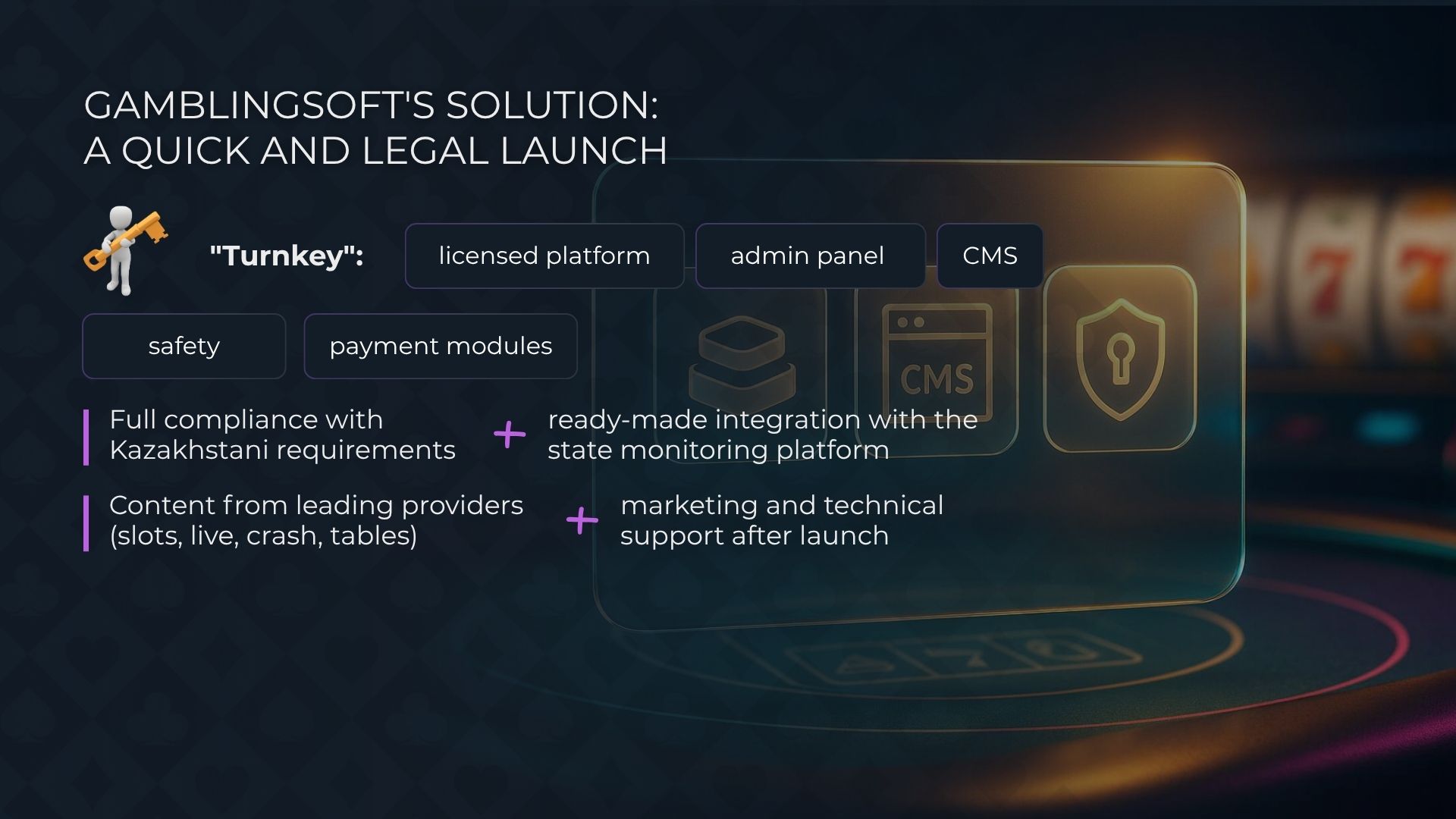
Turnkey platforms provide a moderate level of customization. This is the optimal option for operators seeking to buy a turnkey online casino with the flexibility to adapt the casino software to local market requirements, typically delivered by an experienced gambling software provider or casino software providers. An operator cannot enter the Peruvian market if its B2B suppliers, including platform, game content, payment, and data service providers, do not also meet regulatory requirements. Always request up-to-date documentation from each vendor: MINCETUR approval, certification reports, and service agreements. The use of unlicensed partners may result in license rejection or even suspension after launch. Best practice: select vendors already approved in Peru, such as established casino software providers or a certified gambling software provider.| Format | Launch Timeline | Investment | Control |
| White Label | 2-4 months | Low | Minimal |
| Turnkey | 4-8 months | Medium | Moderate |
| In-house development | 12+ months | High | Full |
Buy a Casino from Gambling Soft
Risks and Common Mistakes
Regulatory Risks
Even if you choose to deploy a top-tier ready-made casino or turnkey online casino, success in Peru is not guaranteed without accounting for local risks.- Political instability: Government cabinets change frequently in Peru, which may cause licensing delays or sudden amendments to the tax code.
- Underestimating marketing costs: The cost per acquisition (CPA) in Peru is increasing. Competition with major brands such as Betsson or Inkabet requires aggressive marketing and influencer engagement.
- Ignoring local holidays: Player activity peaks during “Gratificación” bonus payment periods (July and December). Lack of promotional campaigns during these dates results in lost revenue.
Typical Market Entry Mistakes
- Underestimating local presence: a physical office and local representative are mandatory
- Ignoring cryptocurrency restrictions: a complete ban on direct crypto transactions
- Working with uncertified suppliers: all B2B partners must be registered with MINCETUR
- Unpreparedness for AML inspections: a full SPLAFT regime has been in force since 2025
- Misjudging the impact of ISC on margins: 1% of each wager can significantly affect project economics
Related topic: Beginner Mistakes in iGaming
Summary
Who the Market Is Suitable For
- Operators prepared to invest from $1 million (including the guarantee deposit and marketing expenses).
- Entrepreneurs seeking a stable jurisdiction with clear regulatory rules for the next 5-10 years.
- Companies aiming to scale across the entire LatAm region, using Peru as a strategic foothold.
Who the Market Is Not Suitable For
- Startups with budgets below $200k.
- Operators unwilling to comply with strict reporting and transparent taxation requirements before SUNAT.
When Launching Is Justified
If your objective is to build a scalable, capitalizable business, the most rational approach is to purchase a turnkey casino from a proven vendor with experience in Latin American certifications. This minimizes technical risks at launch and reduces integration time for local payment methods, which are critical for survival in Peru. Leveraging professional online casino software or a compliant igaming software stack significantly accelerates certification and market entry. In 2026, Peru represents a mature market where success depends not merely on acquiring software but on delivering superior service within the legal framework. Begin with a legal audit and the selection of a reliable casino platform: these factors account for the majority of success in this jurisdiction.Useful Resources
- MINCETUR: official regulator website
- SUNAT: tax administration
- SBS: banking supervision and AML oversight
Many operators entering new markets buy casino software ready-made instead of building from scratch.
FAQ
Is online gambling legal in Peru?
Yes. Law No. 31557 of August 2022 and Law No. 31806 set up the framework, and since February 2024 every domestic and foreign operator needs a MINCETUR licence.
Can a foreign company get an online casino licence in Peru?
Yes, a foreign investor may own 100% of the local company. It must register a Peruvian legal entity, appoint a resident legal representative and host servers locally or give the regulator real-time data access.
What taxes does an online casino pay in Peru?
The gaming tax is 11.7% of GGR, paid monthly, and from 1 July 2025 a 1% ISC applies to each wager.
Can a Peruvian online casino accept cryptocurrency?
Not as a direct deposit method: crypto is allowed only through fiat gateways. Players mostly use Visa and Mastercard, bank transfers, Yape, Plin and PagoEfectivo.
How much does the casino software cost and how fast is the launch?
Gambling Soft platform starts from $7,500, ready casinos cost $8,500 to $47,500, and the technical launch takes 7 business days after the advance payment, with a 12-month warranty. In Peru the platform and games must also pass certification by a MINCETUR-accredited laboratory before real-money operation.