


Updated 30 September 2026. Author: Gambling Soft team.
Short answer: A PAM (Player Account Management) platform is the casino core that runs player wallets, bets, bonuses, KYC, segmentation and reporting, ideally for several brands from one back office. Building your own costs €200,000 to €1,000,000+ and takes 12 to 18 months (market estimates), so most new operators start on a ready platform. The Gambling Soft platform starts from $7,500, ready branded casinos cost $8,500 to $47,500 and the platform source code $19,000, with launch in 7 business days.
PAM Platform for Online Casino: What It Costs and Whether to Build Your Own
Here’s the uncomfortable truth I’ve learned over fifteen years in iGaming. Most casinos don’t fail because of an ugly site or a thin game lobby. They fail because of the plumbing nobody talks about: the PAM. Players never see it. Investors forget it in the pitch deck. And then it quietly decides whether the brand survives past year one. PAM stands for Player Account Management. Textbook definition, not very useful. So let me put it in plain terms.What a PAM Actually Does
Think of it as the casino’s nervous system. The player wallet, bet history, bonus engine, KYC and verification, segmentation, regulatory reporting, the wiring to game studios and payment providers: all of it lives inside the PAM. Strip it out and you’re left with a pretty storefront that can’t take money or keep anyone around. A quick war story. An operator I advised in Southeast Asia bolted a slick front end onto a PAM that choked above a couple thousand requests per second. One busy Saturday night the whole thing went dark for forty minutes. That’s not “annoying.” That’s a torched acquisition budget and a batch of players who wandered off to a competitor and never came back. By comparison, serious platforms such as GR8 Tech handle around 20,000 requests per second and go live in two to four weeks. The gap between “holds up” and “falls over” costs exactly as much as you spent getting those players through the door.Build vs Buy: The Honest Math
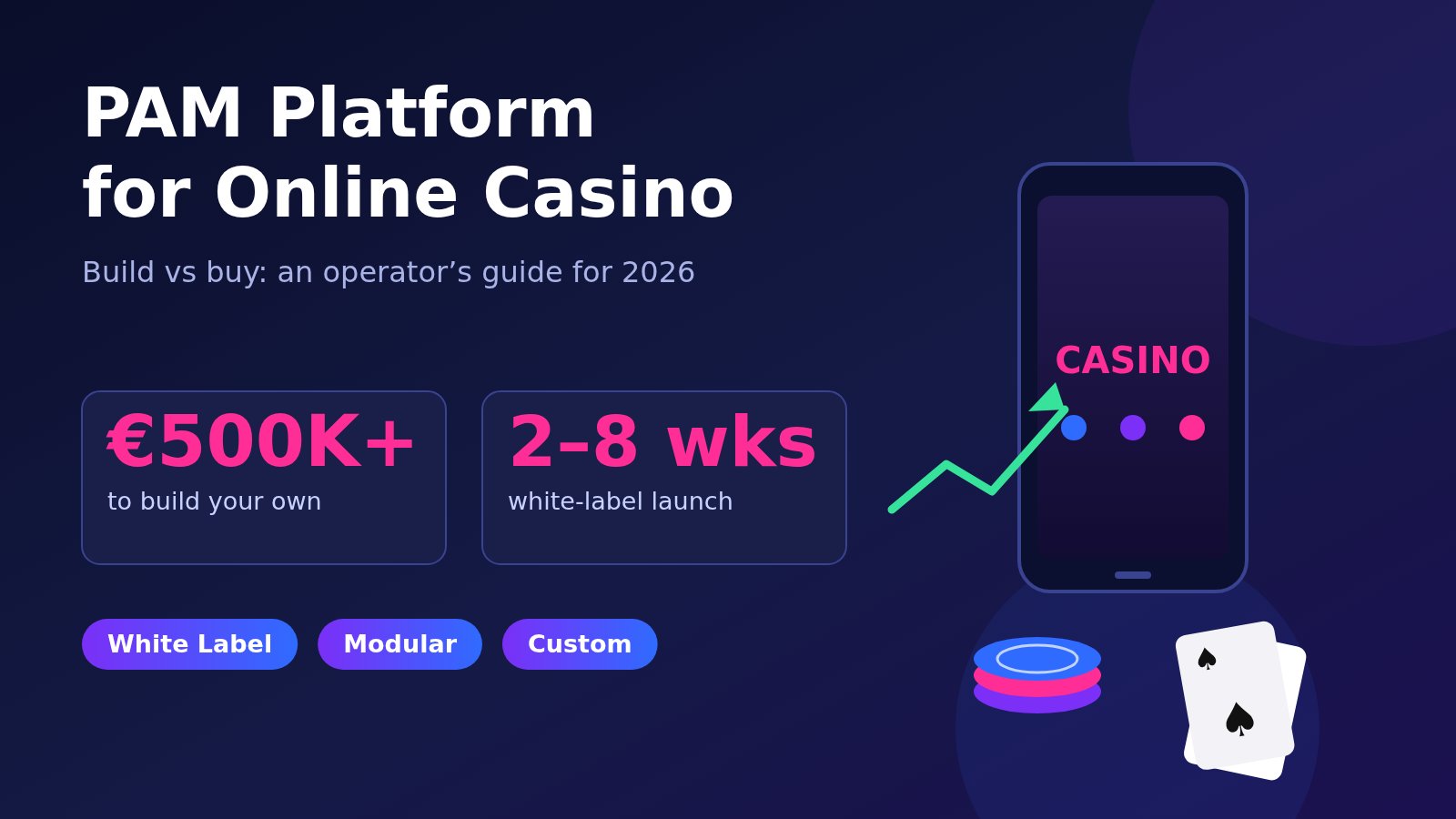
This is the question everyone asks, and there’s no one-size answer, only numbers. For 2026 they look like this. Building your own platform from scratch runs €200,000 to €1,000,000-plus and takes 12 to 18 months before you accept a single bet. And that bar keeps rising: driven by AI, compliance and mobile-first demands, plenty of custom builds in 2026 already cross €500,000 just at launch (europeangaming.eu, July 2026). After that you carry a permanent engineering team that needs feeding every month. A ready-made white-label platform is a different animal entirely. €13,000 to €135,000, and you’re live in two to eight weeks. The catch: you share revenue. Typical GGR rev-share sits at 15-25%, and it keeps flowing to the provider for as long as you run on their stack. See the trade? Own platform means capital up front and better unit economics later. Rented platform means a fast start and a permanent cut of your turnover. My rule of thumb is blunt: if you haven’t proven anyone actually wants your product yet, don’t build your own PAM. Test the idea on a white-label solution first, collect real player data, then run the numbers on whether owning the infrastructure pays off.Three Ways to Get a PAM and the Catch in Each
Broadly there are three models. Each has a different cost of getting it wrong.Full white label
The provider hands you everything: platform, often their license, payments, games, support. You handle brand and marketing. Fast, cheap to enter, minimal technical headache. The downside is lock-in. Player data isn’t really yours, customization is capped, and walking away from the contract can hurt. Worth noting: in 2026 the market finally shifted toward modular deals with clear exit paths, because operators got tired of being trapped and started demanding data and wallet portability.Modular platform
You take a PAM core and assemble the rest around it: your own payments, your bonus logic, your own studio lineup via game integrations. More flexible than white label, but every join is a potential bug. Good fit if you already have engineers on payroll.Custom development
The platform is entirely yours, no rev-share, best long-run economics. But it’s a marathon: a year to eighteen months, a serious budget, and full ownership of maintenance forever. This suits operators who’ve outgrown white label and keep hitting its ceiling. If that’s you, look at turnkey development: you get your own codebase without assembling a team from zero.What to Actually Check in a 2026 PAM
Not the slide count in the vendor’s deck. Here’s the short checklist I run with clients. Multi-brand and multi-currency. Planning more than one brand? You almost certainly will. The PAM needs to run segmentation, wallets and KYC across several brands from one back office. Retrofitting that later is expensive. KYC and compliance baked in. Regulators in 2026 aren’t playing. Check how the platform plays with verification providers and whether it can export jurisdiction-specific reporting without a manual dance. Payments. A pain point of its own. Make sure the PAM plugs into local methods for your target markets, deposit conversion tanks without them. Ready-built payment solutions tuned for specific regions save you a lot of grief here. Speed and resilience. Ask for the requests-per-second figure and the uptime SLA. If the vendor gets vague, that’s your answer. Exit and data portability. The most underrated line item. What happens to your player base if you leave? Get it in the contract before you sign, not after.A Concrete Cost Example
Take a common scenario: a small operator wants to launch in one or two Latin American markets on a total budget of about €150,000. The math writes itself. A custom PAM is off the table: it would swallow the whole budget and ask for seconds, with a year gone before launch. So it’s white label or modular. Say €40,000-70,000 up front for white label plus a 20% rev-share, leaving €80,000-plus for traffic and content. Six to twelve months in, you look at the data: strong ARPU and retention, start costing out a move to your own platform. Weak numbers, and you’ve lost tens of thousands, not half a million. That “prove it, then build it” logic is exactly what separates the operators still standing after two years from the ones who launched with a splash and closed quietly.Bottom Line
PAM isn’t a line item, it’s the foundation. The online gambling market in 2026 is pegged at roughly $98-122 billion, with forecasts pushing past $200 billion by the early 2030s (Grand View Research, Mordor Intelligence). Plenty of money, brutal competition, and the winner isn’t the flashiest logo. It’s the operator whose platform doesn’t fall over and knows how to keep a player. Fifteen years distilled into one line: don’t fall in love with the idea of your own platform too soon. Data first, capital second.FAQ
How is a PAM different from a game engine or a CMS?
The engine runs the games, the CMS runs the storefront content. The PAM runs the player: money, account, bonuses, verification. Different layers, and mixing them up is a rookie mistake.Can I launch a casino with no PAM of my own?
Yes, and most operators do at first, through white label, where the PAM comes bundled. You only need your own once volume justifies dropping the rev-share.How long does connecting a ready-made PAM take?
With mature vendors, two to eight weeks depending on customization and the number of integrations. Building your own is 12 to 18 months.15-25% of GGR across the market in 2026. Below 15% is rare and usually comes with strings; above 25% is a reason to negotiate harder or shop around.
Which matters more: price or data portability?
Over time, portability. A cheap contract you can’t extract your player base from costs more than any entry-point saving. Check the exit terms first.Read also
See also
- Online casino software pricing 2026 (full price list)
- How much does it cost to start an online casino in 2026
- Best turnkey casino software providers 2026: 10 compared
- Casino software comparison: Gambling Soft vs 9 vendors
- White label casino vs source code
- Ready-made casinos with source code
- Turnkey online casino: packages from $7,500 and the 7-day launch
- White label casino solutions
- iGaming platform features
- How to start an online casino in 2026: 7 steps