


Updated 12 November 2026. Author: Gambling Soft team.
Short answer: An Isle of Man online gambling licence from the Gambling Supervision Commission costs £5,250 to apply plus £36,750 a year for a full licence (£5,250 a year for a sub-licence, £52,500 for a network services licence), is issued for up to 5 years and typically takes 10-12 weeks of review after the regulator accepts the application, or around four months including company setup. The standard corporate income tax rate is 0%, and gambling duty is 1.5% of the gambling yield on the first £20 million a year, 0.5% on the next £20 million and 0.1% above £40 million. The casino software is a separate budget line: the Gambling Soft platform starts from $7,500 and a ready casino launches in 7 business days (see our pricing page).
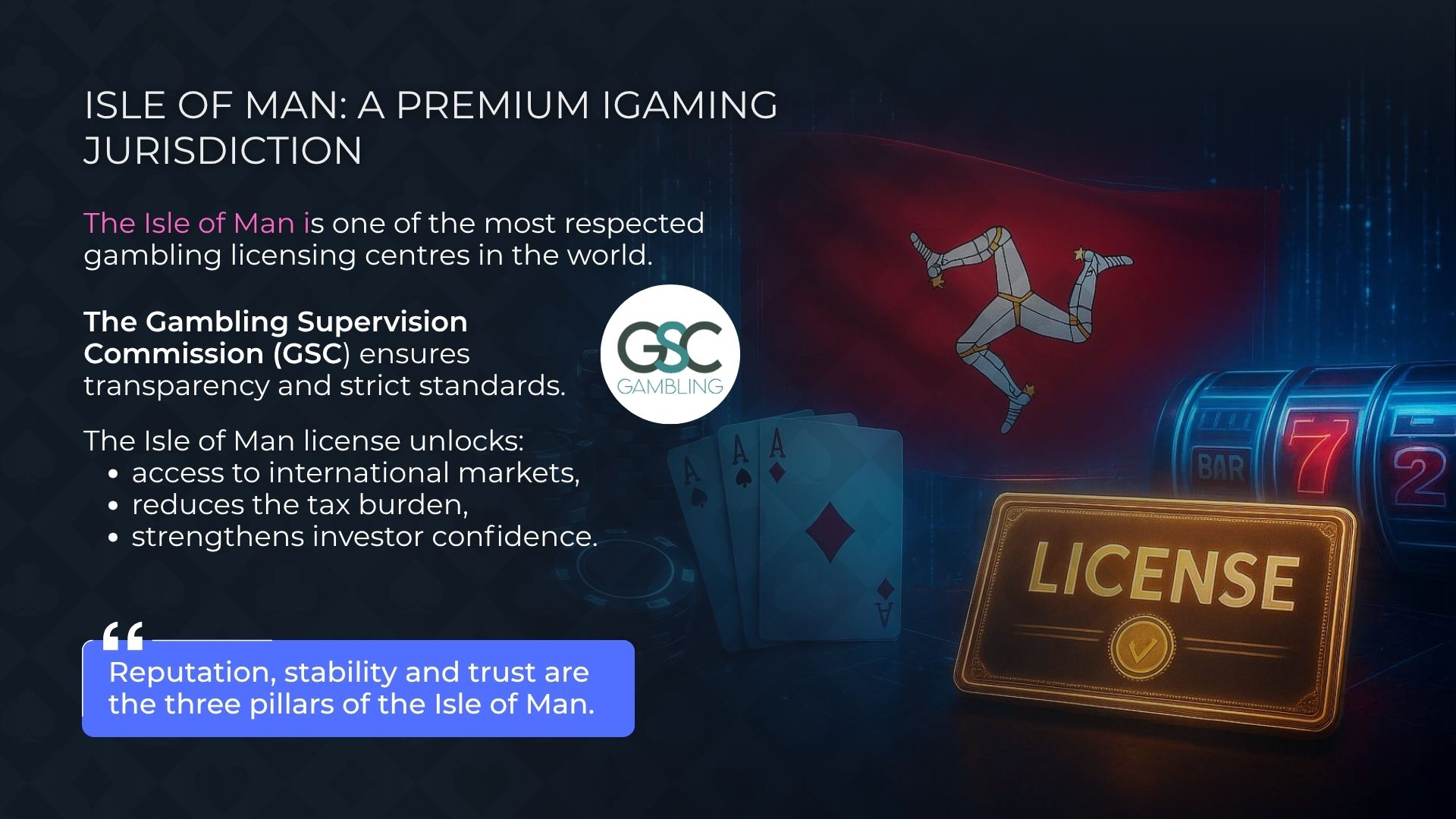
In 2025, the Isle of Man jurisdiction remains one of the most respected destinations for obtaining a gaming license. It attracts entrepreneurs who aim not only to launch a casino but to build a sustainable international business with minimal taxes, access to European payment systems, and strong partner trust.
The island’s regulator, the Gambling Supervision Commission (GSC), is known for its strict standards and transparent licensing procedures. As a result, the Isle of Man has become a gateway for dozens of tech-driven operators who value the combination of reputation, flexibility, and financial efficiency.
Key Facts About the Isle of Man License
Before submitting an application, it’s essential to understand how the Isle of Man licensing system works and what resources are required at the initial stage. Below are the main parameters that define the financial and legal aspects of the project.
Regulator and Legal Framework
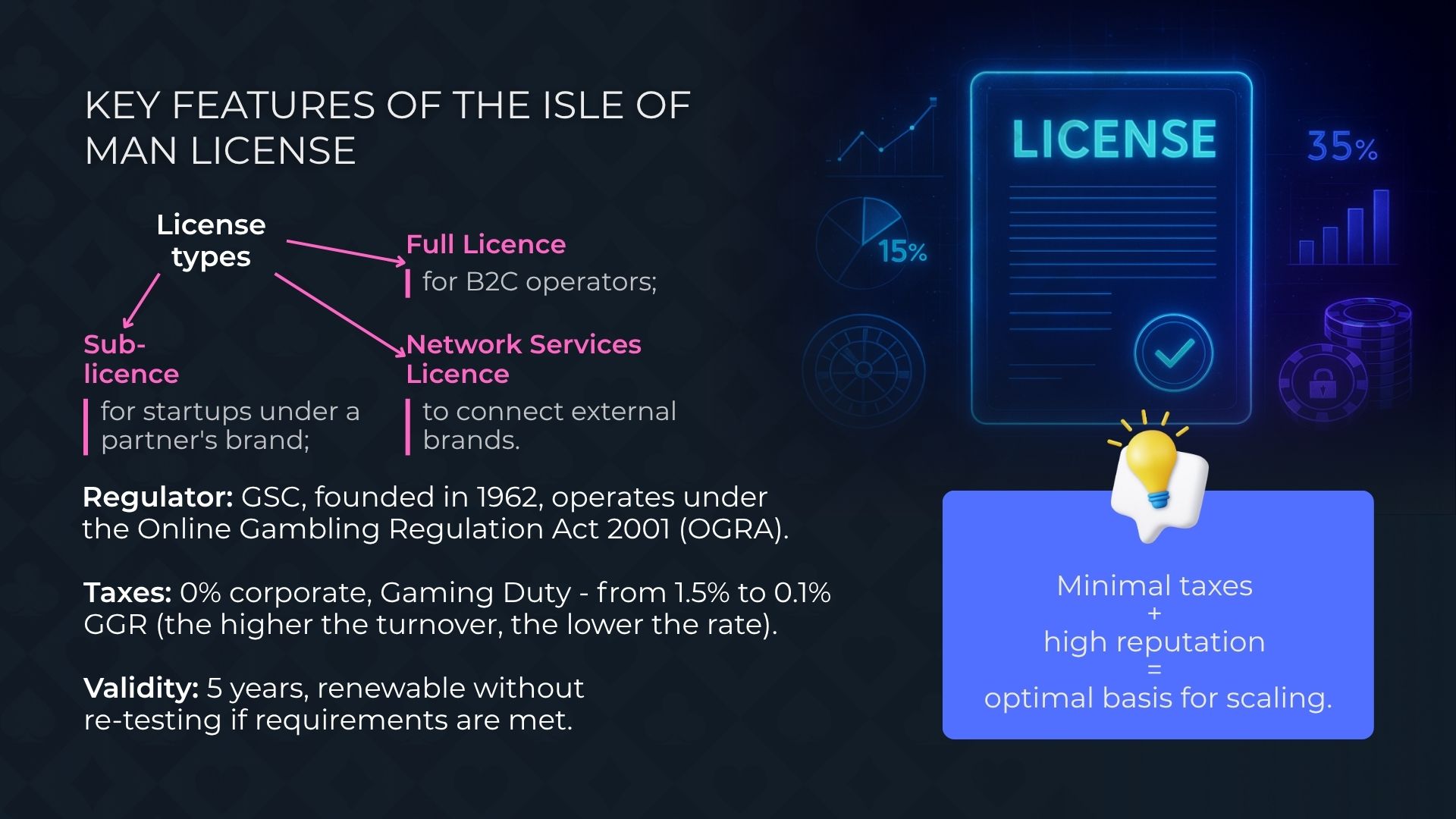
Licensing is carried out by the Gambling Supervision Commission (GSC), an independent statutory body established in 1962. Its activities are regulated by the Online Gambling Regulation Act 2001 (OGRA), which sets out requirements for companies, games, and financial reporting. The regulator publishes its fees, licensing requirements and application guidance, and the licence has a strong reputation with banks, payment providers and game suppliers. It does not replace a local licence in a country that regulates online gambling itself: with each application the GSC asks for a board minute confirming that the company has taken legal advice and that its planned activity is legal in the markets it targets.
Types of Licenses
- Full License (main license): the most popular licence. It covers B2C and B2B activity at once: casino (slots and table games), sportsbook, poker, bingo, mahjong, esports and bespoke game formats, plus supplying software and games to other operators, issuing sub-licences and providing white label solutions.
- Sub-license: designed for smaller operators that have an exclusive relationship with a Full License holder and offer only the products that holder is licensed to offer. The sub-licensee runs its own brand and platform and carries its own player registration, KYC, compliance and reporting duties. The annual fee is lower, but the business depends on the parent licensee.
- Network Services License: carries the same privileges as the Full License and in addition lets the licensee accept players from other operators (network partners) onto its gameplay and back-office servers without registering them again. It suits pooled player liquidity, game networks and progressive jackpots.
- Software Supplier License and Token or Blockchain-Based Software Supplier License: for software vendors. Supplying software to an Isle of Man operator does not require a licence, but products of a licensed supplier are entered in the GSC register, and Isle of Man operators can deploy them immediately without notifying the regulator.
Financial Parameters
- Application fee: £5,250 for every licence type, paid when the application is submitted.
- Annual license fee: £36,750 for a full licence or a software supplier licence, £5,250 for a sub-licence, £52,500 for a network services licence or a token-based software licence. It is paid when the Board of the Commission approves the licence and every year after that (GSC fee sheet, fees in force since 6 July 2023).
- License validity: up to 5 years. A renewal is decided under the same provisions of the law as the grant of a new licence (OGRA, sections 7 and 8), so it is not automatic.
Additional costs should include company registration, legal support, infrastructure, and hosting of servers located on the island (mandatory for every licence type except software-only suppliers).
Taxation
The Isle of Man offers one of the most favorable tax environments in the iGaming sector. The standard rate of income tax for companies in the Isle of Man is 0%. Operators pay gambling duty on their gambling yield, which is close to gross gaming revenue: stakes received less winnings paid (Customs and Excise Notice 451 MAN):
- on the first £20 million a year: 1.5%;
- on the next £20 million a year: 0.5%;
- on any amount above £40 million: 0.1%;
- pool betting: a single rate of 15%.
This model makes the jurisdiction especially attractive for scaling, as the tax burden decreases as revenue grows.
License Processing Time
The GSC typically processes a licence within 10-12 weeks. The period starts when its Inspectorate issues a letter confirming that the application has been accepted (GSC guidance for applicants). Preparing documentation and company registration may take an additional 1-2 months. Thus, the full cycle usually takes about four months, provided all documents and the financial plan are in order. After the licence is issued, the operator has a maximum of nine months to go live.
Technical Requirements
All licence holders must host player registration and gameplay on servers physically located in the Isle of Man; the only exception is software-only suppliers. Network licensees also keep the player wallet, the game aggregation platform and the account management tools on the island. Player funds are held in segregated accounts in an Isle of Man bank, and an exception needs prior written approval from the GSC (GSC licensing requirements). This ensures regulatory oversight, data protection, and compliance with international AML/KYC standards.
Tip: when planning your budget, include not only the license fee but also infrastructure expenses: servers, RNG certification, software audit, and maintenance of the Designated Official (resident representative on the island). These are mandatory requirements to comply with GSC standards.
Why Entrepreneurs Choose the Isle of Man
For several decades, the Isle of Man has been regarded as one of the most reliable and respected iGaming jurisdictions in the world. Its license not only grants access to international markets but also serves as a mark of trust for investors, players, and payment systems. However, to make an informed decision about registration here, it’s crucial to consider both the benefits and potential challenges.
Key Advantages
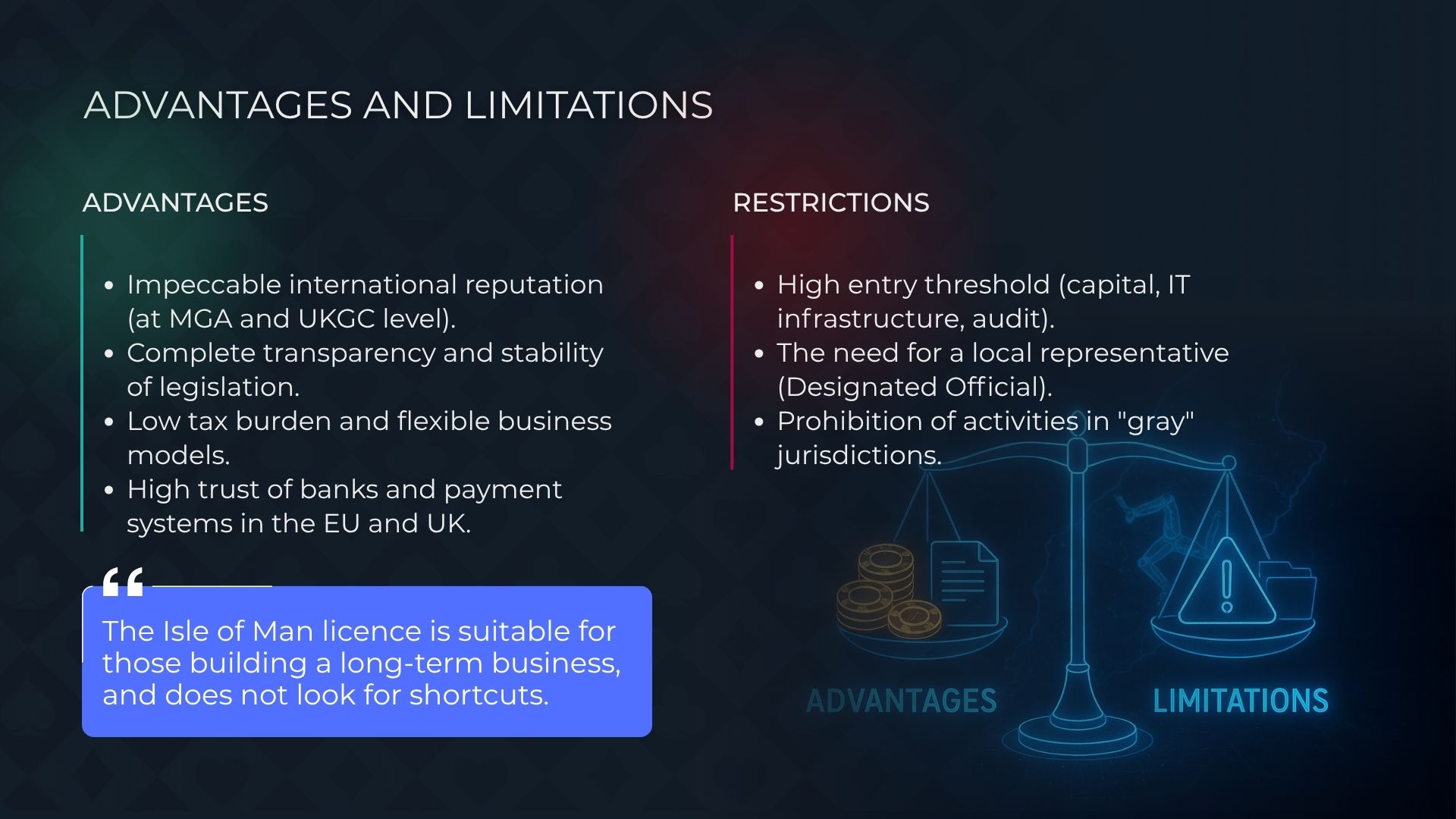
- Impeccable global reputation. The Isle of Man license ranks among the “premium” ones alongside MGA and UKGC. It enhances brand status and simplifies partnerships with major providers, banks, and PSP systems.
- Low tax burden. With zero corporate tax and minimal GGR duty, the jurisdiction is financially efficient, especially for growing operators. This allows more investment in marketing, traffic acquisition, and product development.
- Legal stability and political independence. Although a British Crown dependency, the Isle of Man maintains its own legal system and economic policy. Changes are consulted on in advance, which is critical for long-term business planning: the Gambling Legislation (Amendment) Bill, which brings a new fitness and propriety standard and a civil penalty regime, completed its passage through Tynwald on 28 April 2026 after consultation with the industry.
- High compliance standards and banking trust. Unlike offshore zones, the Isle of Man cooperates actively with international AML/KYC regulators, allowing operators to open settlement accounts and work with payment providers in the EU and UK.
- Flexibility for various business models. The option to choose between a full license, sub-license, or network model makes the system adaptable for everything from startups to large holding structures with multiple brands.
- Transparent and predictable regulation. The Gambling Supervision Commission not only supervises but also supports operators. Applications are processed within clear timelines, and all requirements are publicly available.
Potential Risks and Challenges
- High entry threshold. Capital, corporate, and infrastructure requirements are higher than in offshore jurisdictions like Curaçao. This increases startup costs but significantly reduces regulatory risks in the long term.
- Marketing and gray-market restrictions. The GSC enforces transparent player acquisition policies and prohibits operations in regions without local authorization, which can limit growth for some operators.
- Mandatory physical presence. To obtain a license, the applicant must be a company incorporated in the Isle of Man with at least two directors resident on the island and a resident Designated Official. The GSC reserves the right to reject “brass plate” structures that have no real activity on the island. This adds administrative overhead but ensures compliance with jurisdictional standards.
The Isle of Man Licensing Process: Step by Step
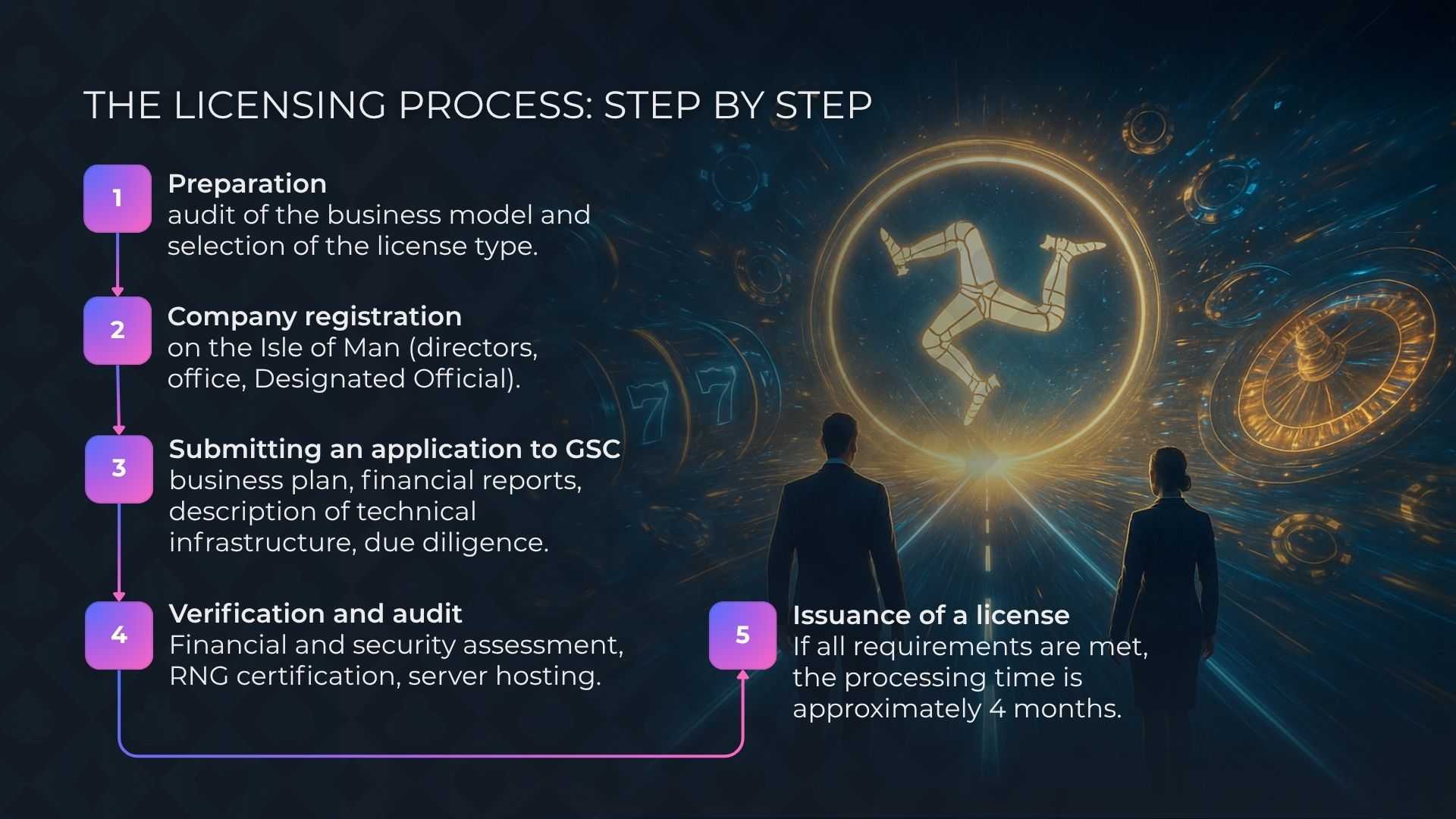
The licensing process on the Isle of Man is transparent but quite rigorous. The Gambling Supervision Commission (GSC) requires operators to prove financial stability, management reliability, and technical readiness before even submitting an application. Let’s review the process step by step, with a focus on areas that most often become bottlenecks for entrepreneurs.
1. Business Model Preparation and Analysis
The first step is to define the operational format: B2C, B2B, or hybrid. This determines the license type and required documentation. At this stage, it’s advisable to conduct a pre-application review with a licensed consultant or law firm to assess compliance with GSC standards and develop a solid financial structure.
2. Company Registration on the Island
The operator must register a legal entity in the Isle of Man. Minimum requirements include:
- at least two directors who are natural persons and residents of the island;
- a genuine operational presence on the island, not a nominal office;
- appointment of a Designated Official who lives on the island; if the Designated Official is not resident, the company must also appoint an Operations Manager based locally.
By law the licence is granted only to a company limited by shares and incorporated in the island (OGRA, section 4).
3. Document Preparation and Submission
Applications are submitted directly to the Gambling Supervision Commission. The document package includes:
- the application form, a detailed business plan and financial projections, typically for three years;
- financial statements and proof of the founders’ source of funds;
- description of technical infrastructure and security systems;
- agreements with game providers, PSPs, and hosting providers;
- vetting forms for all directors, shareholders and key personnel (due diligence).
The GSC publishes an application checklist and a step-by-step description of the process; the application fee of £5,250 is paid on submission. Special attention is paid to capital transparency and compliance with AML/KYC principles.
4. GSC Review and Regulator Interaction
After submission, a due diligence review begins: the regulator examines the company structure, directors’ reputations, funding sources, and platform readiness. The GSC may request additional data or amendments to the business plan. Prompt responses to such inquiries are essential, as they directly affect the 10-12 week processing timeline. The GSC may also interview the Designated Official, the Money Laundering Reporting Officer and the Operations Manager, and the process ends with a formal hearing at which the Board members of the Commission review the application.
5. Server Placement and Software Audit
The operator must show that player registration and gameplay run on servers physically located in the Isle of Man. Every game must be certified by a test house approved by the GSC. The licence itself can be granted before the test certificates are provided, but uncertified games may not be offered to players.
6. License Issuance and Launch
After the Board approves the application and the annual licence fee is paid, the company becomes a licence holder. It then has a maximum of nine months to go live. However, the GSC reserves the right to conduct scheduled and unscheduled inspections, request reports, and demand technical updates. Non-compliance may lead to suspension or revocation of the license.
Tip: entrepreneurs are advised to use local agents or specialized companies experienced in dealing with the GSC. This significantly speeds up the process and minimizes the risk of rejection due to formal inconsistencies.
Conclusion: The Isle of Man License, A Choice for Mature and Sustainable Businesses
Licensing on the Isle of Man is more than just formal authorization to operate gambling services. It’s a strategic tool that enables operators to build a legal, transparent, and reputable business on an international scale. Low taxes, flexible licensing models, and a strict yet predictable regulator make this jurisdiction ideal for those focused on long-term success rather than quick launches.
The key takeaway is simple: the Isle of Man is suited for those ready to invest in reputation and stability. It’s impossible to obtain a license “for formality’s sake” here, but it’s an excellent foundation for scaling, attracting investors, and forming partnerships with leading payment systems and content providers.
However, the license is not the end goal but the beginning of systematic iGaming business development. After obtaining it, operators must establish compliance, IT security, marketing, and player retention processes. The quality of this ecosystem will ultimately determine business success in the first few years.
Gambling Soft helps entrepreneurs navigate the Isle of Man licensing process smoothly and without unnecessary risks or delays. We provide expert guidance and ready-made technological solutions to help your project enter the international market faster and more securely.
FAQ
How much does an Isle of Man gambling licence cost?
The GSC application fee is £5,250 for every licence type. The annual fee is £36,750 for a full licence or a software supplier licence, £5,250 for a sub-licence and £52,500 for a network services or token-based software licence. Add company registration, a resident Designated Official, legal support, hosting on servers in the Isle of Man, game certification by an approved test house and a segregated player funds account in an Isle of Man bank.
How long does it take to get an Isle of Man licence?
The GSC typically processes a licence within 10-12 weeks from the letter confirming that the application has been accepted. With document preparation and company registration, the full cycle usually takes about four months. After the licence is issued, the operator has up to nine months to go live.
What taxes does an Isle of Man online casino pay?
The standard rate of income tax for companies in the Isle of Man is 0%. Gambling duty is charged on the gambling yield: 1.5% on the first £20 million a year, 0.5% on the next £20 million and 0.1% on any amount above £40 million. Pool betting is taxed at 15%.
Which other gambling licences can Gambling Soft arrange?
Gambling Soft offers licence packages with company registration: Anjouan $28,000, Tobique $50,000, Kahnawake $60,000, Malta $70,000 and Curacao $75,000. Offshore options have a lower entry threshold than the Isle of Man, which ranks alongside MGA and UKGC in reputation.
How much does the casino software cost and how fast can it launch?
The Gambling Soft platform starts from $7,500, ready casinos with source code cost from $8,500 (Violet) to $47,500 (Velvet), and the platform source code costs $19,000. A ready platform launches in 7 business days and comes with a 12-month warranty.
Launch your online casino in 7 business days after the advance payment
Gambling Soft has been building casino software since 2010. Ready-made casinos with source code from $8,500, the Casino Lite package without source code for $7,500. Three equal payments, 12-month warranty. Message us on Telegram or WhatsApp to see a demo and get a quote for your project.
