


Updated 29 September 2026. Author: Gambling Soft team.
Short answer: Players choose an online casino by trust and convenience: a valid licence, fast and predictable withdrawals, a quick mobile site, transparent bonus terms and a wide game portfolio. Around 80% of players call fast withdrawals decisive, and more than 60% name game choice as the key factor. For an operator, a ready Gambling Soft platform starts from $7,500 and launches in 7 business days after the advance payment (see current prices).
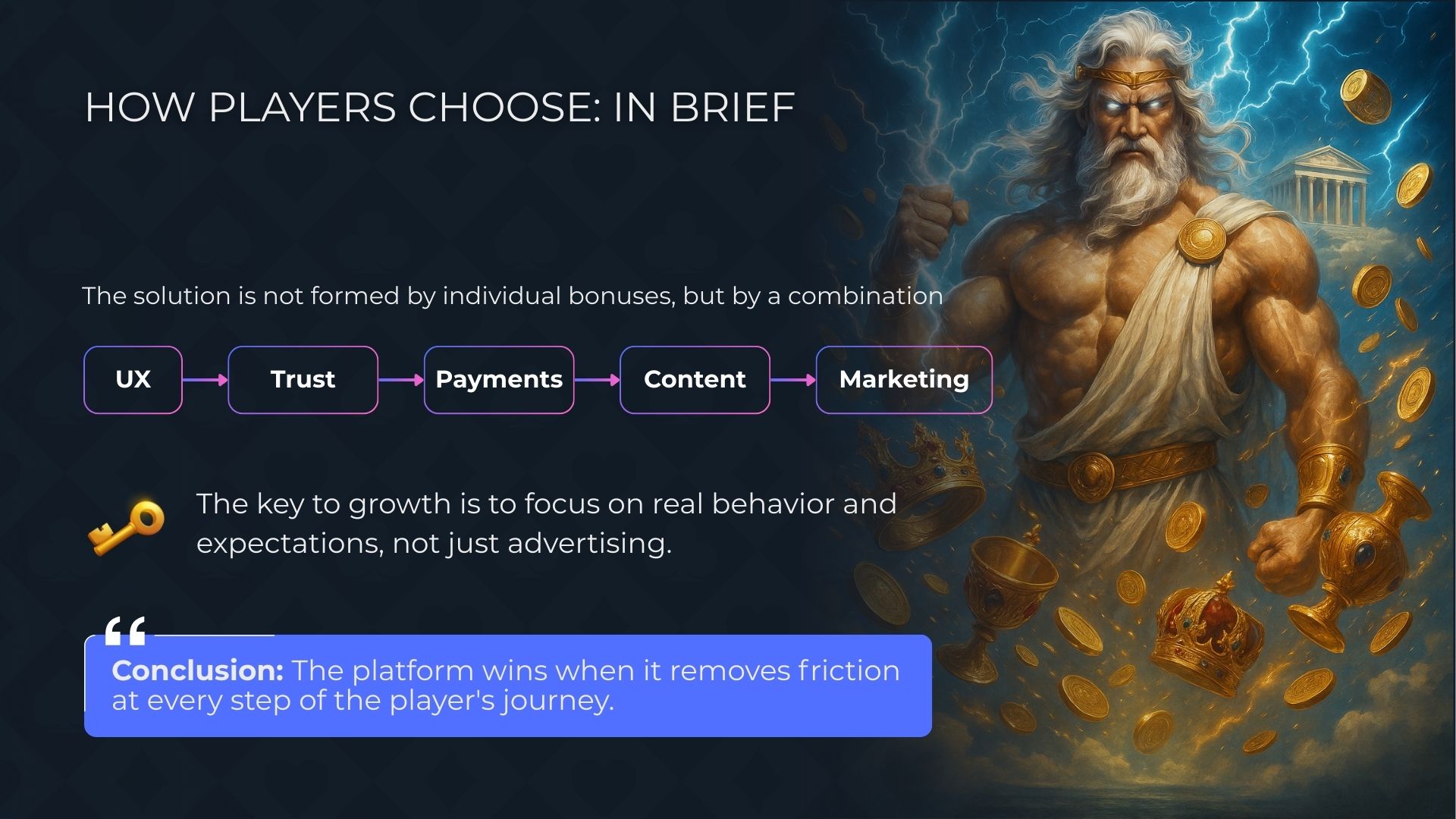 Online gambling remains one of the fastest-growing segments of the digital economy. As a result, competition among platforms is intensifying: dozens of operators operate within the same region, and players easily switch casinos in search of better conditions.
Thus, simply launching an online casino no longer guarantees success, since players’ choices are shaped by numerous factors: from page load speed and payment convenience to licensing, transparency of bonus terms, and even the brand’s reputation on social media.
The key to sustainable growth lies in focusing on real player behavior and expectations rather than relying solely on aggressive marketing. A proper understanding of user motivations allows operators to build competitive advantages through trust, UX quality, and transparent business processes.
UX/UI: the first “filter” for conversion and retention
User experience is the first barrier determining whether a player stays on the site and makes a deposit. Even if licensing, bonuses, and games are excellent, a poor interface or slow loading speed can nullify all marketing efforts.

1. Loading speed and stability
Google reports that more than 50% of mobile users abandon a site if it takes longer than three seconds to load. Each extra second increases the probability of bounce, reducing conversions and the effectiveness of ad campaigns. For casinos, this is critical, as the first visit often determines whether a deposit will occur.
2. Simplicity of registration and onboarding
iGaming research shows that long forms and redirects to third-party pages during payment lead to a loss of up to 58% of potential deposits. This is why the market actively adopts solutions such as one-click sign-up, simplified KYC verification, and integrated payment gateways.
3. Mobile optimization
In 2024-2025, more than 70% of iGaming bets are placed via smartphones and tablets. This means the mobile interface must not only be adapted but also optimized for vertical format, taking into account usability and compact game display.
Players expect quick access to popular slots and live games, filtering by providers, genres, and bet limits. A poorly organized lobby reduces engagement and accelerates churn, even if the game selection is rich.
5. Interface personalization
Machine learning technologies make it possible to recommend relevant games and promotions immediately after login. According to analysts, personalized recommendations increase retention and LTV by 10-20% on average across the market.
Bonuses and loyalty programs: acquisition vs long-term value
Bonuses remain one of the most visible tools in the arsenal of online casinos. They attract new users, help lower the barrier to the first deposit, and create a perception of added value. However, entrepreneurs should understand that the short-term impact of bonuses often conflicts with long-term retention goals.
The role of bonuses for different player segments
-
New players. Their main focus is on the size of the welcome bonus and the availability of free spins, a psychological trigger for a “profitable start.” Research shows that up to 60% of new players base their choice of platform primarily on welcome offers.
-
Experienced users. For them, transparency is more critical than bonus size. Players analyze wagering requirements, rollover periods, and game restrictions. Negative experiences with “unattainable” terms erode trust and drive users away.
Risks and regulatory constraints
Aggressive bonus policies are one of the reasons for increased attention from regulators. UKGC reports highlight links between intrusive promotions and problem gambling. This means operators must strike a balance between attractiveness and responsibility.
Balancing acquisition and retention
A common mistake is focusing only on large welcome bonuses without a long-term retention strategy. Such an approach attracts “bonus hunters”, users who register just to claim the offer and then move on to another platform.
Licensing and trust: a mandatory investment
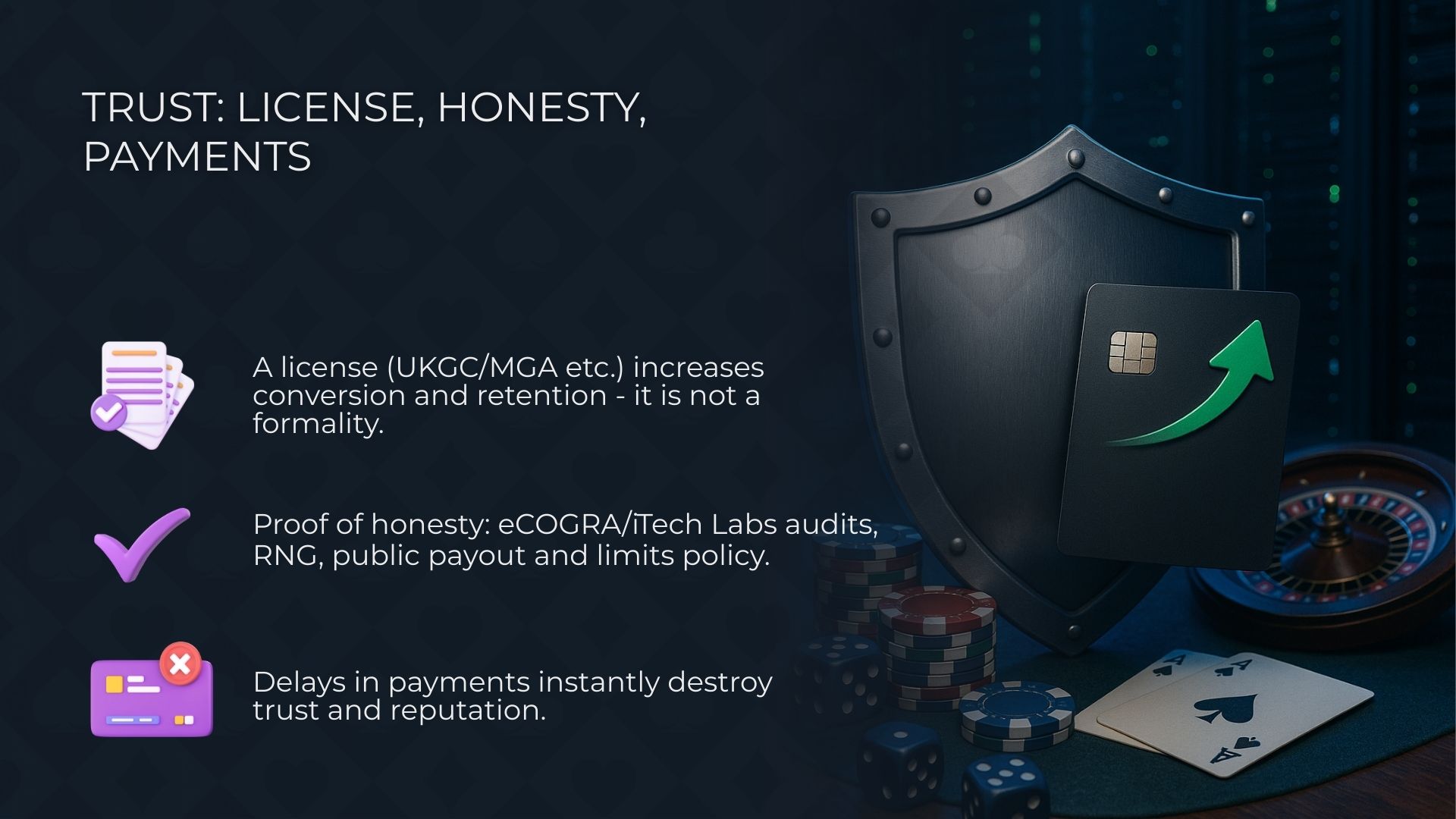
In a highly competitive environment, player trust becomes the key asset of an online casino. Licensing and transparent payout policies are not mere formalities but factors directly influencing conversion and retention.
The importance of licensing for players
According to the Gambling Commission, users are more likely to choose licensed platforms, viewing them as safer and more reliable. A license signals to players that the operator is regulated by government authorities, is not associated with fraud, and must comply with responsible gambling rules.
Transparency and proof of fairness
Experienced players increasingly check not only licensing but also additional proof of fairness:
-
Certificates from independent auditors (eCOGRA, iTech Labs).
-
Information about RNG testing and verification.
-
Clear policies on payouts and limits.
The role of trust in retention
Even the best bonuses and interface lose value if players face payout delays or questionable practices. Loss of trust leads to immediate churn and a negative reputation, which quickly spreads through forums and social media.
Related: Where and how to obtain an online casino license in Europe?
Game portfolio and provider partnerships: a strategic retention factor
The game portfolio is one of the main criteria players use when choosing an online casino. For most users, variety and quality of games determine whether they will stay with a platform or switch to a competitor.
1. The importance of game variety
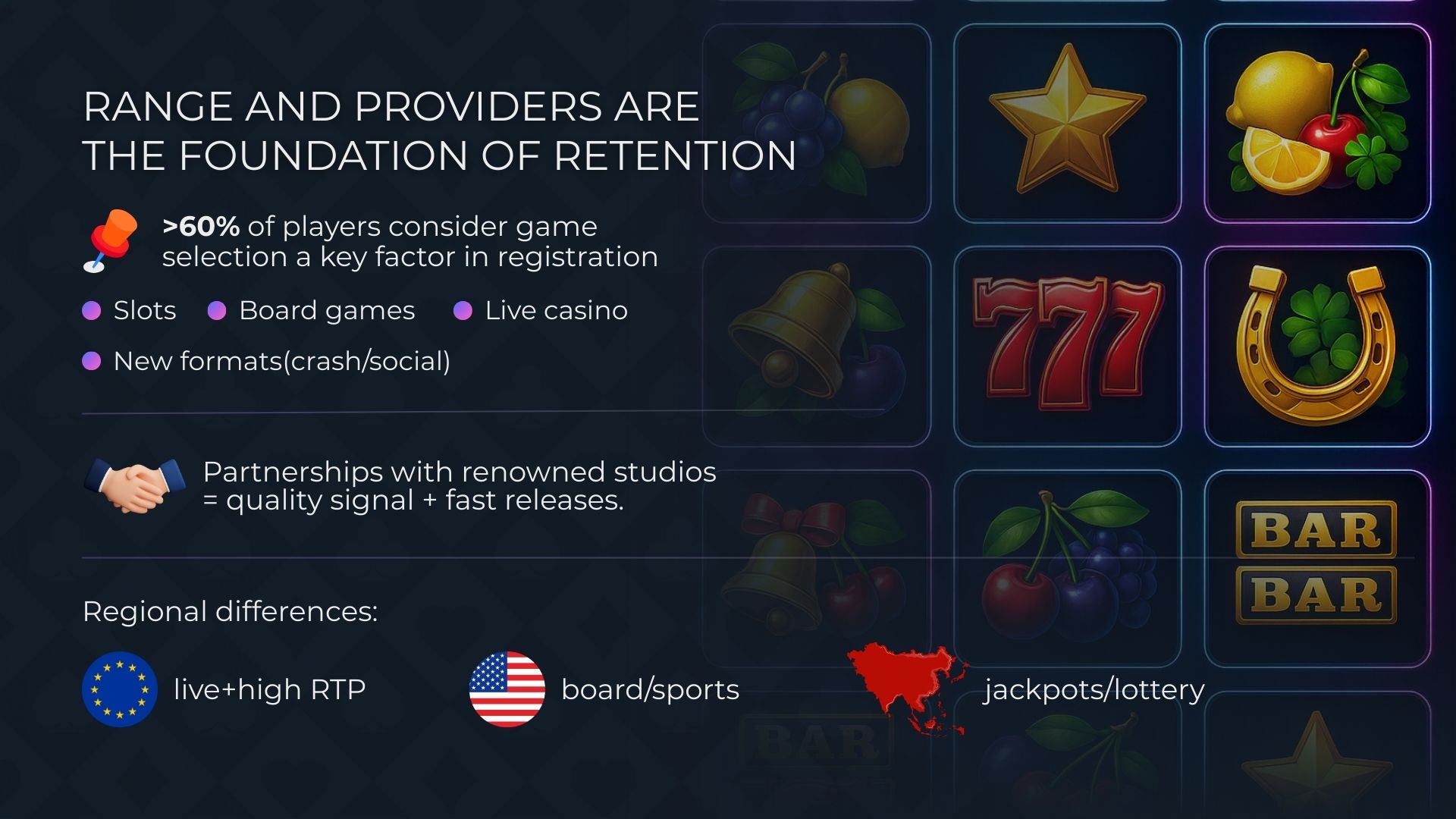
According to YouGov research, more than 60% of players cite game choice as the key factor when registering at an online casino. Particularly important are:
-
Slots. The largest category, ranging from classic “one-armed bandits” to modern video slots with jackpots.
-
Table games. Poker, blackjack, roulette, particularly valued among experienced players.
-
Live casino. A rapidly growing segment thanks to streaming technologies and interactivity. In some regions (e.g., Scandinavia), live games are becoming the primary revenue driver.
-
New formats. Crash games and social mechanics attract younger audiences accustomed to mobile gaming dynamics.
2. Partnerships with providers
Having well-known provider brands is a strong trust signal for players. Market leaders include:
-
Evolution Gaming (live games, creative shows).
-
Pragmatic Play (slots and live).
-
NetEnt and Play’n GO (popular slots).
-
Amusnet (broad game library and progressive jackpots).
Partnerships with major providers solve two tasks:
-
build audience trust (players recognize these names and associate them with quality);
-
allow rapid portfolio expansion through ready-made integrations.
Regional preferences
Markets differ in player preferences:
-
In Europe, live games and high- slots are most popular.
-
In the U.S., table games and sportsbooks paired with casinos are in demand.
-
In Asia, jackpot games and lottery formats hold strong positions.
Long-term business value
The broader and higher-quality the game portfolio, the greater the:
-
Player LTV (lifetime value): users stay longer on the platform.
-
ARPU (average revenue per user): driven by activity across multiple categories.
-
Competitiveness: players are less likely to leave for competitors.
Payments, fees, and payout speed: critical for trust and LTV
Even the best UX and widest game portfolio cannot compensate for delayed withdrawals or a limited set of payment options.
1. The impact of payout speed on player behavior
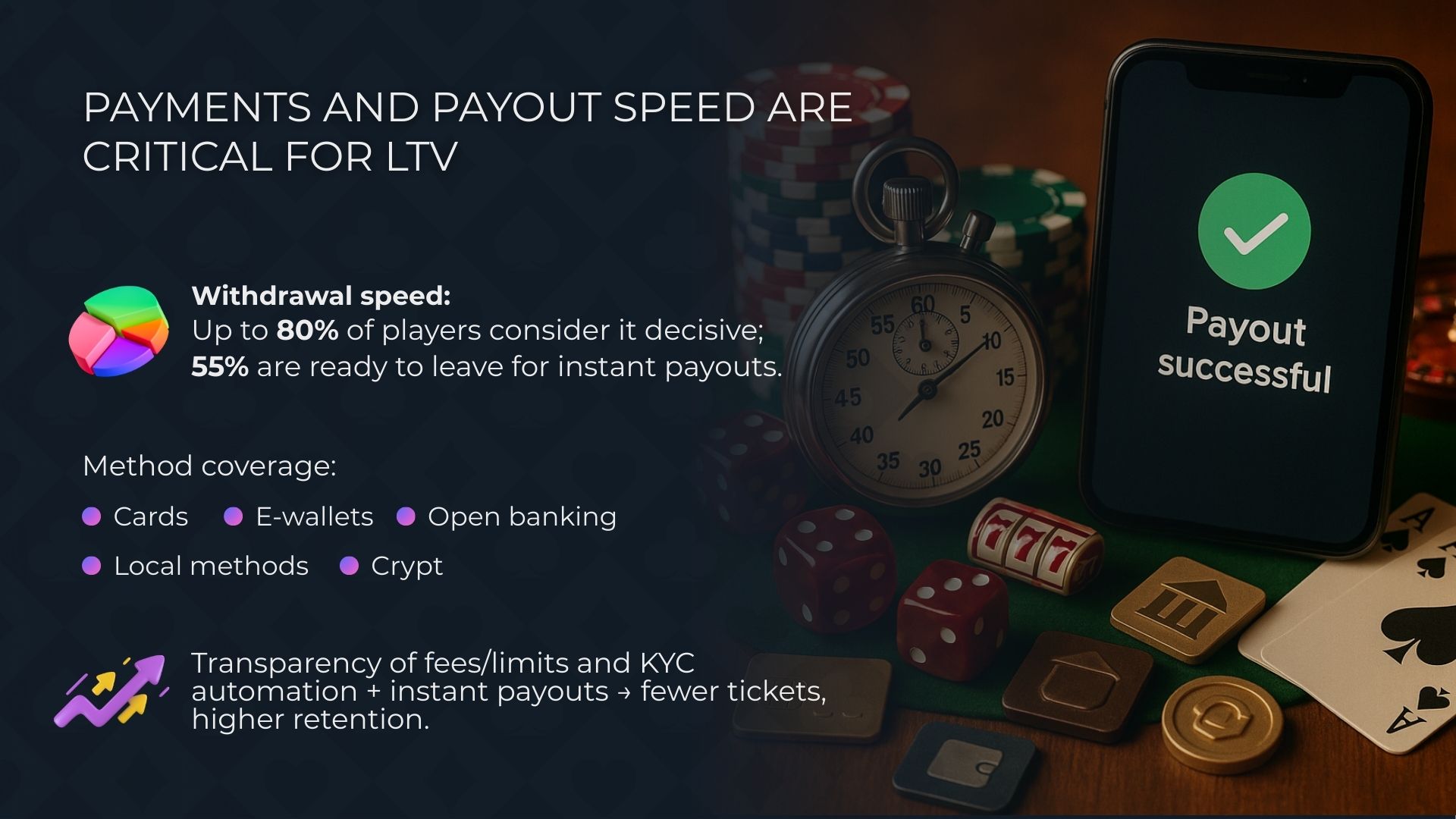
Research from YouGov and TrueLayer shows that around 80% of players consider fast withdrawals a decisive factor when choosing an operator, while 55% are willing to switch platforms for instant transactions. Withdrawal delays directly undermine trust, increasing complaints and negative reviews.
2. Variety of payment methods
To ensure convenience and cover different markets, casinos should support:
-
Debit and credit cards: Visa, Mastercard.
-
E-wallets: PayPal, Skrill, Neteller.
-
Bank transfers and open banking: speeding up local deposits and withdrawals.
-
Regional methods: Pix, Boleto, eCash, and mobile payments in Asia and Latin America.
- Cryptocurrency: Bitcoin (BTC), Ethereum (ETH), as well as stablecoins like Tether (USDT).
3. Minimizing fees and ensuring transparency
Players value transparency: no hidden fees, clear withdrawal timelines, and open information on limits. Publishing these details reduces dissatisfaction risks and strengthens brand trust.
4. Automating KYC and payouts
Using trusted KYC providers and integrating instant payouts/open banking accelerates processes and reduces support load. Industry reports indicate automation speeds up withdrawals by 60-70% and increases retention among new players.
Player psychology and marketing: attracting beyond price
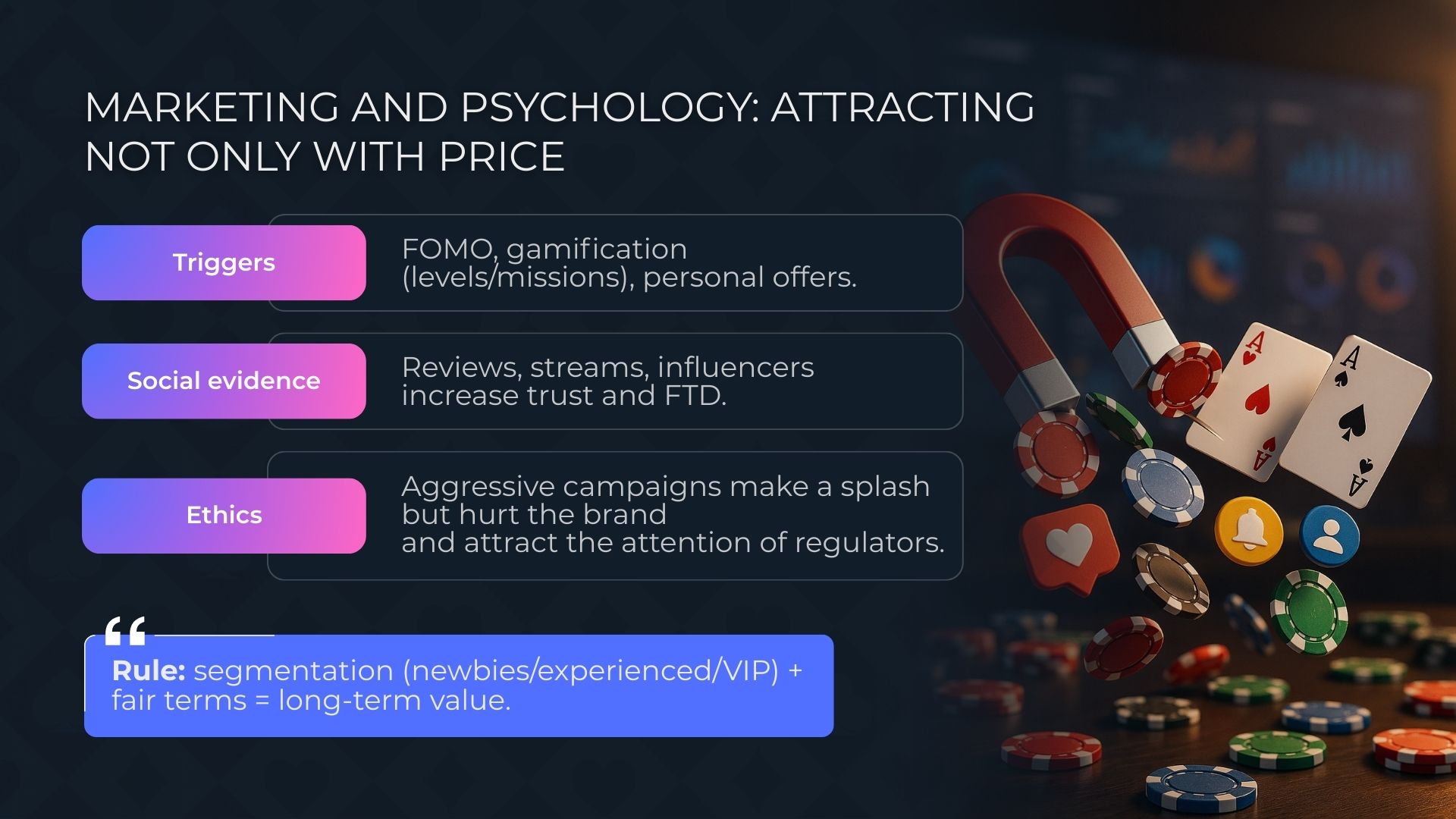
Players make decisions based not only on bonuses or game variety: psychological triggers, social proof, and marketing mechanics shape platform perception and directly affect retention.
Emotional triggers
-
FOMO (Fear of Missing Out). Limited-time offers, leaderboards, and rare bonuses create urgency and encourage registration.
-
Gamification. Levels, missions, rewards, and leaderboards increase engagement and motivate regular play.
-
Personalization. Tailored offers based on player behavior strengthen perceived value and attention from the platform.
Social influence
Reviews from other players, streams, and influencer content enhance trust. Industry studies show that players exposed to positive reviews and live-game streams are 20-25% more likely to make their first deposit.
Brand value perception
-
Transparency. Clear game rules, fair bonus terms, and open licensing information build trust.
-
Responsible gambling. Tools for stake and limit control enhance reputation and reduce the risk of regulatory fines.
Marketing approaches
-
Multichannel marketing. Combining SEO, social media, email, and affiliate programs broadens reach.
-
Targeting and segmentation. Tailored offers for beginners, experienced players, and VIPs increase campaign efficiency.
-
Retention mechanics. Push notifications, triggered emails, and loyalty programs reduce churn.
Conclusion: success depends on a systematic approach
Choosing an online casino is a complex process influenced by numerous factors. It is not enough to invest solely in bonuses or UX. Entrepreneurs must build a system where each element reinforces the other:
-
UX/UI ensures conversion and ease of play.
-
Bonuses create an entry point but should not undermine long-term retention.
-
Licensing and transparency are foundations of trust and reputation.
-
Game portfolio and provider partnerships guarantee engagement and market competitiveness.
-
Fast payments and automation increase loyalty and LTV.
-
Marketing and psychology strengthen emotional connection and build long-term brand value.
The main conclusion: players choose online casinos not by chance but based on a combination of rational and emotional factors. Operators who strategically build this ecosystem gain sustainable growth, higher LTV, and strong market positioning in the global iGaming industry.
FAQ
What matters most to players when choosing an online casino?
Fast withdrawals, a licence, a quick mobile interface, clear bonus terms and a broad game catalogue. Around 80% of players treat payout speed as a decisive factor.
Does a gambling licence affect which casino players pick?
Yes. Players see licensed platforms as safer, and payment providers work more readily with them. Gambling Soft arranges licences with company registration: Anjouan $28,000, Tobique $50,000, Kahnawake $60,000, Malta $70,000 and Curacao $75,000.
How important is the mobile version of a casino?
More than 70% of iGaming bets are placed from smartphones and tablets, so the mobile site decides conversion. The Gambling Soft platform ships with an admin panel and a mobile version.
How much does it cost to launch a casino that meets these expectations?
A turnkey Gambling Soft platform starts from $7,500. Ready casinos with full source code cost $8,500 (Violet) to $47,500 (Velvet), and the platform source code for your own brand is $19,000.
How long does a launch take, and is there a warranty?
A ready platform launches in 7 business days after the advance payment and comes with a 12-month warranty. The licence and payment onboarding usually take longer and set the real launch date.
