


The uncomfortable arithmetic of retention
I have sat through more launch post-mortems than I care to count. The pattern rarely changes. Six months of platform work, two thousand slots integrated, a payment stack negotiated down to the last basis point — and then the traffic hits a bucket with a hole in it.
Three numbers explain the hole. Up to 60% of new registrations disappear inside the first 24 hours. At any given moment roughly 55% of your database sits in a churned lifecycle stage. And acquiring a replacement costs five to seven times what keeping the original would have cost.
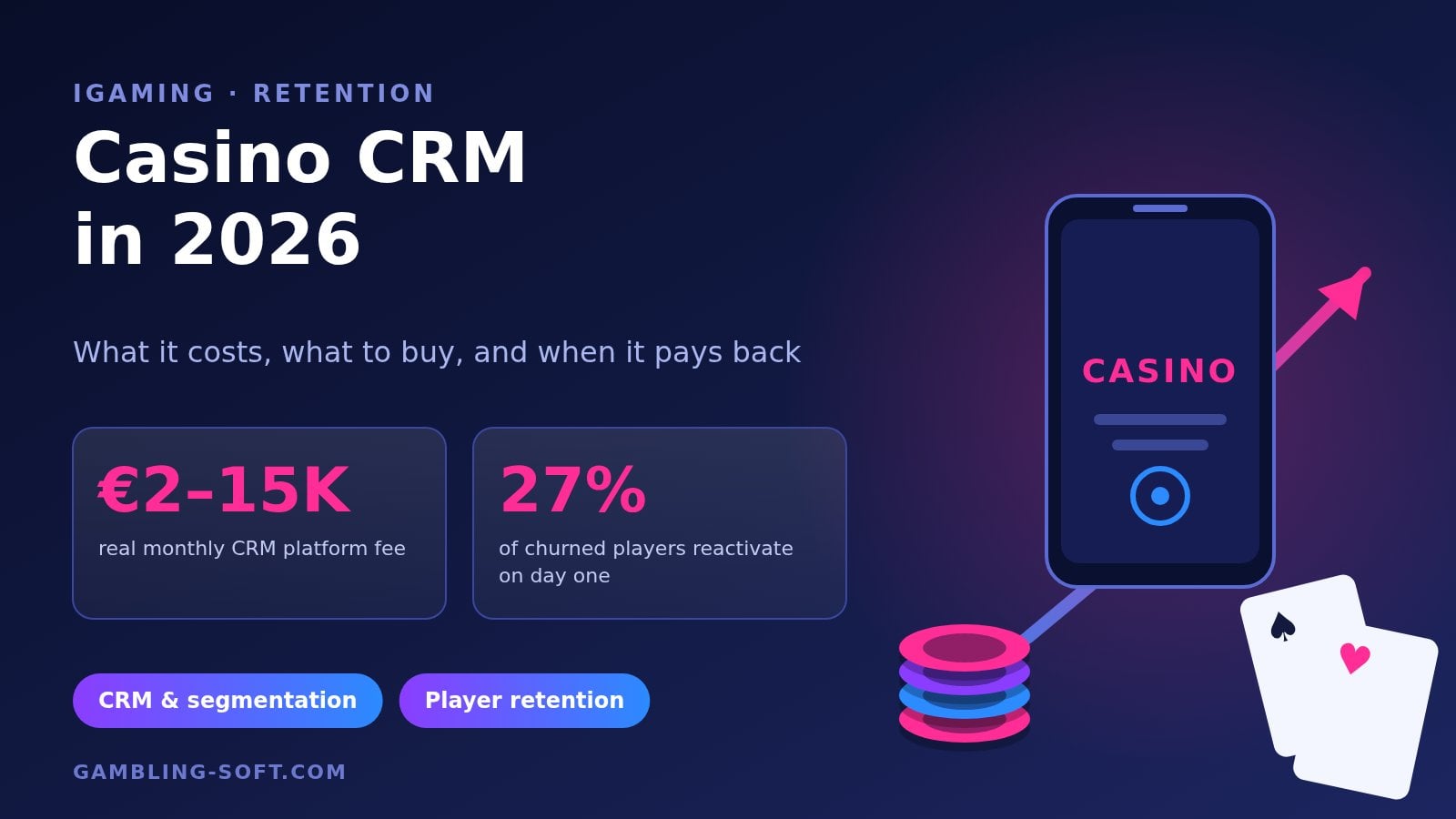
Then there is the number that should genuinely worry you. A player who lapsed yesterday reactivates at around 27%, carrying the highest predicted future value you will ever get out of them. Wait three months and that drops to 2%, with predicted value down 87% (Optimove cohort data, 2026). Your window is measured in days.
A casino CRM is the machinery that hits that window. Everything else sold under the word “retention” is packaging.
Why your existing CRM will not do the job
Operators arriving from e-commerce always ask the same thing: we already pay for HubSpot, why buy twice? Because gambling telemetry is a different animal, and because the reaction has to happen in seconds.
A generic CRM thinks in leads, deals and invoices. Your reality is deposit, bet, withdrawal, withdrawal cancelled, bonus claimed, wagering at 40%, session dropped at minute five, cashier opened three times tonight with nothing paid. Even a mid-size operator generates millions of these rows a day.
Then there is the bonus engine. A specialist platform does not just fire an email — it issues a specific free spin, on a specific game, at a specific wagering requirement, while checking responsible-gaming limits and licence conditions. Generic tools cannot do this natively. You end up building a custom API bridge to your backend, and 2026 estimates put that at three to six months of engineering. A purpose-built iGaming CRM deploys in four to eight weeks.
Price that gap properly. If a three-point retention improvement is worth EUR 200k in monthly GGR, every month of delay costs exactly that. A nine-month Salesforce rollout versus a six-week specialist deployment works out to roughly EUR 1.8M in opportunity cost against EUR 100k. Nobody puts that slide in the pitch deck.
The 2026 vendor map, honestly assessed
April 2026 reshaped this market: Optimove acquired Smartico. The Sofia team had built what I still consider the strongest gamification layer in iGaming — missions, levels and tournament mechanics fused directly into the CRM rather than bolted on. It now belongs to the Tel Aviv incumbent.
A practical warning if you are mid-negotiation with Smartico. Post-acquisition roadmaps freeze. Ask about it on the call, ask for written commitments on SLA and feature delivery, and price the risk of a twelve-month stall into your decision.
The rest of the field, briefly. Fast Track built its reputation on real-time triggers and lifecycle builders and shipped an AI copilot this cycle — my default recommendation for an operator with three to five retention staff. Solitics is strong on unifying scattered data sources into one live profile. Xtremepush competes hard on speed of deployment and multichannel reach. Optimove, post-merger, is an enterprise proposition: assume five-plus CRM specialists, an in-house BI function and a budget starting around USD 10k a month.
What it actually costs
Almost nobody publishes a price list. Here is what shows up in real 2026 proposals.
- Tiered platform fee, EUR 2,000–15,000 per month. The dominant model, scaled to monthly active users. Predictable, easy to budget.
- Per seat, USD 15–50 per user per month. More common among generalist tools than iGaming specialists.
- Revenue share, 10–30% of attributed revenue. Attractive early because you only pay on results.
Revenue share deserves a warning. It is a lovely deal while your database is small. Once you scale, you discover you are handing over a fifth of campaigns that would have converted anyway, because attribution windows sweep up anything a message so much as brushed against within seven days. I have reviewed a contract where year-two revshare cost four times the same vendor’s flat tier. If you sign revshare, negotiate a hard cap and a contractual right to switch to fixed pricing.
Budget the invisible line items too: data migration and integration usually runs EUR 10–30k as a one-off, plus training, plus channel costs. SMS and push are billed separately and on a large database that adds up faster than operators expect.
Five questions that beat a forty-criterion comparison matrix
Comparison matrices are usually written by vendors, which is why the vendor who wrote it always wins. Ask these instead.
How many seconds from event to message?
Not “real time” — a number. If a failed deposit takes five minutes to trigger a push, the player is already depositing somewhere else.
Do you have a connector for our platform, or are we funding the build?
This single answer separates a six-week project from a two-quarter one. If you are commissioning turnkey development, settle the CRM integration during the technical specification rather than a year after launch.
What are your churn models trained on?
Working models flag an at-risk player two to four weeks before they lapse, reading falling deposit frequency, shorter sessions, declining stake sizes and ignored messages. Deployed properly they cut churn by 18–25%. But the training data has to come from gambling, not from generic retail.
What happens to our data if we leave?
A dull question at signing and an expensive one at divorce. Get machine-readable export of player profiles and campaign history written into the contract.
Can we pilot on one segment of our live base?
Any vendor confident in their product will agree. Demo environments prove nothing.
Implementation, and where it goes wrong
A realistic specialist rollout runs six weeks. Weeks one and two cover data integration, SDK work and the initial player import. Weeks three and four are campaign templates, segmentation logic and team training. Weeks five and six put the first campaigns live and start optimising.
The thing that breaks this schedule is almost always your own data. The operator has three competing sources of truth for player balance, one table without a usable key, and 2023 deposit history stored in a different timezone. That is not the vendor’s problem to solve. Add a two-week buffer and clean it before kickoff.
The second failure mode is staffing. Buy an EUR 8k-per-month platform, hand it to a promoted support agent, then wonder why nothing improves. A good platform amplifies a CRM manager; it does not replace one. If nobody on the team can build a cohort and read an A/B test, hire before you buy.
Where the money actually shows up
A Central Asian operator I follow had a small team and no data science function at all. They implemented proper RFM segmentation and stopped blasting one identical message to the whole base. GGR doubled within months — on fewer messages, not more, simply better aimed.
A second data point from recent reporting: one reactivation campaign produced EUR 180k in incremental GGR from 347 returning players, with a 12-point higher deposit rate against a holdout group. Note both “incremental” and “holdout”. Without a control group, any retention report is astrology.
My honest read after a decade of these projects: sane segmentation plus three or four well-tuned triggers delivers about 80% of the achievable lift. Predictive scoring, AI copilots and tiered gamification fight over the remaining 20%, and they start earning their keep somewhere north of a few tens of thousands of monthly actives.
Mistakes worth avoiding
Do not buy for the scale you hope to reach. “Let’s take enterprise now so we never migrate” is the most expensive error in this category. You pay for modules you will not switch on for two years and hand your team an interface they will drown in.
Do not launch CRM ahead of your payment stack. Winning a player back with a clever push is pointless if their card declines ninety seconds later. Fix approval rates and payment solutions first, then talk to players.
And if you are still at the platform-selection stage, remember that the CRM question is easier when the core is already built for it — most modern white label solutions ship with event streaming and a bonus API that a specialist CRM can plug into without custom work.
FAQ
Can we just use the CRM built into our platform?
Early on, yes — and I would actively recommend it. Built-in modules handle the basics competently: welcome series, abandoned deposit, seven-day reactivation. Move to an external platform when you pass roughly 20,000–30,000 monthly actives and segmentation depth becomes the constraint.
How big should the retention team be?
Under 10,000 actives: one capable CRM manager plus freelance copy. Above 50,000: three to five people — campaign manager, analyst, content, and someone dedicated to VIP. Any vendor claiming the platform “runs itself” is telling you something useful about the vendor.
What is the payback period?
At EUR 5k a month against 20,000 actives, you need roughly one to two points of retention improvement to break even. In practice the first campaign wave gets there in month two or three. Full payback including integration is usually a quarter, occasionally two.
What if our budget is under EUR 2,000 a month?
Then do not buy a specialist CRM yet. Squeeze the platform’s native tools, get clean data exports, build segmentation in a spreadsheet if you have to, and ship the obvious triggers. Upgrade when the maths justifies it rather than when the sales call is persuasive.
Do sportsbook and casino need separate systems?
No, but you need one that genuinely understands both. Bettors respond to the sporting calendar; casino players respond to bonus mechanics. Check that sports attributes exist in the segmentation engine before signing if you run both verticals.