


The market nobody can ignore anymore
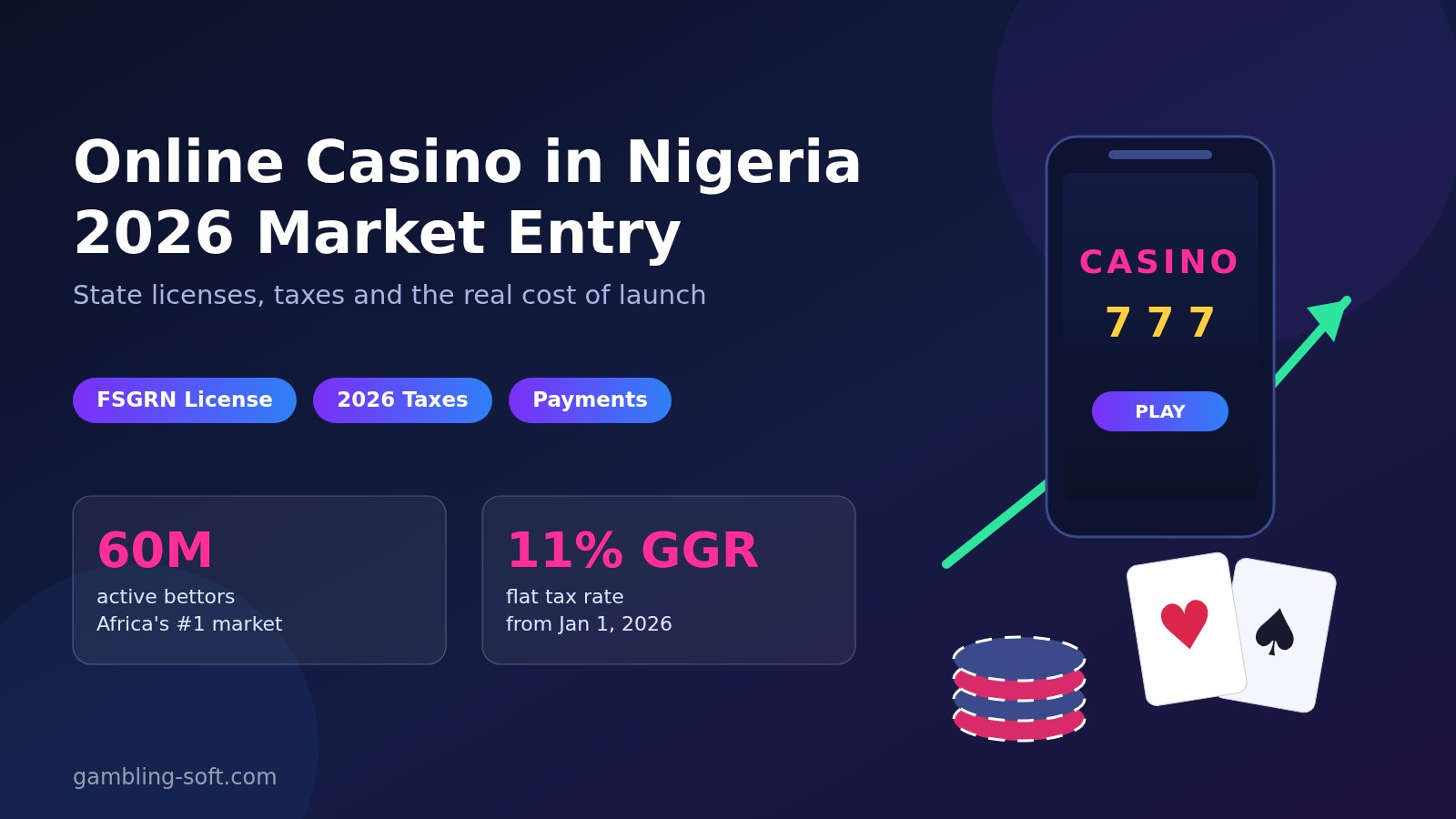
Every second call I get about Africa these days ends up being about Nigeria. Fair enough. Roughly 60 million people bet actively — more than a quarter of the adult population. Daily wagering volume tops ₦10 billion, about $6.5 million, and climbs higher whenever the Premier League is on. Statista puts the 2025 market near $3.6 billion; more cautious analysts count $1.6 billion in gross gaming revenue. Either way, it is Africa’s largest gambling market, growing 8–12% a year.
One number matters more than all the rest: 87% of betting activity happens on mobile. If your platform chokes on an $80 Android phone riding a patchy 3G connection, no bonus program will save you.
Regulation flipped in 2024 — here is where it landed
On 22 November 2024, Nigeria’s Supreme Court struck down the National Lottery Act 2005 in its entirety and barred the federal government from regulating gaming anywhere in the country. Overnight, one federal license became 36 potential state licenses.
Chaos? Less than you would think. Twenty-two states formed the Federation of State Gaming Regulators of Nigeria (FSGRN) and rolled out a unified licensing-and-tax regime from 1 January 2026. Existing operators got 2025 as a transition year with license fees waived. That holiday is over now.
What entry actually costs
Under the FSGRN framework, an operator license runs ₦100 million per year, per vertical — roughly $65,000 — with no online/retail distinction. Lagos, which accounts for about 40% of the country’s registered betting activity, keeps its own schedule: a ₦1 million application fee, up to ₦100 million for the online sports betting license itself, and ₦20 million minimum share capital. Check the current fee sheet with the LSLGA before you file — Lagos has revised it more than once.
The 2026 tax stack, without sugarcoating
From January 2026: a flat 11% on GGR across all verticals, a 5% excise duty on gaming services, and a 5% withholding tax on players’ net winnings that Lagos introduced in February 2026. Offshore operators serving Nigerians pay 4.5% on deposits, tracked through the Sentinel platform. Stakes themselves are VAT-exempt under the Tax Act 2025. My planning advice: model a 20–25% effective load on GGR and you will not get surprised.
Payments will make or break you
This is where I have watched more launches die than anywhere else. Nigerian banks flag gambling as high-risk and freeze deposits without warning. Half the adult population is unbanked. The average deposit through OPay is ₦1,500 — one US dollar — and OPay’s betting partners pushed over a million transactions in Q1 2025 alone. Your processing stack has to survive millions of dollar-sized payments and still turn a profit.
What works in practice: local PSPs (Paystack, Flutterwave, OPay, PalmPay), USSD flows for feature phones, and crypto as a fallback for the day a bank decides to block you. Since the naira’s devaluation, stablecoins have gone from novelty to standard tooling. When we build payment solutions for African markets, the rule is three independent deposit channels minimum. One of them is always down.
Product choices that fit the market
Sports betting brings in three-quarters of Nigerian revenue, and the top four operators — Bet9ja, SportyBet, BetKing and 1xBet — hold around 70% of the market between them. Launching a pure casino with no sportsbook means writing off most of the audience before day one.
The casino content that does pull: crash games (Aviator has near-cult status here), virtual sports, and light slots. Heavy live-dealer studios struggle against expensive data and shaky connections. Keep the front end lean — a PWA or a small Android APK, minimal animation, graceful behavior on weak networks. That is exactly the brief we work to in turnkey development for emerging markets.
A launch plan I would actually stand behind
On a constrained budget, start with a proven casino script that ships with a sportsbook module, license through an FSGRN state with a clean process, and treat Lagos as phase two once your numbers justify its price tag. A realistic timeline is four to six months end to end; a realistic budget starts around $250,000–300,000 including the license and a marketing reserve.
Two warnings from the trenches. Do not fight Bet9ja head-on — find an angle instead: crash-plus-crypto, a regional audience, retention mechanics the giants are too big to bother with. And keep a standing legal budget, not a one-off. A system where 22 states agree and the rest do their own thing will keep shifting for another couple of years.
FAQ
Can I serve Nigeria on a Curaçao license?
Plenty do, but since 2026 it is expensive: 4.5% skimmed off every deposit via Sentinel, plus constant payment-blocking risk. If Nigeria is a core market for you, a local license pays for itself.
How much is a license?
₦100 million a year (about $65,000) per vertical under the FSGRN unified regime. Lagos prices separately — ₦1 million to apply and up to ₦100 million for the online betting license.
What is the total tax burden?
11% on GGR, 5% excise duty, and a 5% withholding on player winnings in Lagos. Budget for a 20–25% effective rate on GGR.
Do I need a sportsbook?
Unless you enjoy competing for a quarter of the market — yes. Sportsbook plus crash games plus slots is the standard winning bundle.
How long does a launch take?
Four to six months with a ready platform. Payment integrations and state compliance eat most of that time.