


 Launching an online casino is a complex process that includes licensing, platform development, game integration, payment system setup, customer support, and marketing. Each of these stages requires significant investment and expertise in operating within a regulated environment. For most entrepreneurs and investors, the main challenge lies in how to enter the market quickly and safely while minimizing costs and legal risks.
In this context, White Label casinos have become one of the most in-demand solutions in the iGaming market, allowing operators to start operations in a short time frame with minimal technical complications.
White Label as a Solution
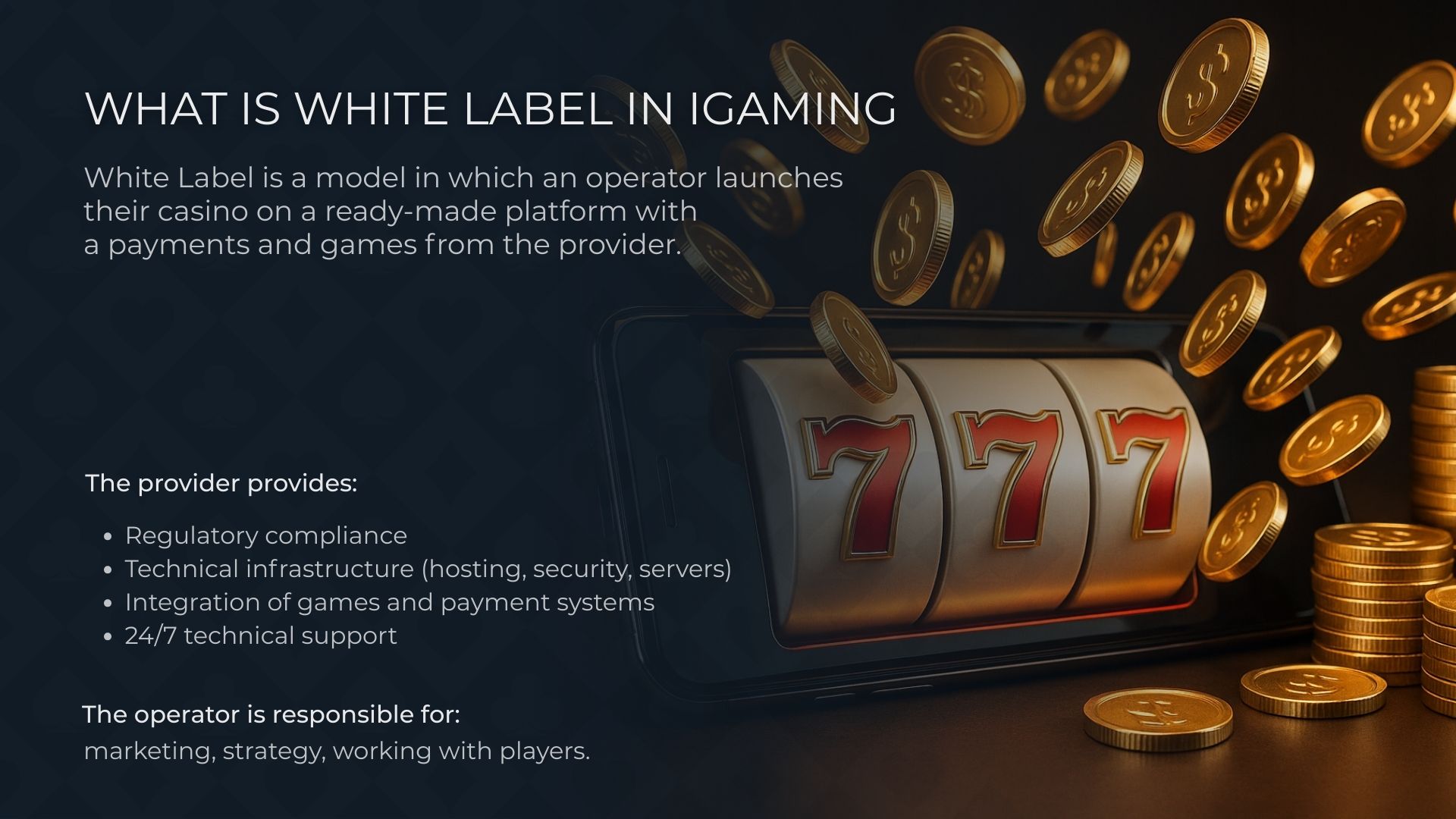
White Label online casinos represent a business model in which an operator launches their own brand on an existing technical and legal infrastructure provided by a specialized provider. In essence, it is the “rental” of a fully operational platform, customized to match the client’s branding.
The White Label provider is responsible for:
-
Regulatory compliance — the operator works under the provider’s active license, avoiding the costs and challenges of obtaining approval in the chosen jurisdiction.
-
Technical infrastructure — hosting, servers, game engines, DDoS protection, and monitoring systems.
-
Content integration — slots, table games, live casino, sports betting, and virtual games from leading providers (Pragmatic Play, Evolution, NetEnt, and others).
-
Payment system — integration of bank cards, e-wallets, cryptocurrencies, and local payment methods.
-
Technical support — 24/7 player assistance and platform administration.
The key feature of White Label in iGaming is the division of responsibilities:
-
The provider ensures technical stability, legal compliance, and regulatory requirements.
-
The operator manages marketing, growth strategy, player engagement, and audience retention.
Thus, entrepreneurs can focus on the commercial side of the project without being distracted by complex back-office processes.

Economic Model
Choosing a White Label casino is primarily a strategic decision on how to allocate investments between initial and operational expenses.
Cost Structure
-
Initial payment
-
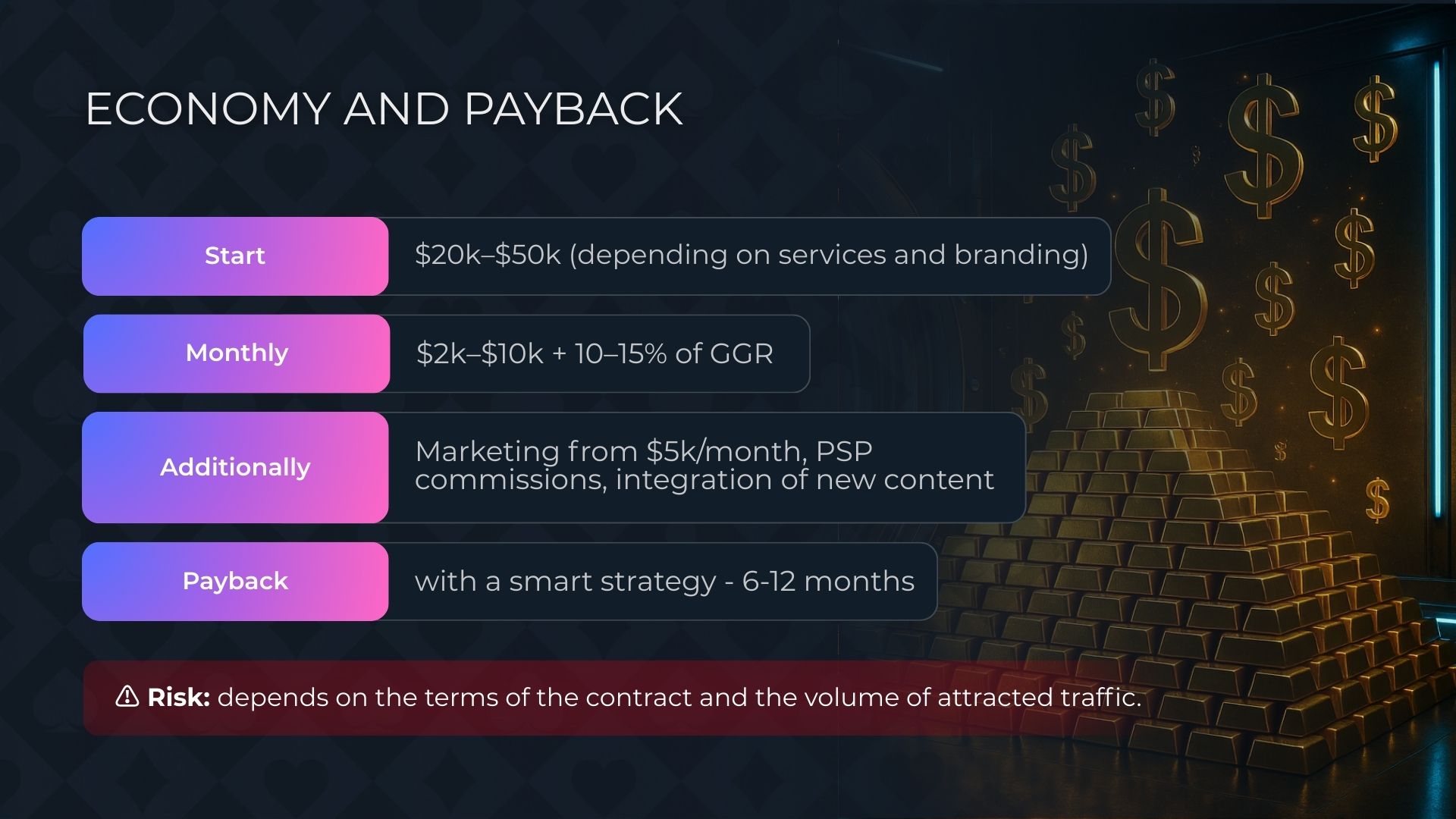
Average range — from $20,000 to $50,000.
-
The amount depends on the range of included services (games, payments, marketing) and the level of branding (template-based design or exclusive).
-
-
Monthly expenses
-
Fixed platform fee — from $2,000 to $10,000.
-
Percentage of GGR (Gross Gaming Revenue) — usually 10–15%. This is the primary income source for the White Label provider.
-
-
Additional expenses
-
Marketing (SEO, advertising, affiliate programs) — starting from $5,000 per month.
-
Payment system fees — 1.5–4% of turnover.
-
Possible fees for integrating new games or features.
-
Financial Payback
-
Initial investments can be recouped within 6–12 months with a well-executed marketing strategy.
-
Break-even point is reached faster due to the absence of development costs.
-
The main risk is the dependency on provider contract terms and the level of traffic the operator can attract.
Pros and Cons from an Investor’s Perspective
Choosing a White Label casino to launch an iGaming project is a balance between speed to market, launch costs, and level of business control. For investors, it is important to evaluate not only initial conditions but also the long-term implications of this model.
| Advantages of White Label | Limitations and Risks of White Label |
|---|---|
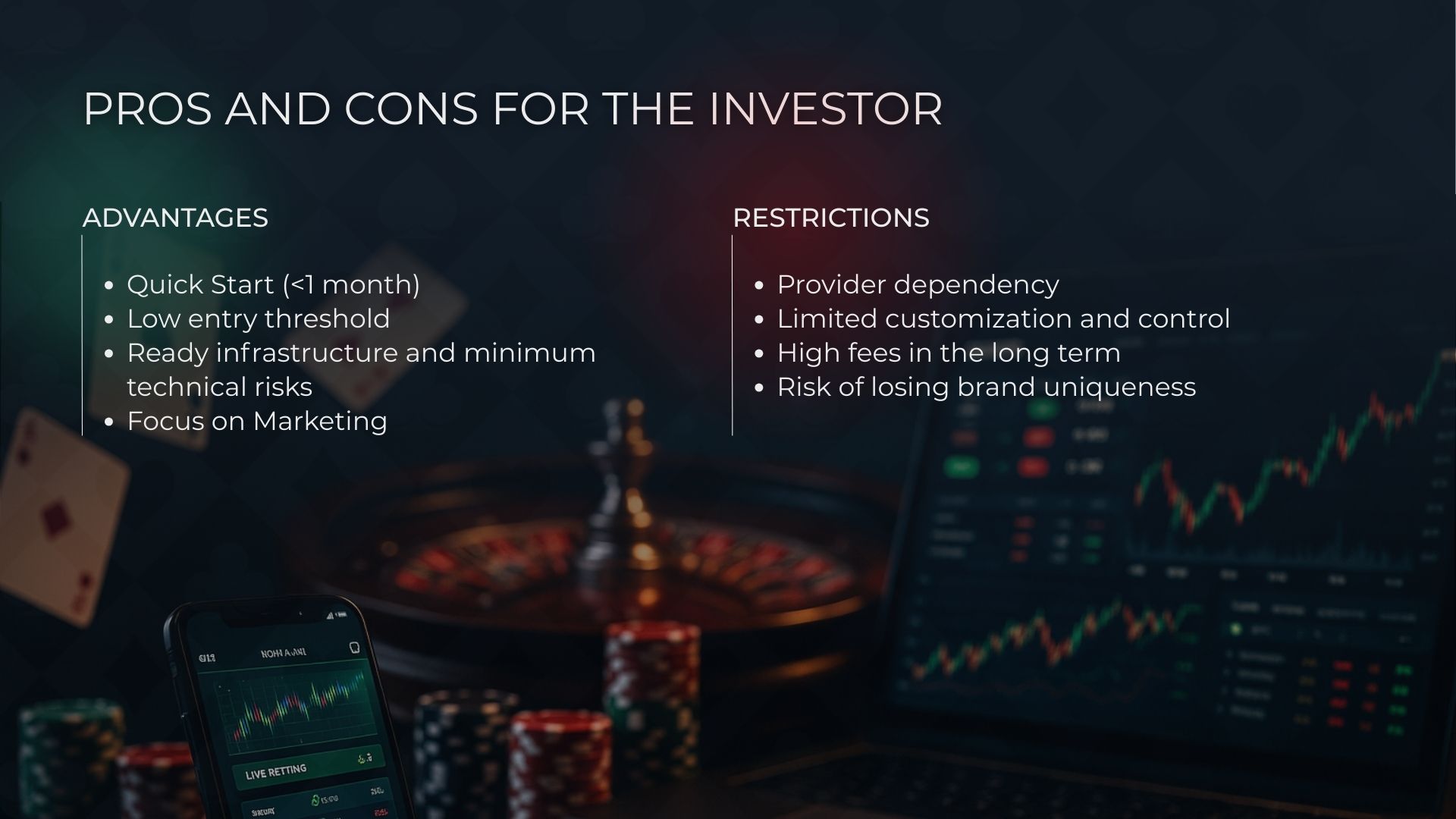
| Fast market entry. Launch a casino in less than a month and test a new niche or geography. |
Provider dependency. Changes in contract terms can halt the project. |
| Low entry barrier. No need for in-house platform development. |
Limited customization. Unique mechanics and features cannot always be implemented. |
| Ready-made infrastructure. Integrated payment systems, game providers, CRM, and analytics. |
Limited control over legal processes. |
| Minimal technical risks. The provider ensures stability, updates, and technical support. |
High long-term commissions. GGR percentages become significant as turnover grows. |
| Focus on marketing. The operator concentrates on acquiring and retaining players. |
Risk of losing brand uniqueness. Template-based solutions make websites look similar. |
Strategic Perspective
-
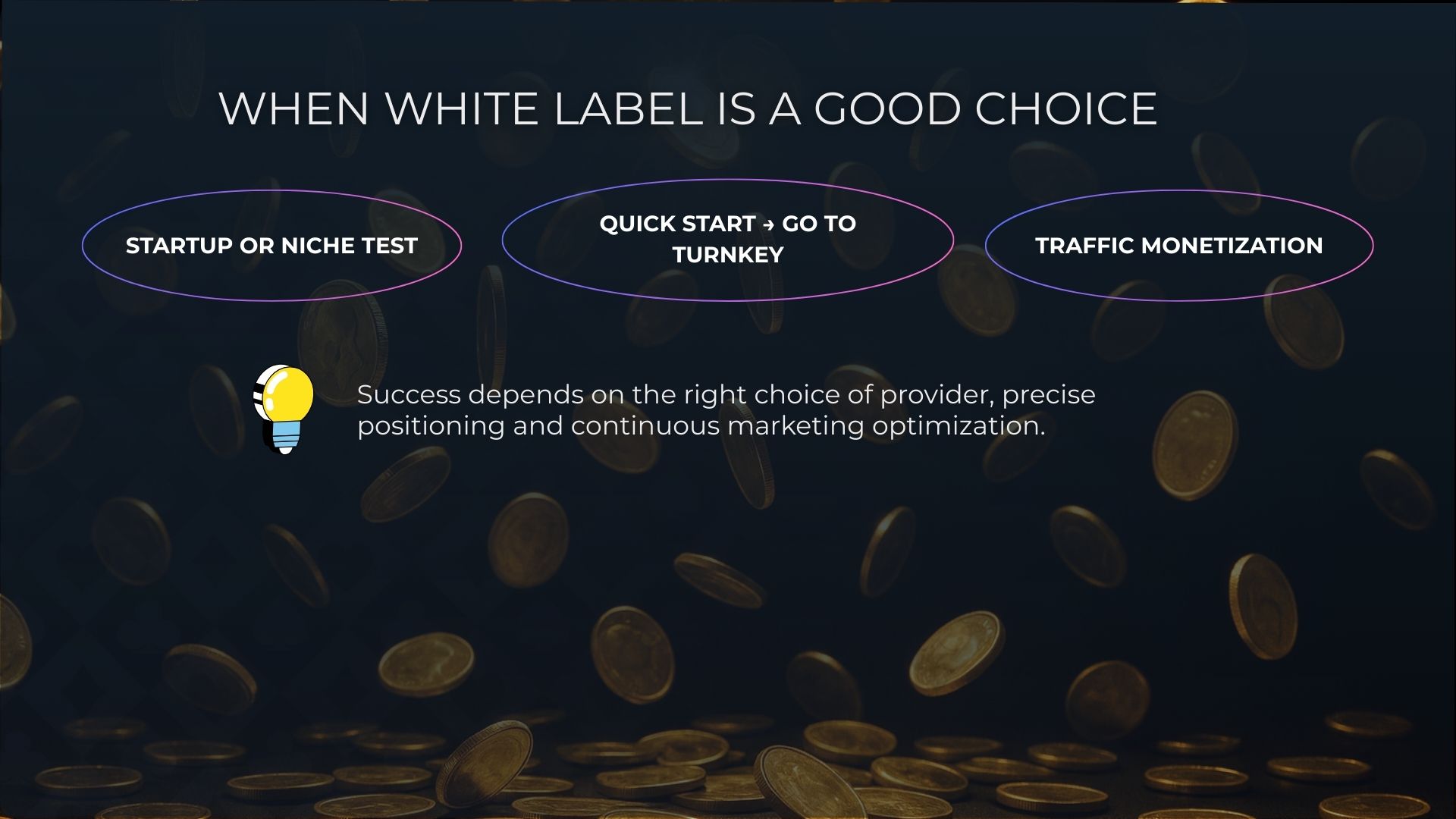
Scenario 1 — Startup or pilot project
White Label is ideal for testing a concept, assessing demand, and entering the market without major investments.
-
Scenario 2 — Quick entry with subsequent transition
Launching with White Label and then switching to a Turnkey or proprietary platform once stable revenue is achieved.
-
Scenario 3 — Marketing-driven brand
For companies with ready traffic sources (affiliates, media groups), where the main goal is rapid audience monetization.
Step-by-Step Strategy for Choosing and Launching a White Label Online Casino
Launching a White Label casino requires a systematic approach. Although the provider handles a significant portion of the tasks, successful entry depends on careful planning and control of every stage.
Step 1. Define target market and audience
-
Analyze the countries where promotion is planned and the provider’s software availability.
-
Determine player preferences: popular game genres, currencies, and payment methods.
-
Conduct a competitive analysis to assess market saturation and identify unique opportunities.
Read more: Where to launch a casino in 2025: TOP GEOs with high potential
Step 2. Choose a White Label provider
-
Examine the company’s reputation and feedback from existing partners.
-
Evaluate technological capabilities: loading speed, mobile optimization, and customization options.
-
Check contract terms, revenue sharing, and legal guarantees.
Step 3. Develop brand and UX design
-
Create a unique name and visual identity to stand out among competitors.
-
Adapt the interface for user convenience in the target audience.
-
Design the user journey: from registration to withdrawals.
Step 4. Configure payment solutions and currencies
-
Choose suitable payment providers based on player geography and currencies.
-
Integrate cryptocurrency payments if aligned with the strategy.
-
Ensure compliance with KYC/AML requirements.
Step 5. Plan marketing strategy
-
Define promotion channels: SEO, content marketing, affiliate programs, influencers, social media ads.
-
Develop a media plan and marketing budget.
-
Design player retention systems: bonuses, tournaments, loyalty programs.
Step 6. Project launch and testing
-
Test all features: games, payments, bonus systems.
-
Launch a beta version for a limited audience.
-
Gather feedback and implement improvements.
Step 7. Scaling and optimization
-
Track key KPIs: LTV, CPA, retention, conversion.
-
Optimize marketing campaigns based on analytics.
-
Expand functionality and geography as profits grow.
Conclusion
The White Label online casino model has become one of the most effective solutions for a fast entry into the iGaming business with minimal risks and shorter launch timelines. It allows operators to focus on marketing, brand development, and player relations while delegating technical infrastructure and operational management to an experienced provider.
For entrepreneurs and investors, this is not just a ready-made solution but a strategic tool that, with the right partner and a well-thought-out marketing strategy, can ensure sustainable growth and expansion into new markets.
However, the success of a White Label project directly depends on thorough market analysis, correct positioning, reliable provider selection, and continuous optimization of business processes.
In today’s highly competitive environment, the winners are not only those who launch quickly but also those who manage to deliver a unique player experience based on quality products and a deep understanding of their audience.