


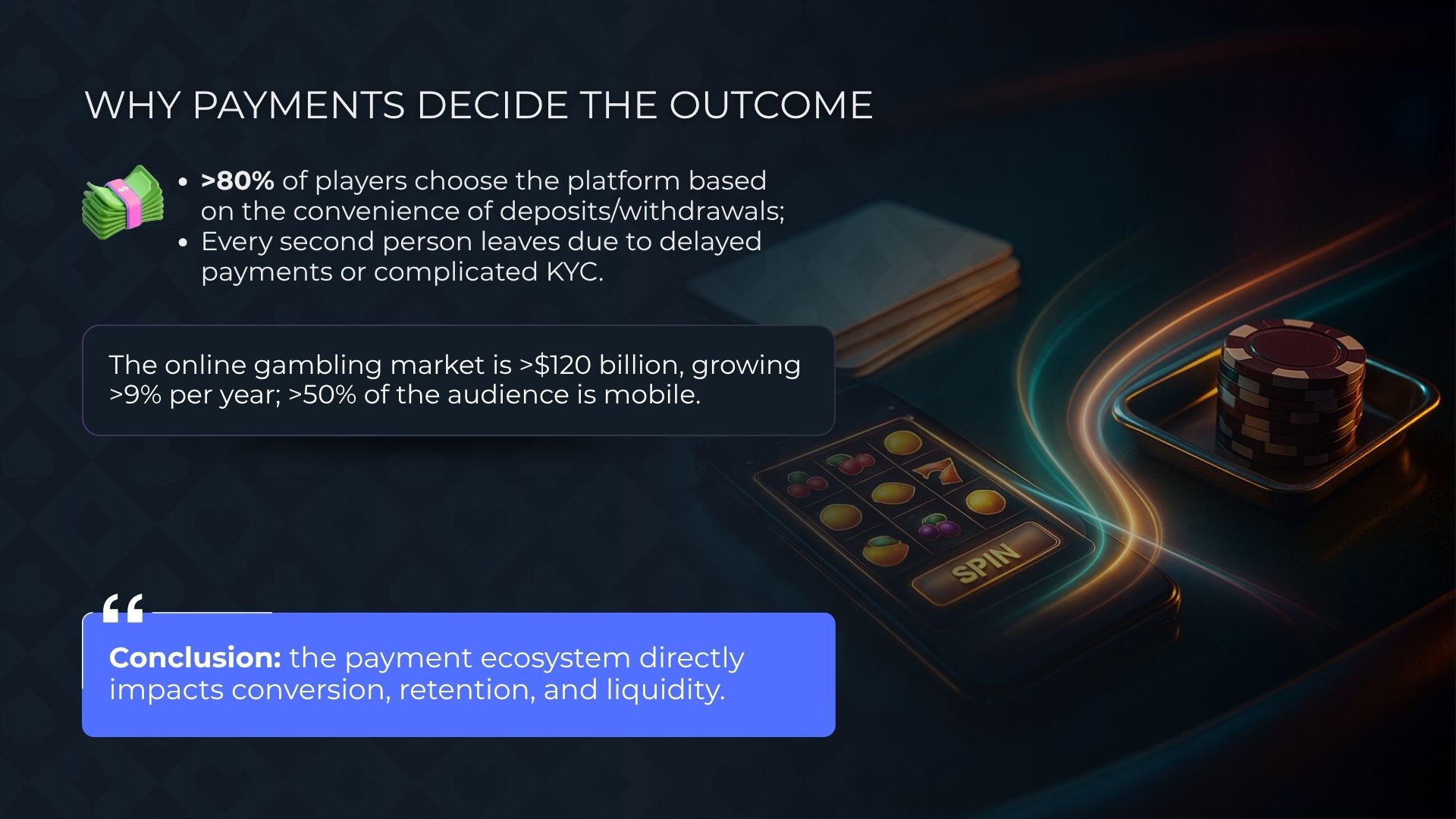
In the online gambling industry, payment infrastructure is not an auxiliary component — it is the financial foundation of the business. For players, convenient deposit methods and fast withdrawals are often more important than promotional offers; for casino owners, payments are a tool that directly affects conversion rates, customer retention and the project’s liquidity.
According to the Paysafe “All the Ways Players Pay 2025” report, more than 80% of users choose a platform based on the convenience of financial operations. Every second player stops using a service if they encounter delayed payouts or a complicated KYC procedure. That means a well-designed payment ecosystem becomes a competitive advantage rather than just a technical requirement.
According to Statista, the global online gambling market exceeded $120 billion and continues to grow at over 9% annually. At the same time, mobile users already account for more than 50%, which means payment solutions must be not only reliable but also perfectly optimized for smartphones.
For an entrepreneur planning to launch a casino, the question “which payment system to work with” is strategic rather than technical. Mistakes at this stage are costly: account blocks, inability to accept deposits from target countries, low payment conversion, reputational risks and loss of customers to competitors.
Key types of payment solutions for online casinos in 2025
By 2025, entrepreneurs entering the iGaming market can no longer rely solely on bank cards and basic transfers. Players expect a wide selection, instant transactions and transparent fees. Below we review the main categories of solutions that are setting the industry standard.
Bank cards: a familiar but not universal tool
Advantages:
-
High trust and brand recognition for Visa and Mastercard.
-
Easy integration via payment gateways (for example, Praxis, BridgerPay, Paydoo).
-
Possibility of instant deposits.
Limitations:
-
In some jurisdictions (for example, the United Kingdom, Norway, India) card acceptance for gambling is restricted or prohibited.
-
Average fee — 2.5–3.5%, sometimes higher for cross-border operations.
-
Withdrawals can take up to 5 business days.
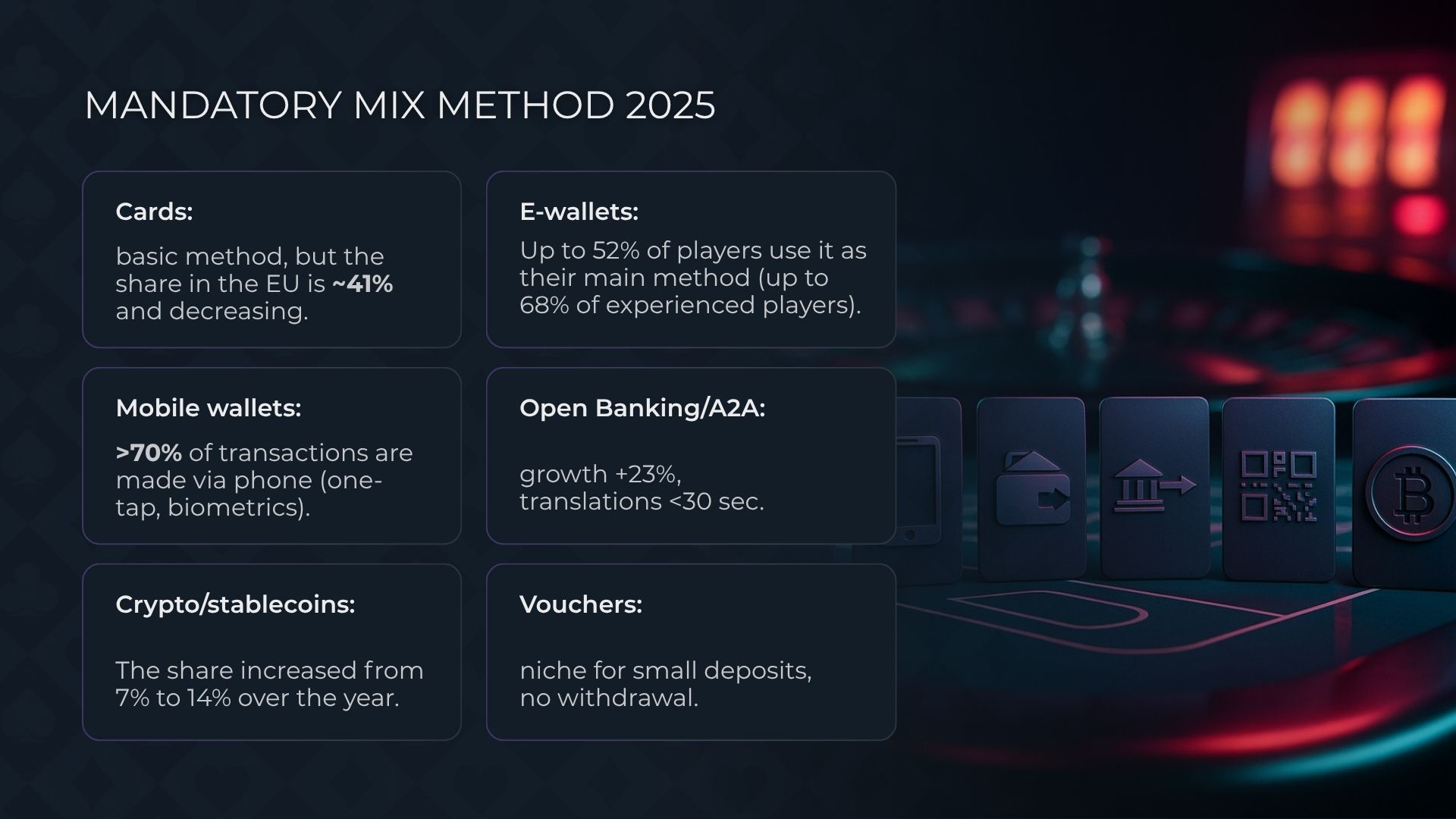
According to the 2025 report by H2 Gambling Capital, cards remain the primary method for deposits in the EU (around 41% of all transactions) but are losing ground to wallets and crypto options.
Electronic wallets (e-wallets): flexibility and speed
Major market players: Skrill, Neteller, AstroPay, MuchBetter, EcoPayz.
E-wallets have become standard in Europe and Latin America thanks to instant transactions and easy registration.
Advantages:
-
Instant deposits and fast payouts (up to 24 hours).
-
Support for multi-currency accounts.
-
Simple integration via API.
Disadvantages:
-
Additional fees for currency conversion.
-
Not all wallets operate in high-risk regions (for example, the USA).
Mobile payments: the standard for the smartphone generation
Solutions: Apple Pay, Google Pay, Samsung Pay, and local equivalents such as M-Pesa (Africa), PayByPhone (Asia).
In 2025, the share of mobile transactions in online gambling exceeded 70%, and mobile wallets became the dominant way to top up accounts.
This trend is driven by the rise of casual players and the spread of fast-payment APIs (for example, Open Banking Europe API).
Advantages:
-
One-click funding and biometric authentication.
-
High payment conversion on mobile devices.
Disadvantages:
-
Dependence on device and OS.
-
Partial support for withdrawals.
Bank transfers and open banking
Solutions: Trustly, Sofort, PayByBank, Volt.
Open-banking solutions allow players to connect directly to their bank account, bypassing card schemes. This reduces fees and increases speed.
According to a report by Juniper Research, open-banking payments in iGaming grew by 23% for 2024–2025, and the average transfer time fell to under 30 seconds.
Pros:
-
Low fees (on average 1–1.5%).
-
Instant transfers across EU countries.
-
Minimal chargeback risk.
Cons:
-
Limited availability outside Europe.
-
Requires more complex compliance processes (PSD2, SCA).
Cryptocurrencies and stablecoins
Key currencies: Bitcoin, Ethereum, Tether (USDT), USD Coin (USDC), Binance Pay.
The share of crypto payments in the iGaming sector rose from 7% to 14% over the past year. Crypto transactions are most active in Asia, Latin America and Eastern Europe.
Advantages:
-
Minimal fees (below 1%).
-
No intermediaries and no delays.
-
Ability to operate in jurisdictions where traditional payment solutions are restricted.
Disadvantages:
-
Exchange rate volatility.
-
Increased regulatory scrutiny (AML / KYC).
Vouchers and prepaid cards
Examples: Paysafecard, Neosurf, Flexepin.
Suitable for players who do not want to reveal banking details. In Europe, they remain a popular instrument for small deposits.
Advantages:
-
Anonymity and simplicity.
-
Minimal fraud risk.
Disadvantages:
-
Not suitable for withdrawals.
-
Fees can be higher (up to 5%).
Vouchers are an auxiliary tool useful for specific markets (Germany, France, Eastern Europe).
| Payment system type | Example providers | Main advantages | Limitations and risks |
|---|---|---|---|
| Bank cards (Visa, Mastercard) | Trust Payments, Cardpay, Nuvei | High player trust, easy integration, instant deposits | Country restrictions, frequent chargebacks, higher fees |
| Electronic wallets (eWallets) | Skrill, Neteller, MuchBetter | Fast transactions, anonymity, convenience for mobile users | Regulatory restrictions in EU and UK, risk of account blocks |
| Crypto payments | CoinsPaid, Cryptopay, Binance Pay | Minimal fees, instant transfers, access to global audience | Exchange volatility, compliance complexity, reputational risks |
| Payment gateways | PayOp, AstroPay, Interkassa | Multi-currency support, localization, API integrations | Varying regional fees, dependence on intermediary stability |
| Open Banking and A2A | TrueLayer, Trustly, Volt | Instant account-to-account transfers, high security | Not yet covering all countries, integration complexity with casino platforms |
How to choose a payment provider and build a casino’s financial architecture
Mistakes when choosing a PSP (payment service provider) can cost the project account blocks, rising chargebacks and loss of player trust. Therefore, it is strategically important to design the payment system as a multi-layer model that ensures stability, scalability and legal compliance.
1. Multi-layer payment architecture
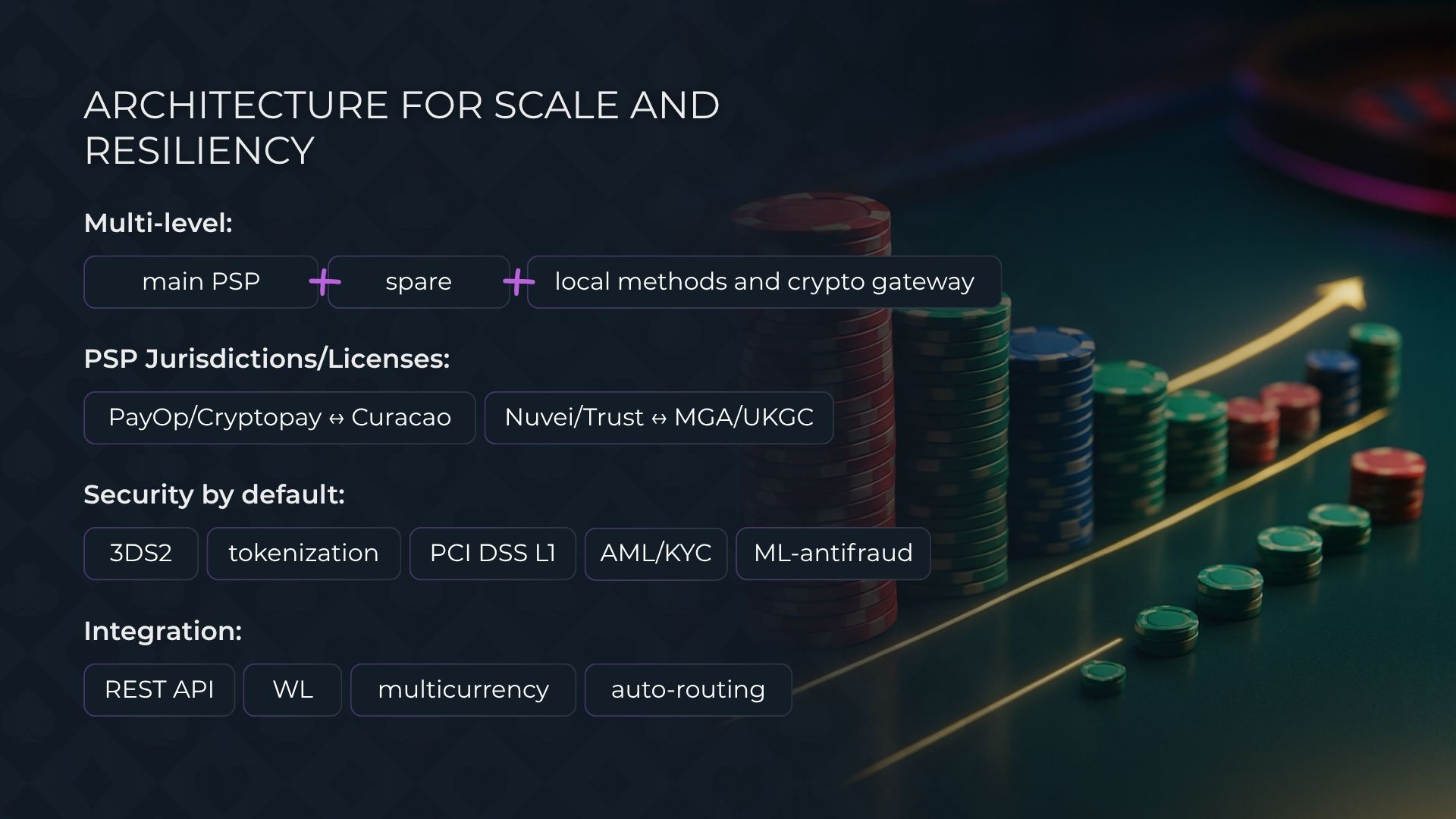
Modern casinos do not rely on a single payment gateway. An optimal scheme includes:
-
primary PSP — to accept transactions from target countries with high traffic volume (for example, EU, LATAM, Asia);
-
backup provider — to duplicate operations and reduce risks during outages or blocks;
-
auxiliary solutions — crypto gateways, local payment methods and wallets integrated via API.
Such distribution reduces dependence on a single channel and provides flexibility when regulations change.
2. PSP jurisdiction and licensing
Payment providers for gambling operate under strict compliance requirements. When choosing, consider:
-
availability of an EMI or PI license (Electronic Money Institution / Payment Institution);
-
registration jurisdiction (the most stable — Malta, Cyprus, United Kingdom, Lithuania);
-
compatibility with the casino’s license (MGA, Curacao, Isle of Man, Tobique, etc.);
-
PSP’s policy on high-risk countries and restricted territories.
Example: providers like PayOp and Cryptopay actively work with projects under a Curacao license, while European players (for example, Nuvei or Trust Payments) target MGA and UKGC licenses.
3. Transaction security and protection
At the security level, payment solutions for iGaming should include:
-
3D Secure 2.0 and card tokenization;
-
anti-fraud modules with machine-learning components;
-
segmentation by high-risk regions and adaptive transaction screening;
-
data protection according to PCI DSS Level 1 standards.
This is critical to minimize losses and protect the brand’s reputation — players do not return where a payment failed or was delayed.
4. Fees and economic efficiency
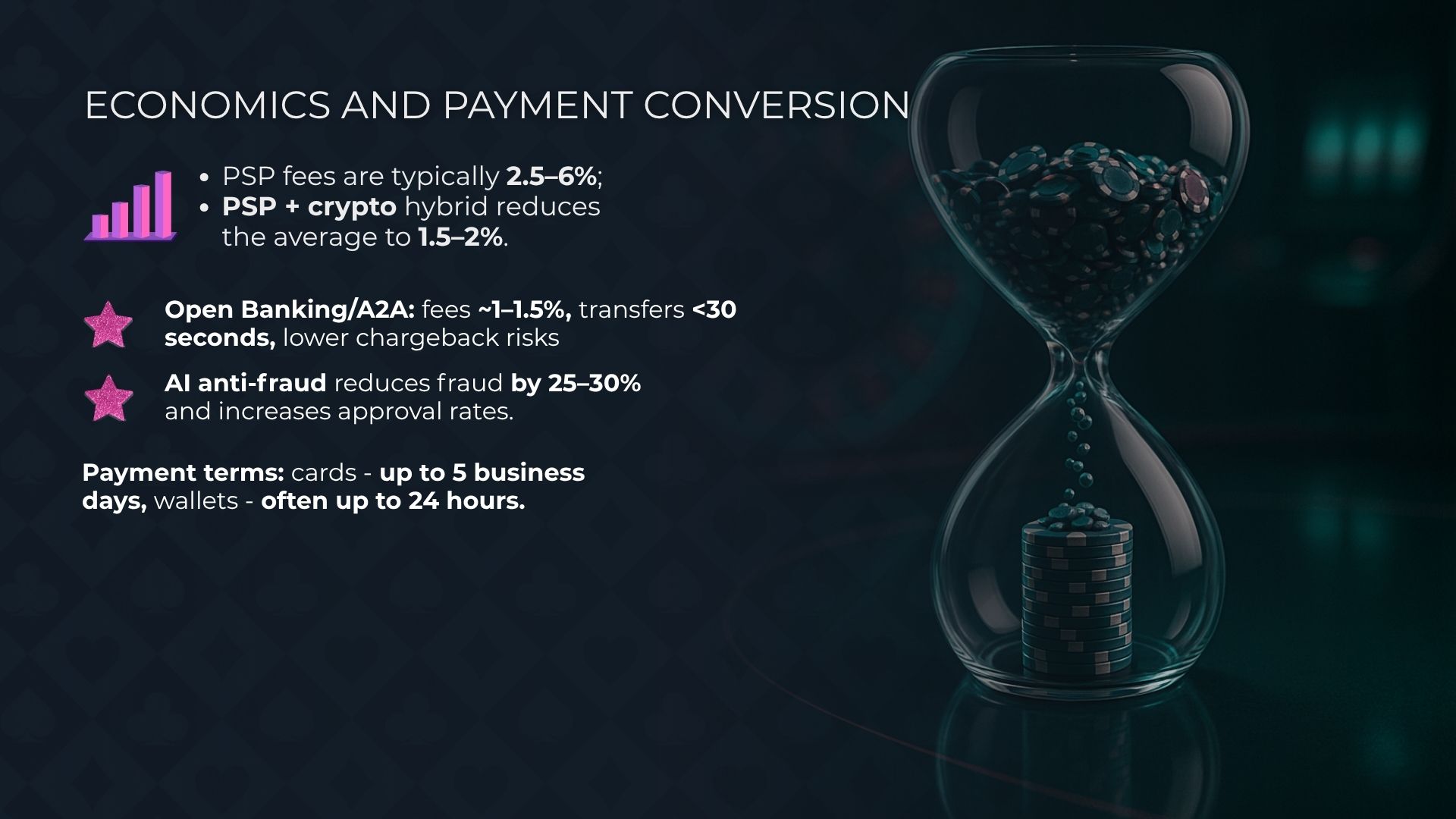
PSP fees usually range from 2.5% to 6%, depending on:
-
the payment gateway’s jurisdiction;
-
transaction currency;
-
average ticket size;
-
the business risk level.
Tip for entrepreneurs: the optimal model is a combination of a classic PSP with a crypto gateway. This lowers the average fee to 1.5–2% while maintaining fiat stability.
5. Integration level and API support
Modern PSPs offer ready-made APIs, SDKs and plugins for popular platforms (SoftSwiss, BetConstruct, Gambling Soft, etc.).
It is important to choose a provider that offers:
-
a REST API with access to transaction statistics;
-
white-label integration capabilities;
-
support for multi-currency wallets and automatic payment routing.
This simplifies scaling and enables centralised management of financial flows across jurisdictions.
Key payment-system trends in gambling for 2025
The online gambling industry is traditionally sensitive to fintech changes. In 2025, payment solutions for casinos stop being merely tools for moving money — they become part of player retention and identification strategies. Below are the main directions shaping the sector’s development.
AI integration into financial processes
AI is increasingly embedded into payment gateways and monitoring systems. It helps detect anomalies in player behaviour, prevent fraud and automatically block suspicious transactions.
For example, the AI Risk Engine from Trust Payments reduces fraud levels by 25–30%, and predictive models make it possible to assess transaction risk in advance depending on country, device and amount.
For casinos, this is not just security — it reduces false declines and increases the conversion of successful payments.
According to TripleA, the number of crypto-payment users in gambling exceeded 10 million, and the total volume of crypto transactions in iGaming for 2024 grew by 19%.
In 2025, particular attention is paid to stablecoins (USDT, USDC, EURC), which reduce volatility and are already supported by leading payment providers such as CoinsPaid and CryptoProcessing.
For entrepreneurs, this is a solution that allows legally accepting deposits worldwide, circumventing traditional banking restrictions and lowering costs.
Direct transfers (A2A and Open Banking)
Account-to-Account (A2A) and Open Banking technologies are gradually becoming standard in Europe and the United Kingdom.
A player can top up an account directly from their bank account — without cards or intermediaries.
Solutions from Volt, TrueLayer, and Trustly provide instant transfers, transparency and minimal fees.
For the operator, this reduces dependence on traditional PSPs and can cut costs by up to 50%.
Stricter compliance and KYC requirements
Financial regulators are increasing oversight of gambling transactions.
In 2025, the focus is on automation of KYC/KYB and AML processes.
Providers such as Sumsub and Shufti Pro offer comprehensive solutions with biometric identification and instant document verification.
For licensed casinos, this is no longer optional — compliance directly affects the ability to accept and process payments without the risk of blocking.
Mobile and alternative payment methods
More than 60% of deposits are now made from smartphones, and that share continues to grow.
Players increasingly use Apple Pay, Google Pay, Revolut, as well as local alternatives — M-Pesa, PIX, Gcash, Boleto Bancário.
Payment systems that do not offer mobile solutions lose up to a third of potential customers.
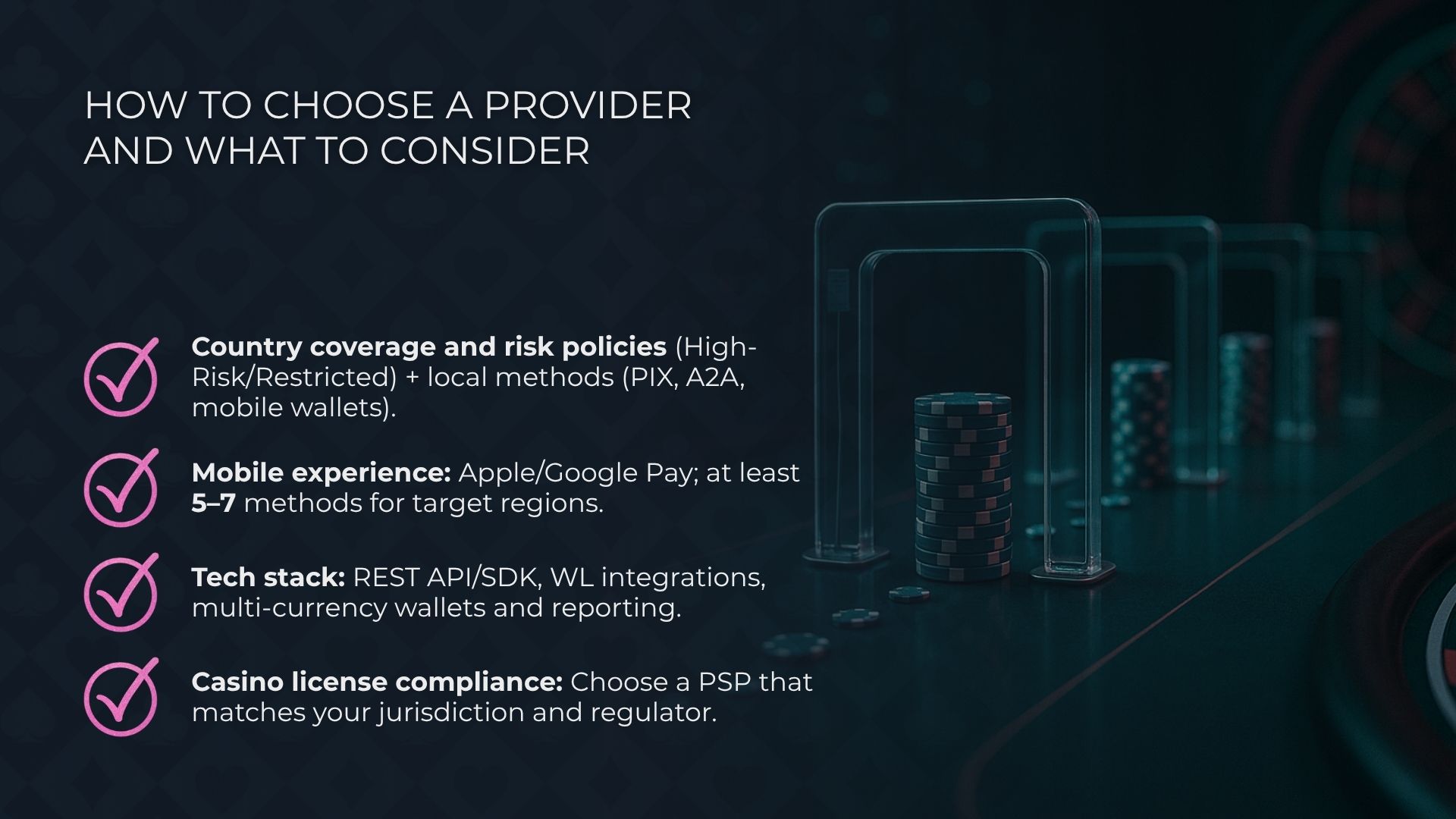
A modern casino should integrate at least 5–7 methods adapted to the regions of its audience.
Payment strategy as the foundation of a successful casino
Payment systems in gambling have long ceased to be background — today they are the core on which the entire user experience, brand trust and the financial resilience of the business are built.
A player evaluates a casino not only by the selection of games but also by how quickly and conveniently they can make a deposit or withdraw winnings. For an entrepreneur, payments are an indicator of the project’s maturity and its ability to operate internationally.
In 2025, the market for payment solutions in iGaming is becoming more technologically complex but also more flexible.
AI, cryptocurrencies, open banking and automated compliance create opportunities that were not available five years ago. However, only operators who strategically build their financial architecture — taking into account regulatory requirements, regional specifics and player behaviour — will be able to leverage them.
Successful projects use a multi-layer approach: combining multiple PSPs, crypto gateways and local payment methods. This model reduces risks, optimizes fees and ensures stability when working with different countries and licences.
If you are planning to launch an online casino, start with the payment ecosystem.
Choosing the right solutions, partners and integrations will not be just a technical step but the foundation for scaling the business and achieving long-term profitability.