


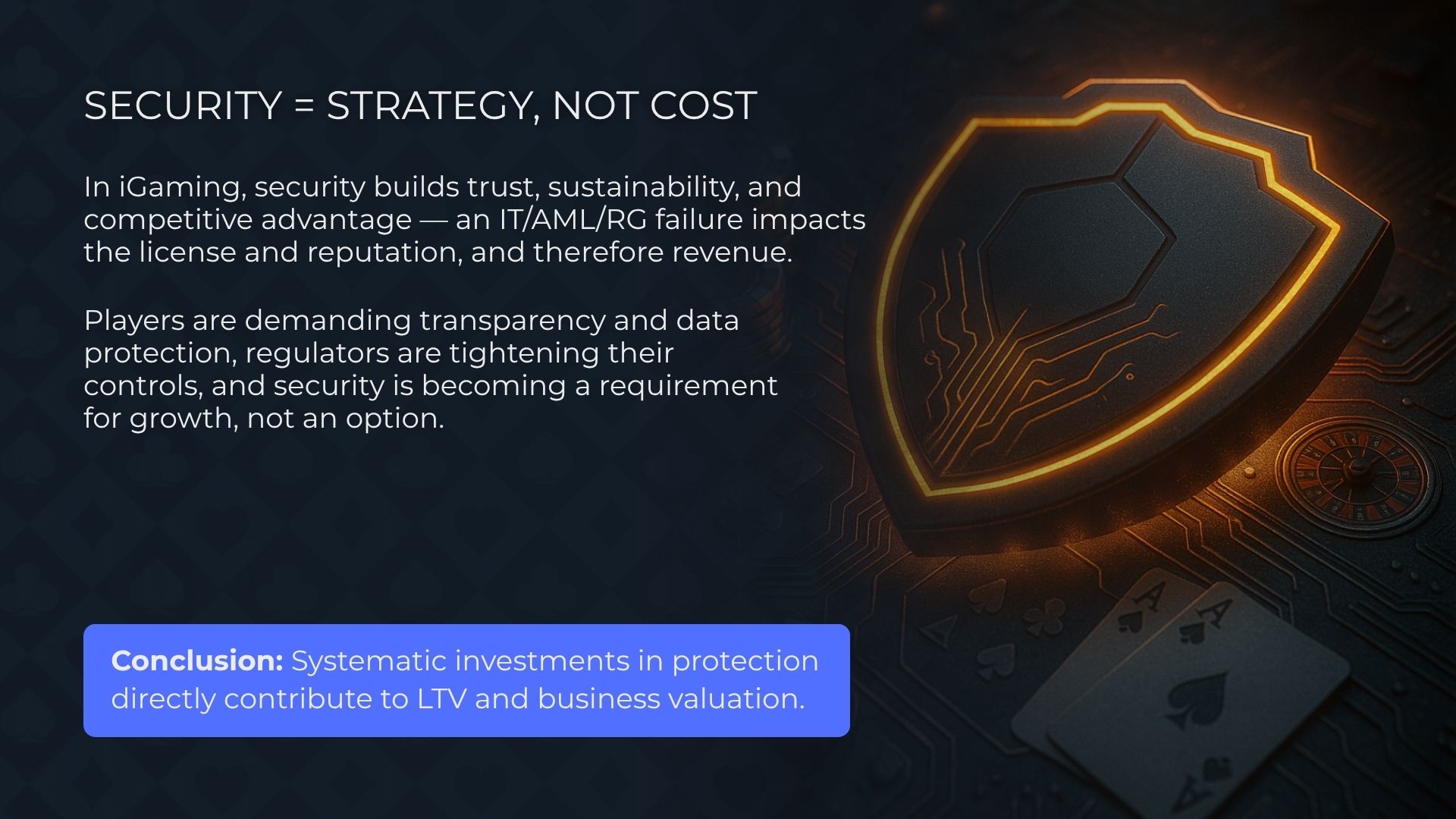
 Security in iGaming today is not just about protection against cyberattacks, but a strategic foundation upon which customer trust, business resilience, and competitive advantages in the global market are built. Any vulnerability—whether in IT infrastructure, AML procedures, or responsible gambling policies—can result not only in fines and legal consequences but also in reputational damage, which directly impacts an operator’s profitability.
Players’ expectations and regulatory pressure are increasing simultaneously. Players demand transparency, data protection, and fair conditions, while licensing authorities are tightening their oversight by introducing new control mechanisms and accountability measures. As a result, security is no longer an optional task but a mandatory requirement for business survival and growth.
Thus, security in iGaming is a key asset that influences strategic development, long-term sustainability, and investment appeal. Companies that systematically invest in cybersecurity, KYC/AML procedures, and Responsible Gambling today will be perceived tomorrow as reliable partners and industry leaders.
Regulatory Requirements
Online casino security is primarily defined by legal frameworks. Licensing authorities in different jurisdictions set standards that establish the rules of the game for operators and solution providers. Compliance is not just a formality but a condition for maintaining a license and earning trust from both players and investors.
-
United Kingdom (UKGC).
The UK regulator is traditionally regarded as the strictest in the world. Its approach focuses on three areas: anti-money laundering (AML), player identity verification (KYC), and protection of vulnerable categories of users. Companies are required to implement regular independent audits, maintain transaction monitoring systems, and prevent problem gambling. Violations result in multimillion fines and license revocations, as we have already witnessed in 2025.
-
Malta (MGA).
The Maltese jurisdiction remains one of the most popular due to its balance of flexibility and reliability. The focus here is on player data protection, implementation of Responsible Gambling tools, and certification of random number generators (RNG) by independent laboratories. The MGA requires operators to demonstrate transparency in management and regularly update their internal security policies.
-
Curaçao.
Traditionally perceived as a “simplified” licensing option, Curaçao completely reformed its regulatory system between 2023–2025. The new licensing model strengthened oversight of AML procedures, introduced mandatory technical certification of platforms, and established transparent rules for operators. Today, a Curaçao license is not only affordable but also a more competitive tool for entering international markets.
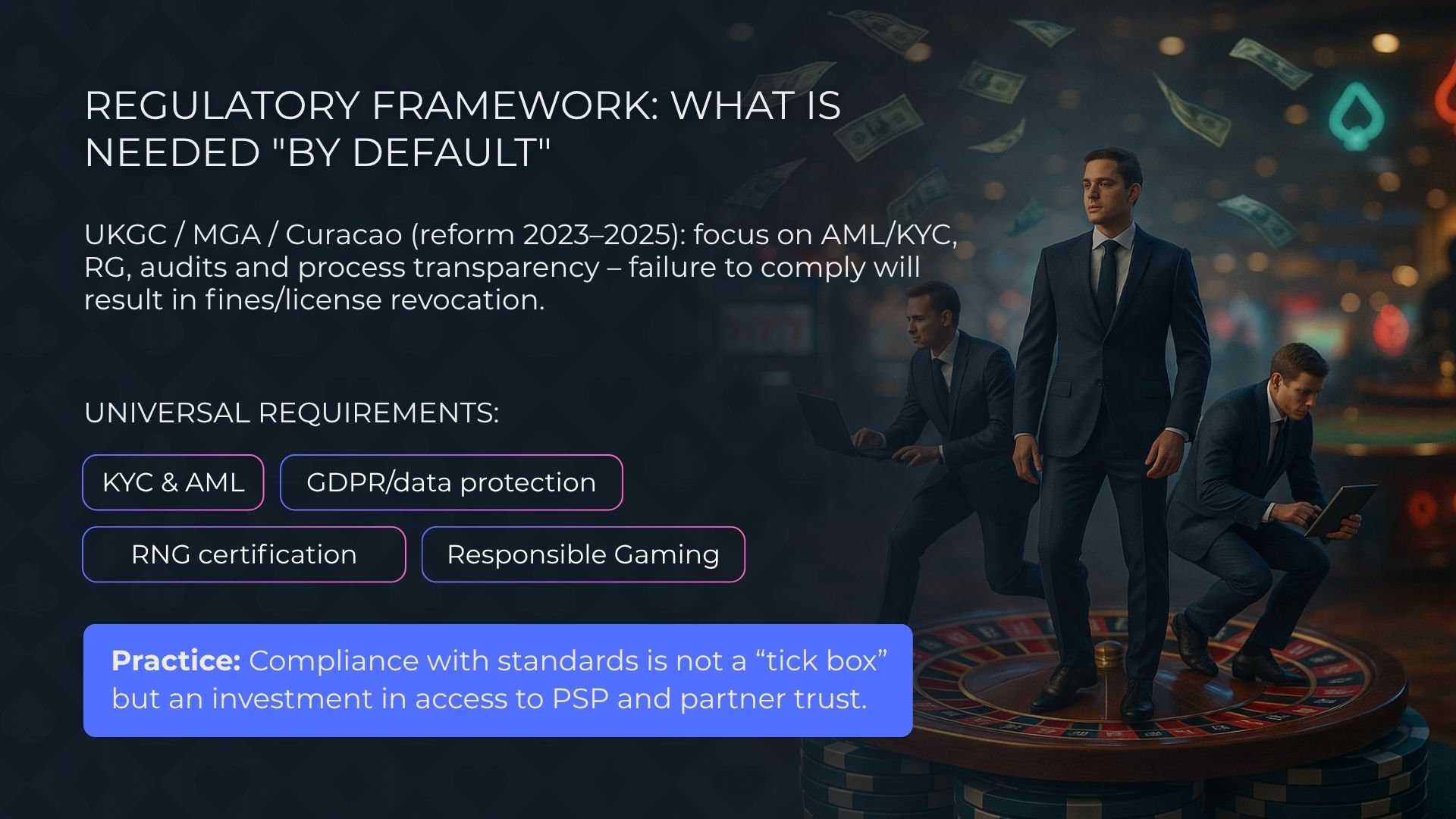
In practice, requirements from different jurisdictions converge into a unified global framework:
-
KYC and AML: client identification and verification of fund origins to prevent money laundering and terrorist financing.
-
Data protection: compliance with GDPR and local privacy laws.
-
Responsible Gambling: implementation of player self-control mechanisms (deposit limits, self-exclusion, monitoring of abnormal behavior).
-
Game certification: independent testing of RNGs and software to confirm game fairness.
For businesses, regulatory compliance is not just a legal obligation but an investment in resilience. In an environment where regulators are tightening oversight and fines are becoming more severe, fulfilling AML/KYC and Responsible Gambling requirements becomes a competitive advantage that directly impacts reputation and market valuation.
Technological Security and Game Integrity
Robust technological infrastructure is the backbone of an online casino’s resilience and long-term success. It determines not only the level of data protection but also the extent to which players are willing to entrust the platform with their funds and personal information.
Game Fairness
-
Random Number Generators (RNGs).
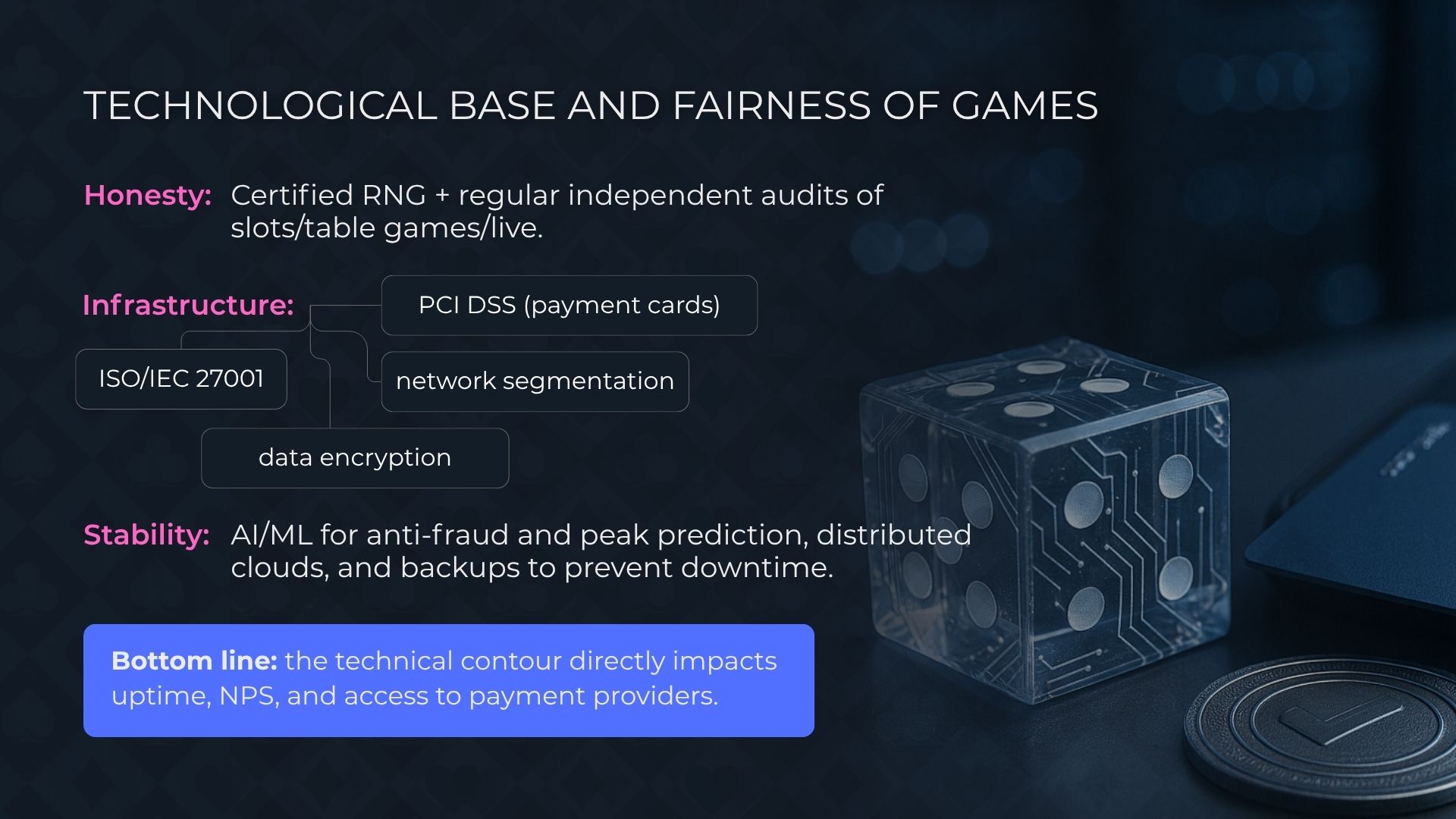
Each operator is required to use RNGs certified by independent laboratories (e.g., eCOGRA, iTech Labs, or GLI). These audits ensure that game outcomes are genuinely random and cannot be predicted or manipulated. Without such certification, access to regulated markets in Europe and North America is impossible.
-
Independent audits.
In addition to RNG certification, regular testing of gaming solutions—including slots, table games, and live casinos—is conducted. This confirms that mathematical models are fair and payout percentages match declared values.
Data and Payment Security
-
International standards.
Compliance with PCI DSS (payment card processing) and ISO/IEC 27001 (information security management) is now a baseline requirement for operators and software providers. Non-compliance can lead not only to fines but also to blocked cooperation with major payment systems.
-
Encryption and network segmentation.
Player data must be stored and transmitted in encrypted form, while network segmentation minimizes damage in the event of a cyberattack. The 2025 Bragg Gaming incident demonstrated the effectiveness of these measures: despite the cyberattack, critical customer information remained secure.
New Technologies and Resilience
-
Artificial intelligence and machine learning.
Modern systems are used not only to analyze gaming patterns and detect fraud but also to prevent technical failures. AI can predict peak loads and automatically allocate resources.
-
Fault tolerance and data centers.
The use of distributed cloud infrastructures and backup systems reduces downtime risks, which could otherwise cost operators millions. The iGaming industry cannot afford even brief outages.
Combating Fraud
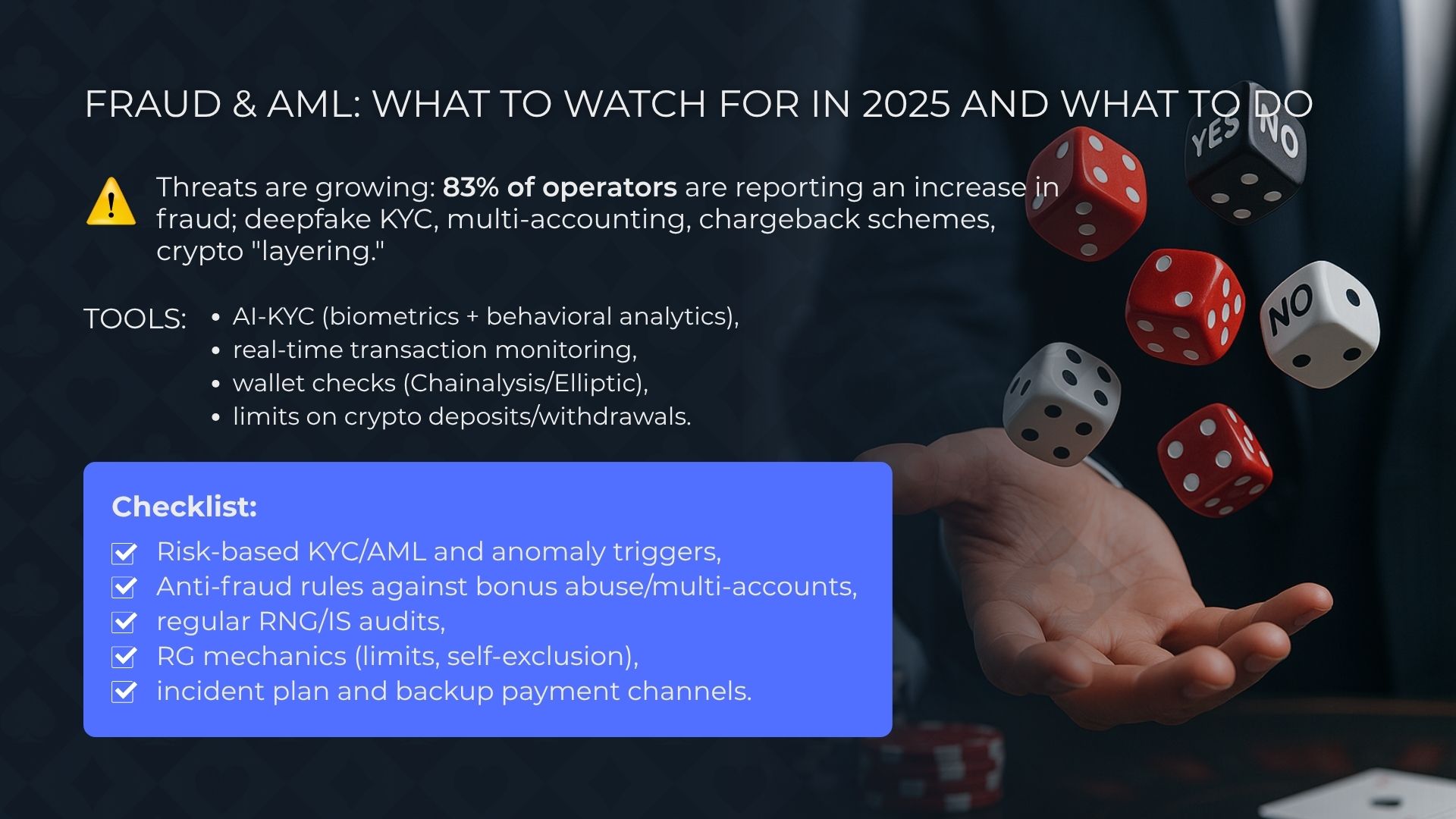
Fraud remains one of the most serious threats to the iGaming industry. The scale of the problem is growing: according to the 2025 Sumsub Report, 83% of operators reported an increase in fraudulent activity. The use of deepfake technologies and forged documents is particularly problematic, complicating the customer identification process.
Main Threats
-
Fake accounts and multi-accounting to exploit bonus systems.
-
Payment fraud (chargebacks, stolen card details).
-
Use of cryptocurrencies for money laundering through anonymous transactions.
-
Identity theft via forged documents and deepfake videos during KYC checks.
Effective Protective Measures
Modern operators are increasingly implementing integrated systems that combine technology and analytics:
-
Automated identity verification (AI-KYC).
The use of biometrics (facial, voice, fingerprint recognition) and behavioral analytics helps filter out fake accounts during registration.
-
Real-time transaction monitoring.
AML systems track suspicious activity, such as sudden betting changes, frequent small deposits, or transactions from “high-risk” jurisdictions.
-
Advanced AML algorithms.
Machine learning technologies help detect complex money laundering and layering schemes that cannot be identified manually.
Special Focus: Cryptocurrency Payments
With the growing share of cryptocurrencies in iGaming payments, operators face new challenges. While blockchain ensures transaction transparency, its high degree of anonymity requires enhanced procedures:
-
wallet screening through solutions like Chainalysis or Elliptic;
-
strict limits on cryptocurrency deposits and withdrawals;
-
additional identity verification for players using digital assets.
For operators, ignoring fraud and AML threats means not only direct financial losses but also the risk of fines, license suspension, and reputational damage.
Conclusion
Security in online casinos today is not just a formal regulatory requirement but a strategic factor in business resilience. Investments in modern technologies, compliance with international standards, and implementation of player protection tools form the foundation for long-term growth.
A comprehensive approach enables operators to:
-
minimize the risks of fines and cyber incidents;
-
ensure player and partner trust;
-
increase customer loyalty and retention;
-
strengthen brand positions in the global iGaming market.
The experience of leading companies and recent statistics demonstrate: operators that treat security as a key competitive advantage not only protect their business from threats but also enhance its value in the eyes of investors, regulators, and customers.
The bottom line is clear: in the iGaming industry, security is becoming a driver of growth, not just an expense item.