


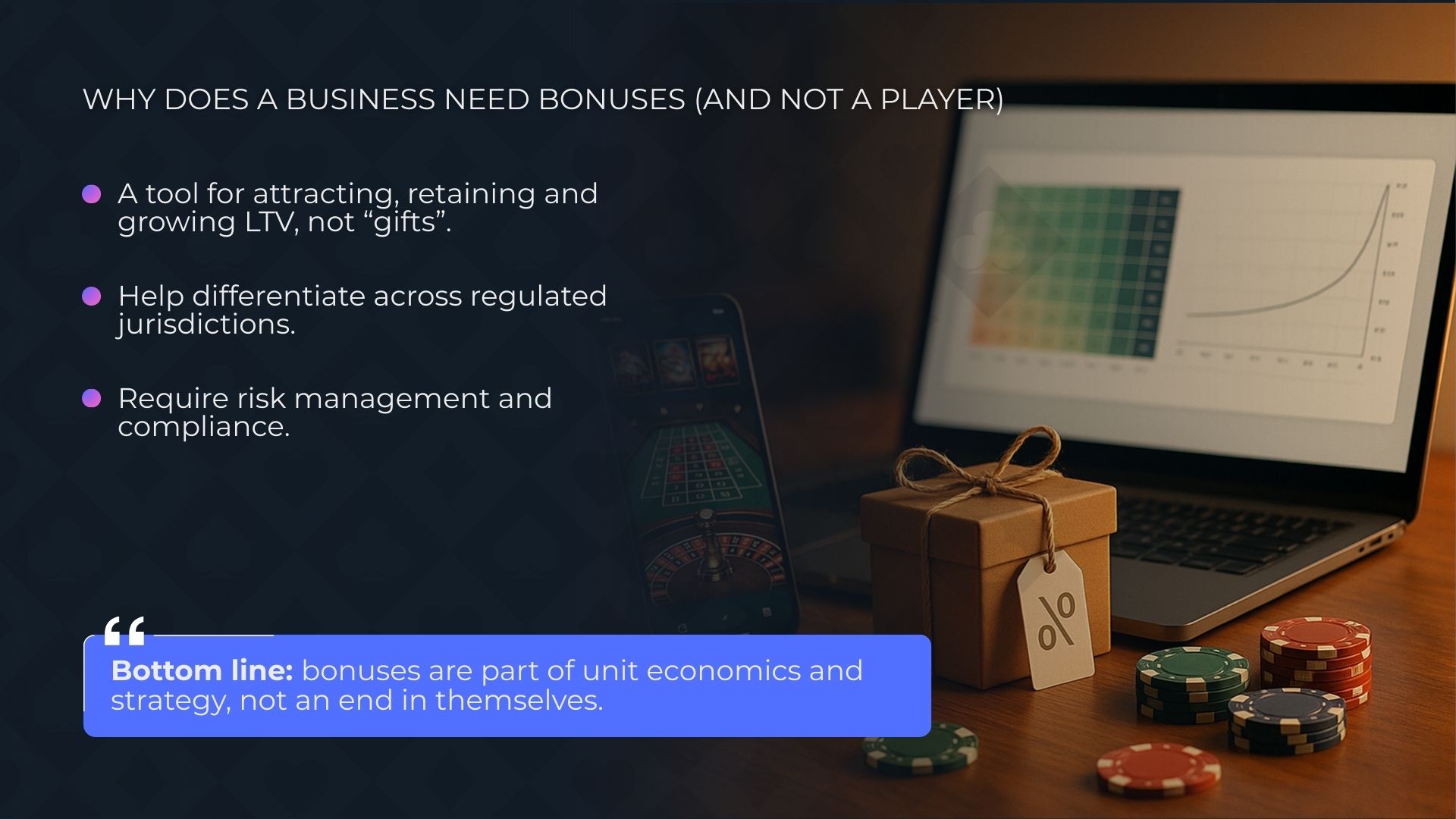
 Bonuses have become an integral part of online casino strategies. For players, they look like attractive promotions offering extra funds or free spins. For businesses, however, bonuses are a powerful marketing tool that addresses multiple objectives at once: attracting new users, retaining the existing audience, increasing customer lifetime value (LTV), and strengthening brand competitiveness.
In a highly competitive and saturated market, particularly in regulated jurisdictions, bonus mechanics serve as a key differentiator and a way to comply with legal requirements. However, their use also carries risks: from player abuse and financial losses to sanctions from regulatory authorities.
The purpose of this article is to analyze bonuses in online casinos not from the player’s perspective, but from a business standpoint. We will review the main types of bonuses, their impact on business performance, associated risks, and global trends.
Main Types of Bonuses in Online Casinos
Online casino bonus mechanics are diverse and adaptable to the operator’s goals: from aggressive new player acquisition to long-term loyalty building. Let’s review the key formats.
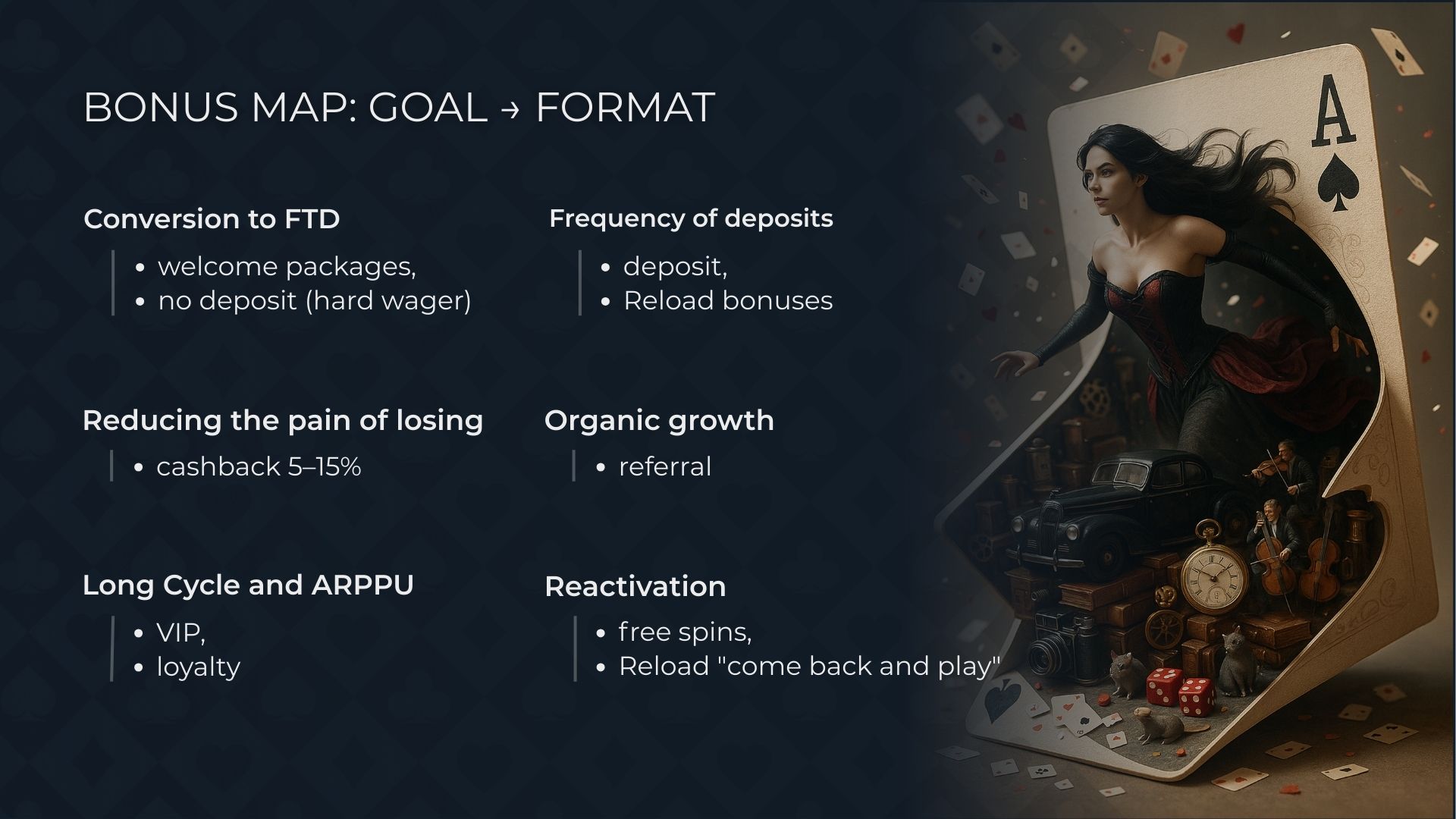
1. Welcome Packages
-
Most often include 100% or more on the first deposit + free spins.
-
Their goal is to turn a visitor into a registered client and motivate them to make the first deposit.
-
In some cases, the welcome package extends across several deposits, increasing the likelihood of establishing a playing habit.
2. Deposit Bonuses
-
Classic model: the player funds their account, and the casino adds a percentage on top.
-
Used not only in welcome packages but also in regular promotions (e.g., “50% on deposits every Friday”).
-
Encourage players to deposit more frequently and in larger amounts.
3. No-Deposit Bonuses
-
The player receives money or free spins immediately after registration without needing to deposit.
-
Advantage: maximum reduction of the entry barrier.
-
Disadvantage: high risk of bonus hunting, which is why such promotions usually come with strict wagering and withdrawal conditions.
4. Free Spins
-
Free slot spins, often combined with deposit bonuses.
-
Appeal to slot players and help promote specific gaming products.
5. Reload Bonuses
-
Offered to existing customers for repeat deposits.
-
Frequently used to reactivate “dormant” accounts (e.g., a bonus for players inactive for a week or more).
-
Serve as a retention and re-engagement tool.
6. Cashback
-
Return of a percentage of losses over a period (usually 5–15%).
-
Lowers the psychological barrier to playing by creating a sense of “insurance.”
-
Often used to strengthen brand loyalty.
7. Referral Programs
-
Players invite friends and receive rewards after their deposit.
-
An effective tool for organic customer base growth.
-
Success depends on transparent terms and strong motivation on both sides.
8. VIP and Loyalty Programs
-
Designed to retain high rollers and regular players.
-
Include exclusive bonuses, personal account managers, faster payouts, and access to private tournaments.
-
Build long-term brand commitment and significantly increase LTV.
Related topic: High-Roller Industry: How VIP Players Drive Online Casino Revenues
The Impact of Bonuses on Business Performance
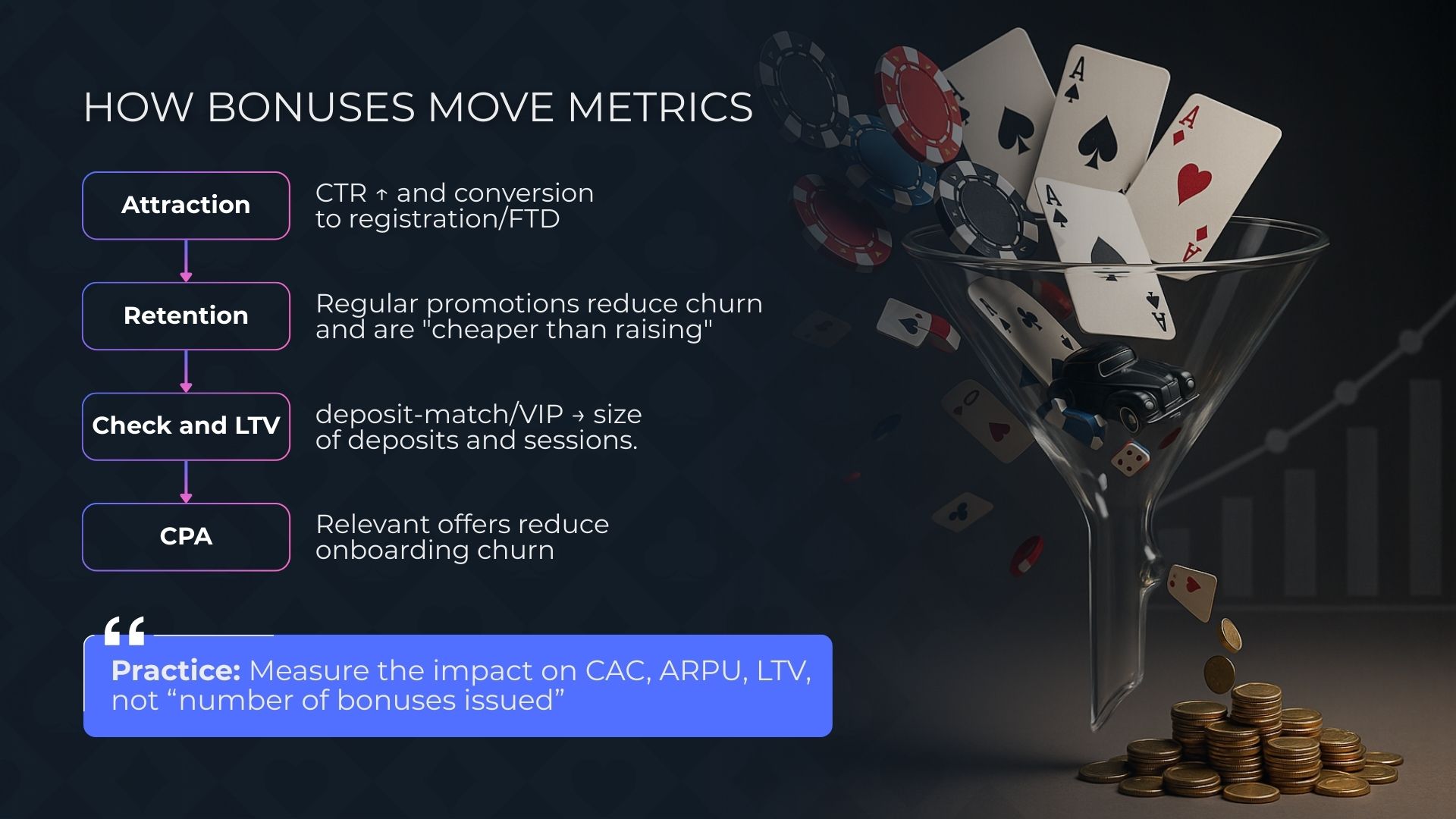
Bonuses are not just a marketing tool; they are a direct lever that influences an operator’s key metrics. Proper configuration determines the effectiveness of acquisition and retention strategies.
Customer Acquisition
Welcome bonuses and no-deposit offers help convert traffic into registrations and first deposits. The more attractive the bonus, the higher the CTR and conversion from visitor to player.
For startups and new brands, this is the primary tool for market entry.
Retention and Churn Reduction
Reload bonuses, cashback, and regular promotions encourage players to return. Statistics show that even a small bonus (e.g., 20 free spins for logging in over the weekend) can trigger reactivation.
It’s important to note that retention costs less than acquisition: bonus mechanics help reduce overall marketing spend.
Increasing Average Revenue and LTV
Deposit bonuses and VIP programs encourage higher deposits, while cashback reduces the fear of losses. Together, this extends gaming sessions and increases overall spending.
As a result, LTV grows: each player generates more long-term revenue.
Reducing CPA and Boosting Conversions
A well-designed bonus package helps reduce customer acquisition cost (CPA): players receiving relevant bonuses are less likely to drop out during registration or their first deposit.
This is particularly critical in competitive niches where traffic costs continue to rise.
Building Brand Loyalty
Loyalty programs create emotional attachment: players feel like “valued” customers. This lowers the risk of switching to competitors, even with similar offers.
Data Collection and Personalization
Bonus campaigns allow operators to collect data on player behavior: which incentives perform better and at what stage they are most effective.
This analytics-driven approach enables personalized offers, increasing marketing efficiency and ROI.
Related topic: How to Attract and Retain Players in Your Casino?
Risks and Vulnerabilities of Bonus Strategies
Bonuses can become a growth catalyst, but if misused, they turn into a source of losses and legal issues.
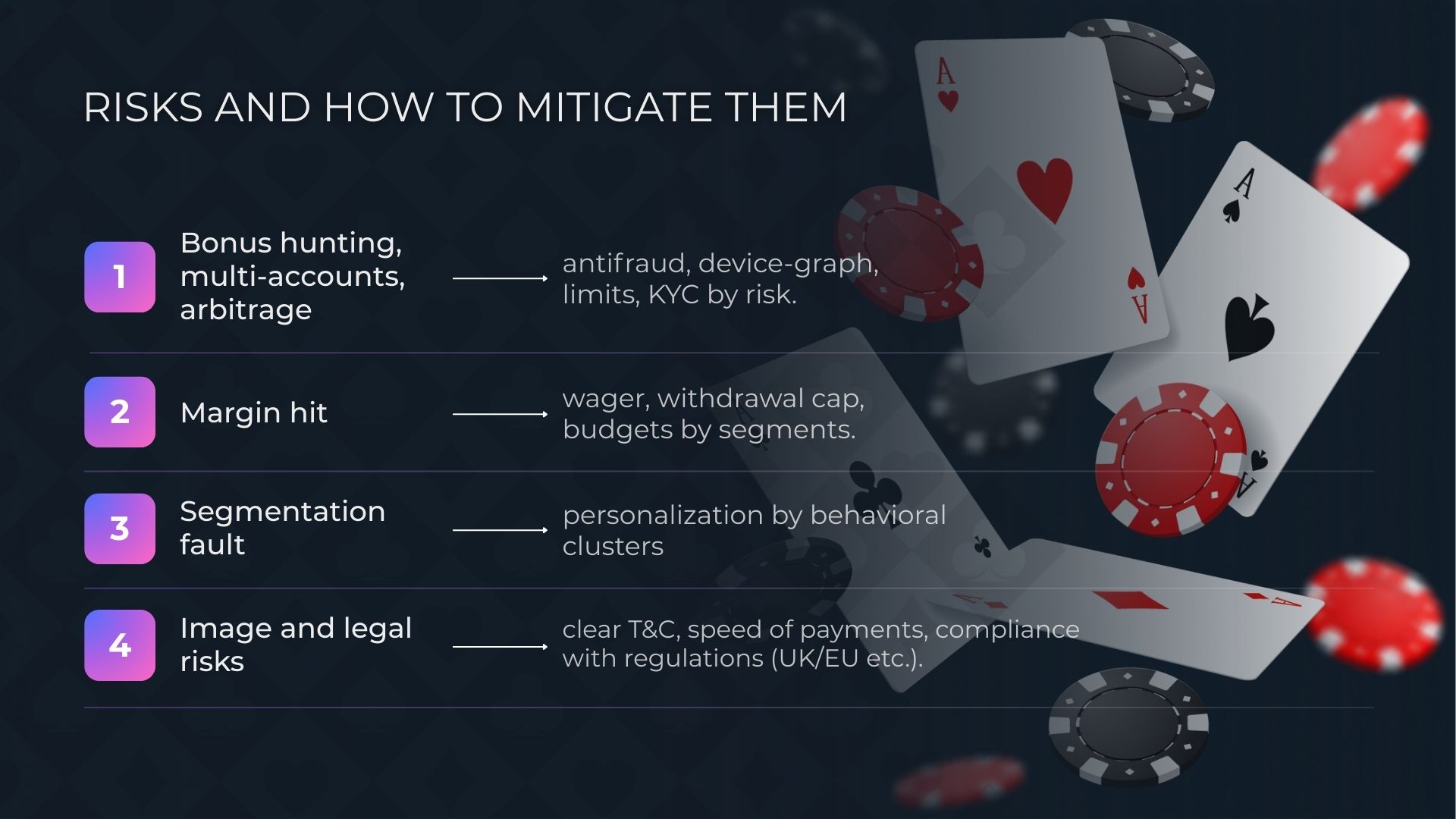
Abuse and Bonus Hunting: players may create multiple accounts or use betting arbitrage to profit from bonuses. Without anti-fraud systems, such users “drain” the marketing budget without delivering real value.
Financial Costs and Margin Reduction: generous bonuses require careful planning. Mistakes in configuration (e.g., low wagering or no withdrawal limits) can lead to significant losses. In a highly competitive environment, operators risk entering a “generosity race,” reducing profitability.
Audience Segmentation Errors: mass bonus distributions without considering player profiles lead to budget waste. VIP players require personalized approaches, while newcomers need simple incentives for their first deposit. Lack of segmentation reduces campaign effectiveness and increases abuse risks.
Reputational Risks: unclear bonus terms or payout delays inevitably damage reputation. Negative reviews and low aggregator ratings may deter new players, even if the bonus itself seems attractive.
Regulatory and Legal Restrictions: in regulated markets, bonus practices are strictly monitored. For example, the UK introduced strict rules for VIP programs and bonuses to protect vulnerable players. Violations may result in fines, site blocking, or license revocation.
Related topic: Risk Management in iGaming: Legal, Financial, and Operational Threats
Global Trends in Online Casino Bonuses
|
Trend |
Essence |
Business Impact |
|---|---|---|
|
Personalization and AI |
Using player data for tailored offers |
Higher conversion and retention, optimized marketing costs |
|
Mobile Bonuses |
Promotions via apps, push notifications, install bonuses |
Stronger presence among mobile users (80%+ of the market) |
|
Gamification |
Tournaments, leaderboards, achievements |
Boost engagement, build loyalty |
|
Crypto and Innovative Bonuses |
BTC/ETH bonuses, NFT rewards, VR/AR offers |
Attract crypto audiences, position as a high-tech brand |
|
Regional Differences |
Strict regulation in the EU, flexibility in Asia and LatAm, variability in the US |
Need to adapt strategies per jurisdiction, reduce risks |
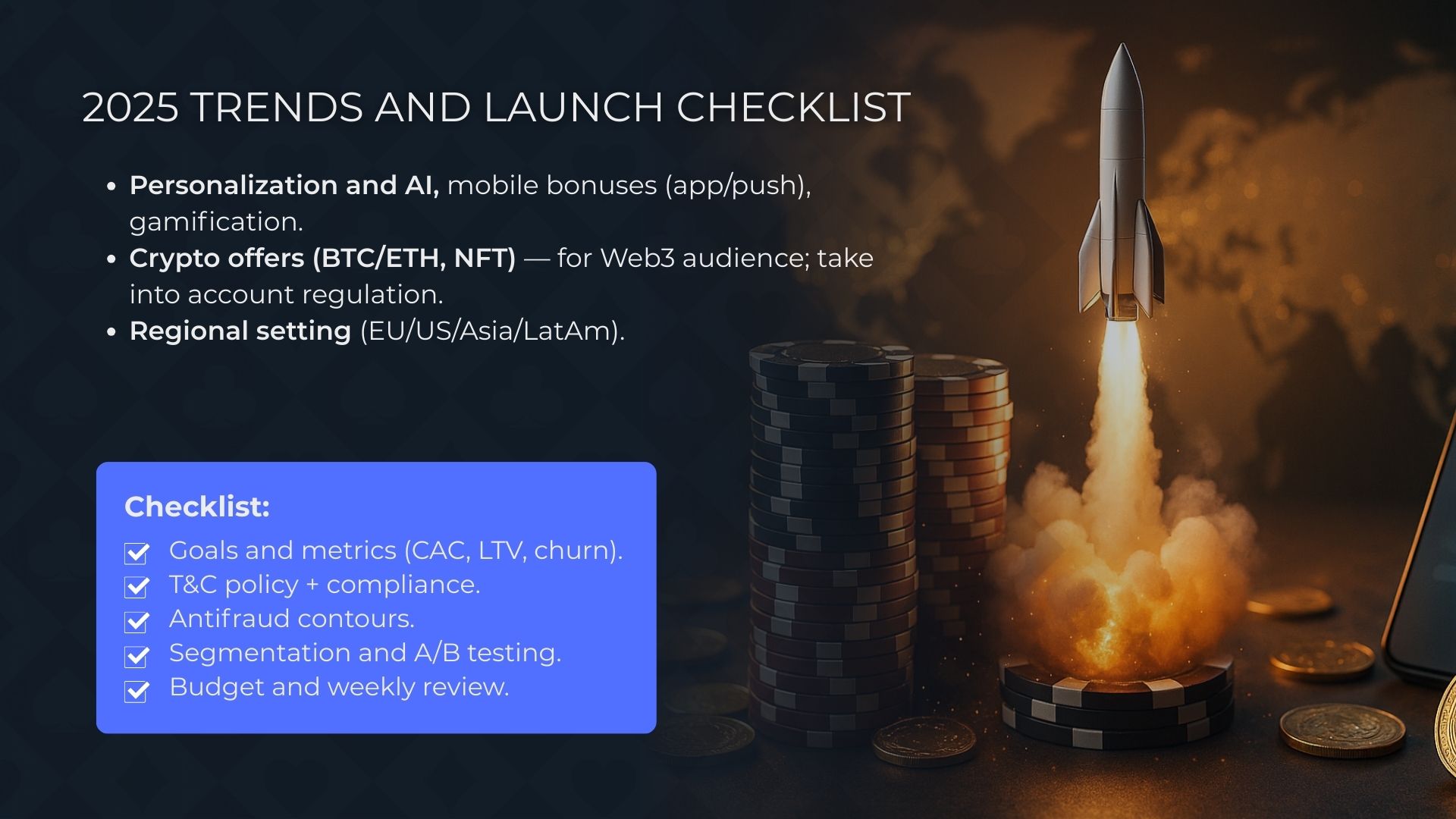
Key Takeaways
-
Bonuses are a growth tool, not an end in themselves. They help attract players and increase LTV but must be embedded in a long-term business strategy.
-
Regulation is a critical factor. In the EU and US, bonuses are heavily restricted, and mistakes can cost millions. In unregulated regions, risks shift toward reputation.
-
Personalization outperforms mass offers. The more a bonus fits a player’s profile, the more effective it becomes.
-
Technology reshapes the rules. AI, cryptocurrencies, and gamification are becoming the standard rather than an innovation.
Practical Recommendations for Businesses
-
Build an anti-fraud system. Without protection against bonus hunting, operators lose up to 20–30% of their budget.
-
Segment your audience. From beginners to VIPs — each segment should receive relevant bonuses.
-
Test and optimize. Use A/B testing and analytics to select the most profitable strategies.
-
Invest in AI and personalization. This reduces costs and improves marketing ROI.
-
Monitor regulatory changes. Compliance is becoming a competitive advantage in mature markets.
-
Diversify your bonus portfolio. Don’t rely on a single type of promotion — combine deposit bonuses, free spins, cashback, and loyalty programs.
Thus, a well-structured bonus strategy can become a driver of exponential casino growth but requires careful configuration and risk management. Entrepreneurs should view bonuses not as “expenses” but as investments in retention and business sustainability. Partnering with a reliable igaming software provider or choosing a flexible online casino platform is essential to implement bonus systems effectively. Modern casino software providers offer turnkey solutions that integrate bonus mechanics directly into the online casino software infrastructure, helping operators maximize both compliance and profitability.