



Who are the people who play in online casinos? What influences their behavior, motivation, and loyalty level?
In the iGaming industry, operators strive not just to attract traffic but to work with precise behavioral models of players — studying their motivation, habits, and factors influencing engagement.
This analytics-driven approach allows companies to craft personalized offers, optimize communication, and build long-term relationships with users. Businesses that systematically analyze their audience increase lifetime value and retention without additional marketing costs.
In this article, we’ll take a closer look at who makes up the core online casino audience in 2025, how this profile has evolved over recent years, what the key player segments are, and how this data can be used to create effective marketing strategies.
Why Understanding the Casino Audience Matters
For an online casino operator, audience data is a strategic management tool. Behavioral analysis helps shape product policies, bonus systems, and communication strategies based on real data rather than assumptions.
Modern players expect a personalized experience, and their choices depend on numerous factors: interface design, win frequency, payout speed, trust in the brand, and even the emotional tone of their interaction with the platform. When an operator understands which values drive specific player segments, they can create highly relevant offers.
Deep audience insights help to:
-
accurately forecast demand and behavioral patterns;
-
develop personalized retention scenarios;
-
optimize advertising budgets and acquisition channels;
-
improve user experience through precise UX and gamification adjustments.
In the competitive iGaming landscape, such data becomes a genuine advantage that directly impacts profitability and business sustainability.
Player Segmentation in Online Casinos: Audience Structure and Key Types
The online casino audience is far from homogeneous. Player behavior, motivation, and engagement levels vary depending on goals, financial capacity, and risk tolerance.
Modern operators apply a multilayered analytical approach that enables the creation of predictable behavior models based on real data.
|
Criterion |
Description |
|---|---|
|
Demographic Parameters |
Age, gender, geography, and income level |
|
Psychographics |
Motivation, attitude toward risk, content and gameplay preferences |
|
Behavioral Data |
Visit frequency, average deposit, response to promotions and bonuses |
|
Player Lifecycle (LTV) |
Activity level, engagement periods, and churn reasons |
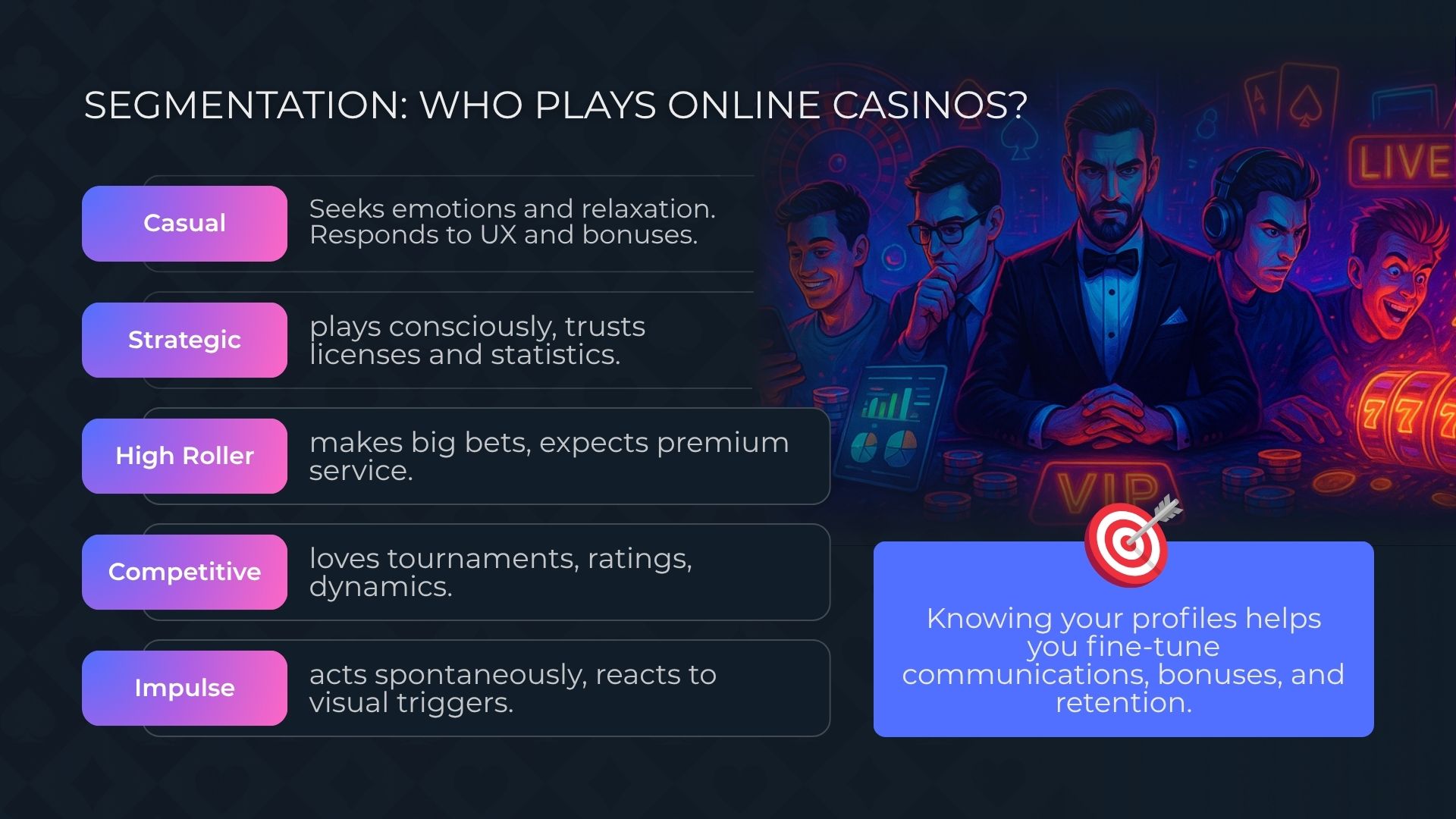
Key Player Profiles
-
Casual Player
The largest audience segment. Their goal is entertainment and emotion, not consistent wins. These users are sensitive to UX and bonuses but rarely become high-risk spenders.
Marketing focus: visual simplicity, easy onboarding, social campaigns, free spins.
-
Strategic Player
Plays regularly, analyzes RTP, volatility, and win probability. Prefers licensed brands and values transparency.
Focus: expert content, honest statistics, financial guarantees.
-
High Roller
Places large bets and expects a personalized approach and premium service.
Focus: VIP programs, fast payouts, dedicated account managers, exclusive bonuses.
-
Competitive Player
Engaged in tournaments and live formats. Their motivation stems from competition and dynamic gameplay.
Focus: gamification, leaderboards, tournaments, progressive jackpots.
-
Impulse Player
Driven by visual and emotional triggers. Often spontaneous and prone to short-term activity.
Focus: push notifications, dynamic bonuses, visual triggers.
Systematic analysis of these profiles enables operators to forecast conversion, identify optimal communication channels, and develop long-term retention strategies.
How to Use Player Behavior Data in Online Casino Marketing and Strategy
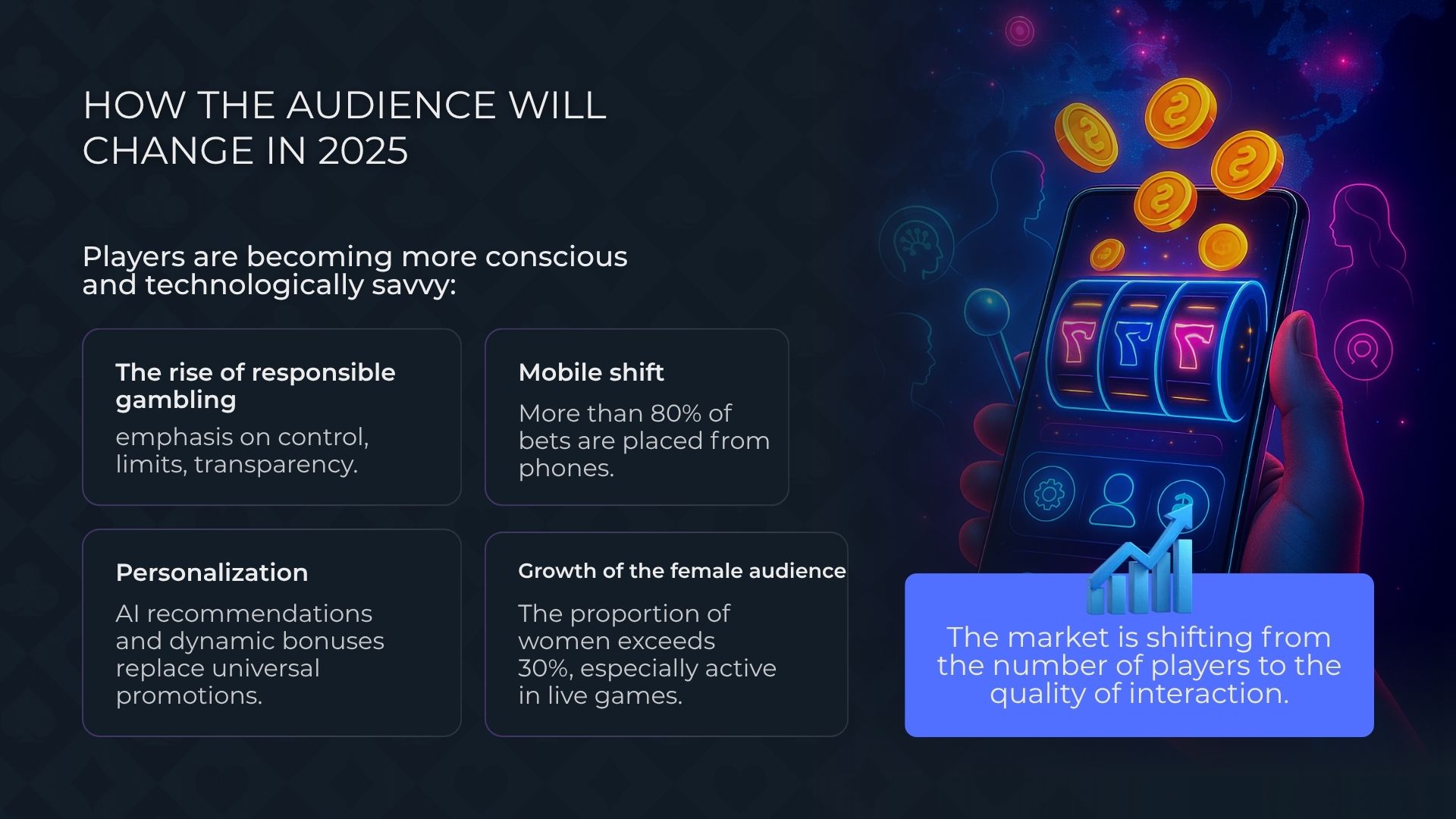
Player behavior data forms the foundation for strategic and marketing decisions that influence conversion, retention, and overall profitability.
Marketing Personalization
Players expect a tailored approach where every offer feels relevant and timely. Segmentation enables the use of dynamic bonuses, adaptive banners, personalized emails, and push notifications based on previous user activity. This increases engagement and builds sustainable loyalty without over-reliance on advertising.
Behavioral Analytics and Automation
Modern CRM systems integrate with game engines to collect real-time data — from average deposits to promotional responsiveness.
These systems allow operators to:
- identify early signs of user inactivity and trigger reactivation flows;
- offer personalized bonuses or cashback for specific profiles;
- automate retention funnels without manual intervention.
Product Analytics and UX Optimization
Behavioral patterns help identify weak spots in the interface and user journey. For example, if high-deposit users frequently abandon the cashier page, this signals potential UX or trust issues with payment methods. Data-driven improvements directly influence UI design, load speed, mobile optimization, and deposit conversion.
Prediction and Retention
Using big data and machine learning, operators develop churn prediction models that forecast potential player drop-off and enable proactive retention. This reduces acquisition costs and stabilizes LTV — a critical factor in mature, competitive markets.
How the Online Casino Audience Is Changing in 2025
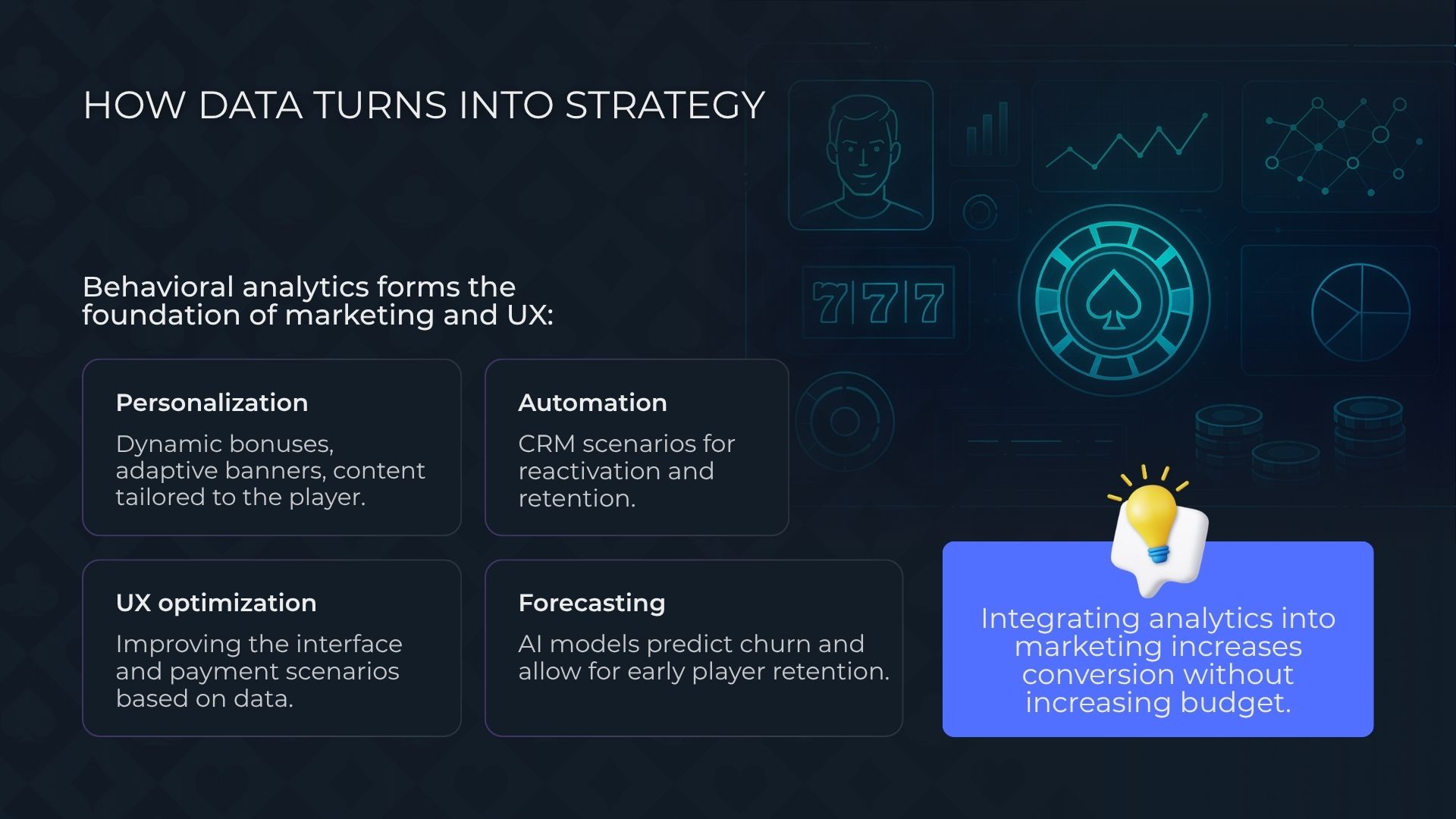
The iGaming market is undergoing a transformation driven not by audience growth, but by shifts in player behavior and expectations. In 2025, the online casino audience is becoming more mature, informed, and demanding — requiring operators to deliver higher levels of transparency, technology, and personalization.
1. The Rise of Conscious Gambling
Players increasingly view gambling as a form of digital entertainment rather than a source of income. The growing popularity of responsible gambling and the introduction of self-control tools (limits, reminders, session pauses) are creating a new culture of interaction between platforms and users.
2. The Shift Toward Mobile Experience
In 2025, mobile devices account for over 80% of bets. Generation Z and younger millennials prioritize speed, simplicity, and instant access.
3. Personalization and Adaptive Content
Recommendation algorithms are becoming a market standard. Platforms analyze gaming history and deliver content that matches individual preferences. The industry is moving from universal bonuses to dynamic, data-driven reward systems tailored to each player’s style.
4. Growth of the Female Audience
While men once dominated the player base, by 2025 women account for more than 30% of the audience. Female players demonstrate stable activity and higher engagement in live and social gaming formats.
Conclusion
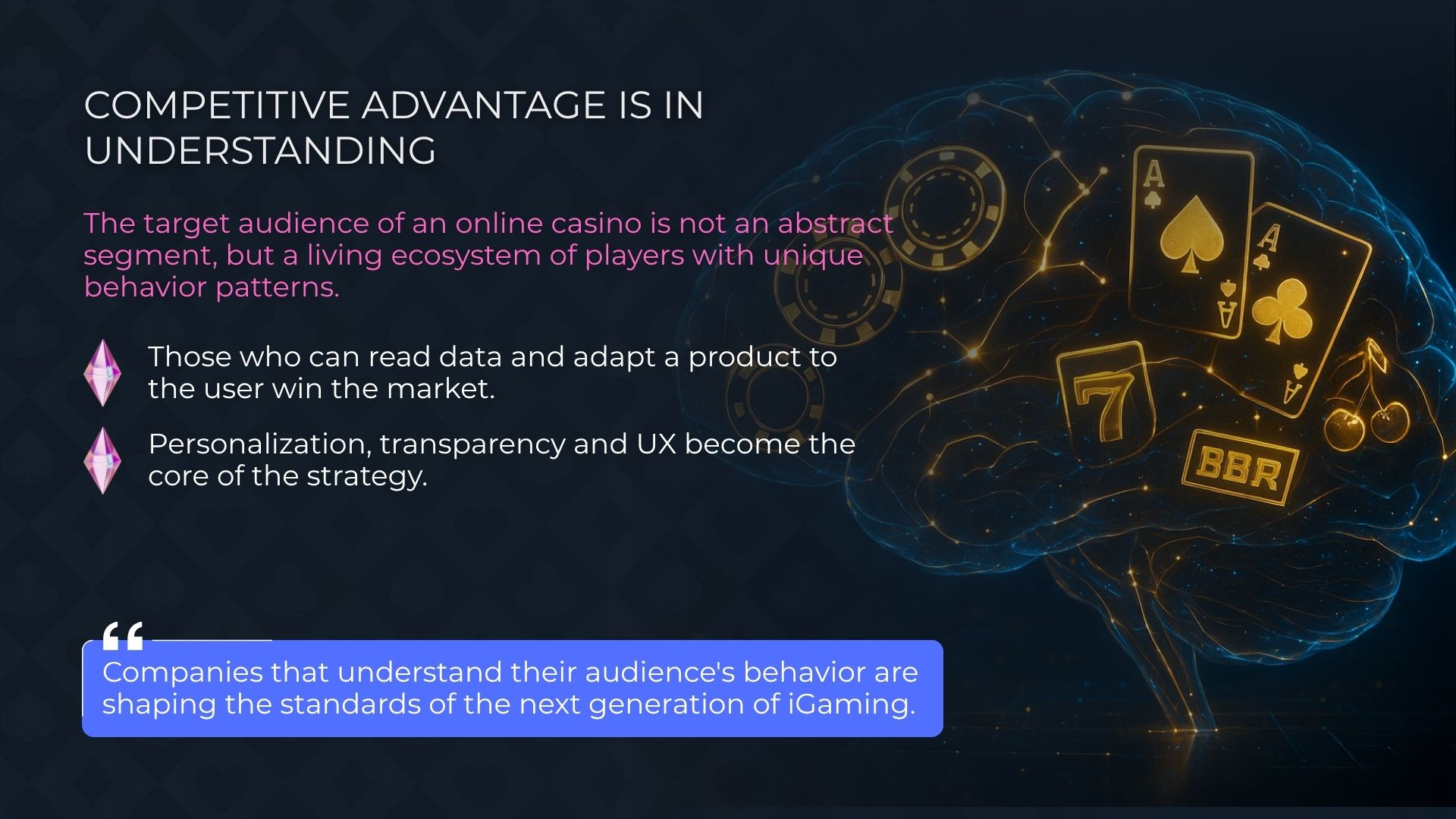
The online casino audience in 2025 is not an abstract group of players but a dynamic ecosystem of users with diverse motivations, values, and digital habits.
Understanding the online casino audience is the foundation of strategic management. Companies that can interpret data, adapt their products, and build individualized interaction scenarios gain a sustainable competitive edge and set the standards for the next generation of iGaming.