


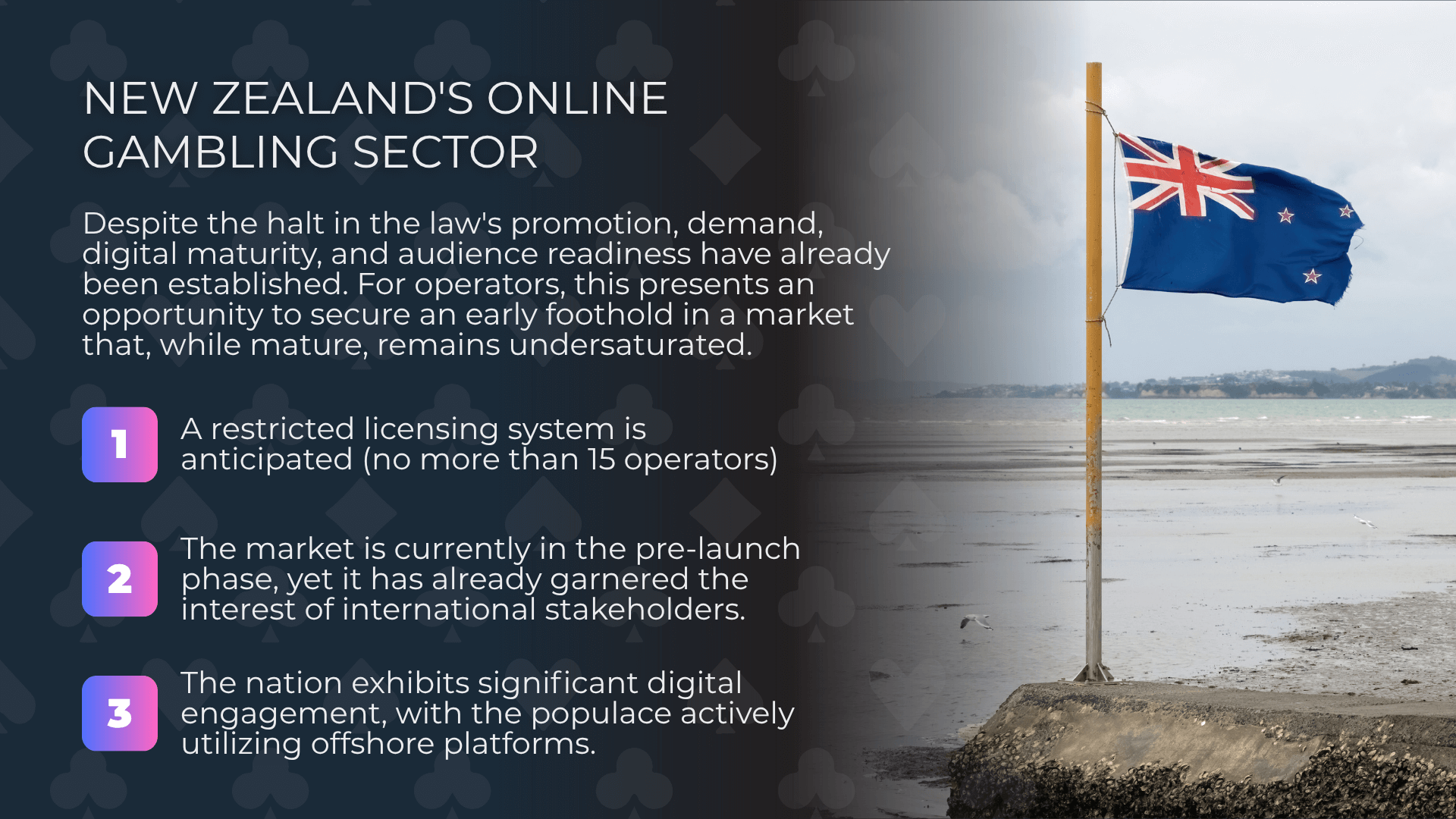
New Zealand’s Online Gambling Reform: Strategic Opportunity or Regulatory Challenge?
The online gambling market in New Zealand is entering a critical phase of transformation, opening opportunities for experienced casino platforms and gambling software providers. For the first time, the government has initiated a full-scale reform aimed at licensing online casino operators and redirecting offshore gambling revenue into a regulated legal framework. The Online Casino Gambling Bill, introduced in June 2025 and already passed in its first parliamentary reading, is a strategic move to increase market transparency, enhance consumer protection, and establish a sustainable tax base.
Currently, over 80% of New Zealand’s online gambling is conducted on offshore casino platforms—unlicensed, untaxed, and outside the oversight of online casino software regulations. This not only results in lost fiscal revenue but also presents serious social risks, from problem gambling to money laundering. The new bill aims to change this by introducing a controlled, license-based system with a limited number of operators and a clear path to market entry.
New Zealand’s Delayed Entry Into the Global iGaming Regulatory Shift
Unlike neighboring Australia or EU jurisdictions, New Zealand has long focused on offline gambling and state-run sports betting via TAB NZ. No licensing structure for online casinos existed, and the digital market has effectively gone unchecked.
According to government data, over 80% of online gambling by Kiwis occurs on offshore sites—beyond the reach of tax, regulation, or player protections. The Department of Internal Affairs (DIA) estimates up to NZD 370 million in lost tax revenue in 2023 alone due to this regulatory vacuum.
The social costs have also grown. With increased participation—especially among younger and vulnerable demographics—problem gambling cases are rising. But with offshore platforms operating beyond jurisdictional control, the government lacks tools for intervention, site blocking, or enforcement.
This reform is not merely legislative housekeeping. It’s a systemic response to mounting economic, regulatory, and social pressure. In a world of borderless services, New Zealand is betting on a limited-access, high-compliance licensing model with long-term sustainability in focus.

Inside the Bill: Licenses, Taxation, and Compliance Standards
The Online Casino Gambling Bill lays out a tightly structured framework for regulating online gambling—far from the open-license models seen in some European countries. New Zealand proposes a limited-access system focused on high standards and social responsibility.
Key Provisions:
License Cap
Up to 15 licenses will be issued, each tied to a named operator and non-transferable. No entity may hold more than 3 licenses—an anti-monopoly safeguard.
Three-Stage Application Process
-
Expression of Interest (EOI) – A brief dossier and strategic outline.
-
Invitation to Apply – Selected candidates receive full criteria and application requirements.
-
Final Licensing – Evaluation based on financial strength, operational history, responsible gambling strategy, localization plans, and technical infrastructure.
Tax & Financial Burden
-
12% GGR (Gross Gaming Revenue) tax
-
1.24% levy to fund harm-reduction programs
-
Additional GST
-
Ongoing audit and administrative fees
This makes the framework costlier than offshore options—but also legally sound and investor-friendly.
Mandatory Compliance Measures
-
Full KYC and AML implementation
-
Player protection tools (self-exclusion, deposit/loss limits)
-
Age and residency verification
-
Ban on gambling on credit
-
Strict ad regulations (no misleading or aggressive promotions)
-
Independent audits, including algorithmic transparency
Execution Timeline
Operators must launch operations within 90 days of license approval or risk revocation. The model is built for mature, well-resourced players able to move quickly.
Together, these provisions reflect New Zealand’s intent to build a responsible, high-integrity market—with real barriers to entry but strong positioning for compliant operators.

Market Potential: Is It Worth Entering?
Despite the strict framework and unresolved questions, the initiative is drawing strong interest from global operators. Why?
Established Demand
New Zealanders already gamble online—heavily.
DIA data shows over 50% of users access offshore platforms. The market is estimated at NZD 600–700 million GGR annually. Demand exists; licensed operators won’t need to build it from scratch—they need to redirect it.
Low Initial Competition
If the 15-license limit holds, early entrants using turnkey casino solutions or white label online casino setups will face limited competition on a digitally mature but previously underregulated market. Delayed license cycles may further protect first movers for several years.
Strategic Entry Point to the Asia-Pacific
For EU operators, New Zealand offers a regulated, English-speaking hub where gambling software providers and online casino software developers can deploy advanced casino platforms and expand into the Asia-Pacific region.
Regulatory Prestige
A license in one of the world’s most transparent jurisdictions is not just operational—it’s reputational. It’s a credibility asset for marketing, investor relations, and cross-jurisdictional expansion.
In short: high entry thresholds come with high strategic value. For committed operators, this could be one of the most attractive English-speaking iGaming markets to enter over the next 3–5 years.

What’s Next: Timeline, Uncertainty, and Strategic Watchpoints
As of July 2025, the bill’s future remains uncertain. Although it passed the first reading, the New Zealand government has suspended further movement on it until at least late 2025, citing political pressure and the need for revisions.
Current Status:
-
The bill has not been withdrawn but is temporarily on hold.
-
The Internal Affairs Committee completed public consultations and submitted preliminary findings.
-
The government is reviewing the licensing framework, potential license reallocations, and localization requirements.
What Operators Should Do Now:
-
Monitor legal updates via DIA and Parliament.
-
Audit internal platforms for technical and compliance readiness (AML/KYC, responsible gambling).
-
Build local partnerships – alliances with NZ media, fintech, and service providers will likely be advantageous under localization rules.
-
Plan for entry in 2026–2027, with early preparation offering a first-mover advantage.
A Market in Waiting — But Not to Be Ignored
New Zealand’s move to regulate online casinos is not just another update in global iGaming. It’s a rare example of a mature economy launching a market from scratch—where demand already exists, but legal infrastructure is being built.
The proposed system is clear in intention: limited licensing, strong player protection, and control over offshore activity. But it also faces valid concerns—from operators, legal experts, and international observers—over its restrictiveness, vague criteria, and potential conflicts with trade agreements.
Still, New Zealand is more than a market-in-waiting. It may become a model for future English-speaking jurisdictions aiming to balance strict oversight with economic viability. For seasoned operators, this is a chance to enter early, build reputation, and secure regional footing beyond the EU.
If your company has a long-term strategy in regulated, English-speaking markets, New Zealand should already be on your radar—despite the delays and uncertainty.