


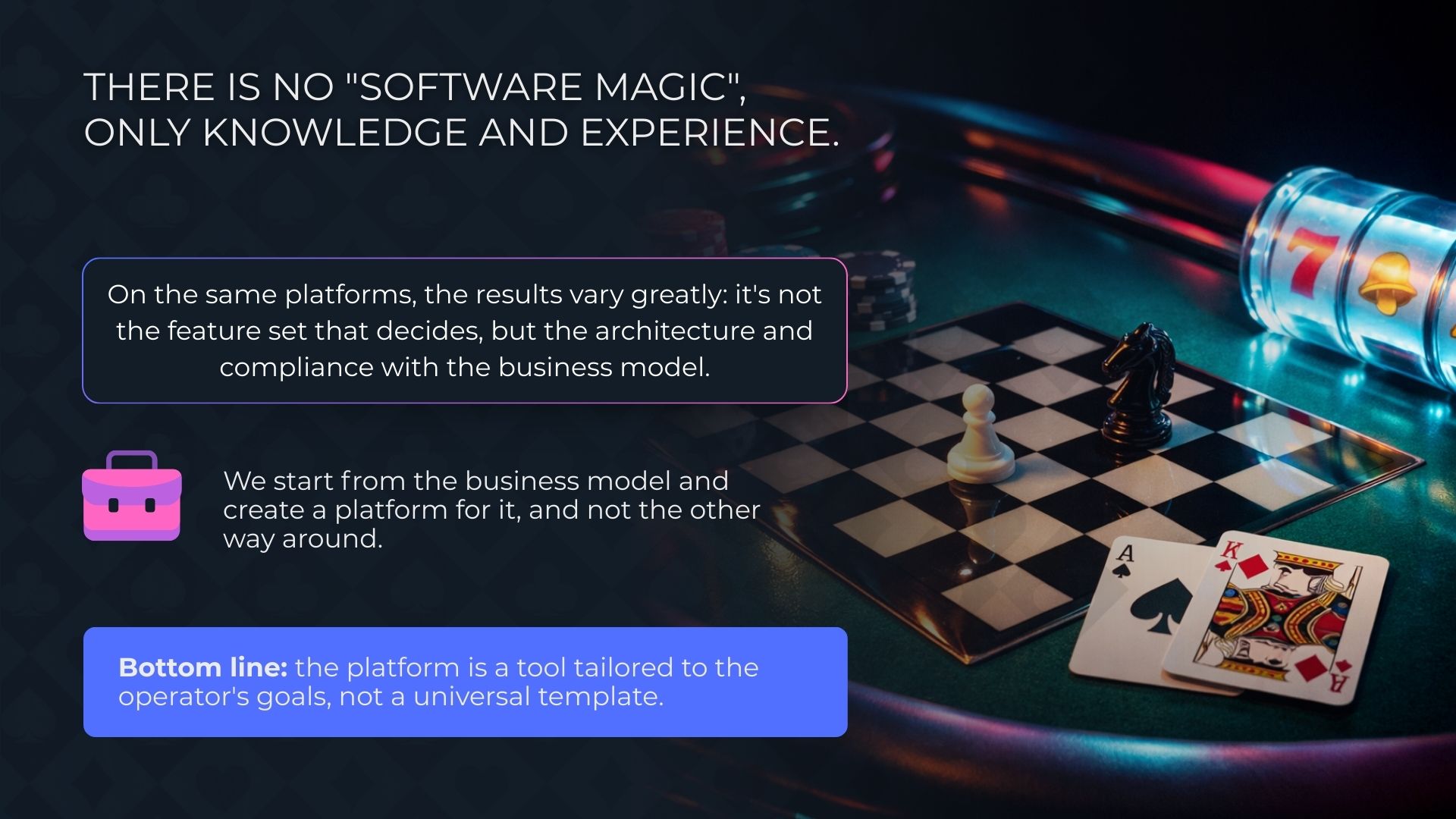
 Online casinos are increasingly being launched on ready-made platforms with comparable functionality and sets of integrations. At the same time, the results of such projects differ significantly even within the same market. Practice shows that the decisive factor is not the gambling software itself, but the architecture of the solutions and their alignment with the operator’s business model.
Over the years of developing and launching iGaming projects, we have identified a set of stable principles. They manifest regardless of geography, traffic sources, or the chosen license. It is these principles that distinguish projects that develop steadily from those that stall at the launch stage or within the first months of operation.
In this article, we have systematized these approaches and demonstrated which architectural and product decisions form the foundation of our products. This is not about specific features or marketing advantages, but about practical patterns that shape a sustainable Gambling business in the long term.
Principle 1. An Online Casino Starts with the Business Model
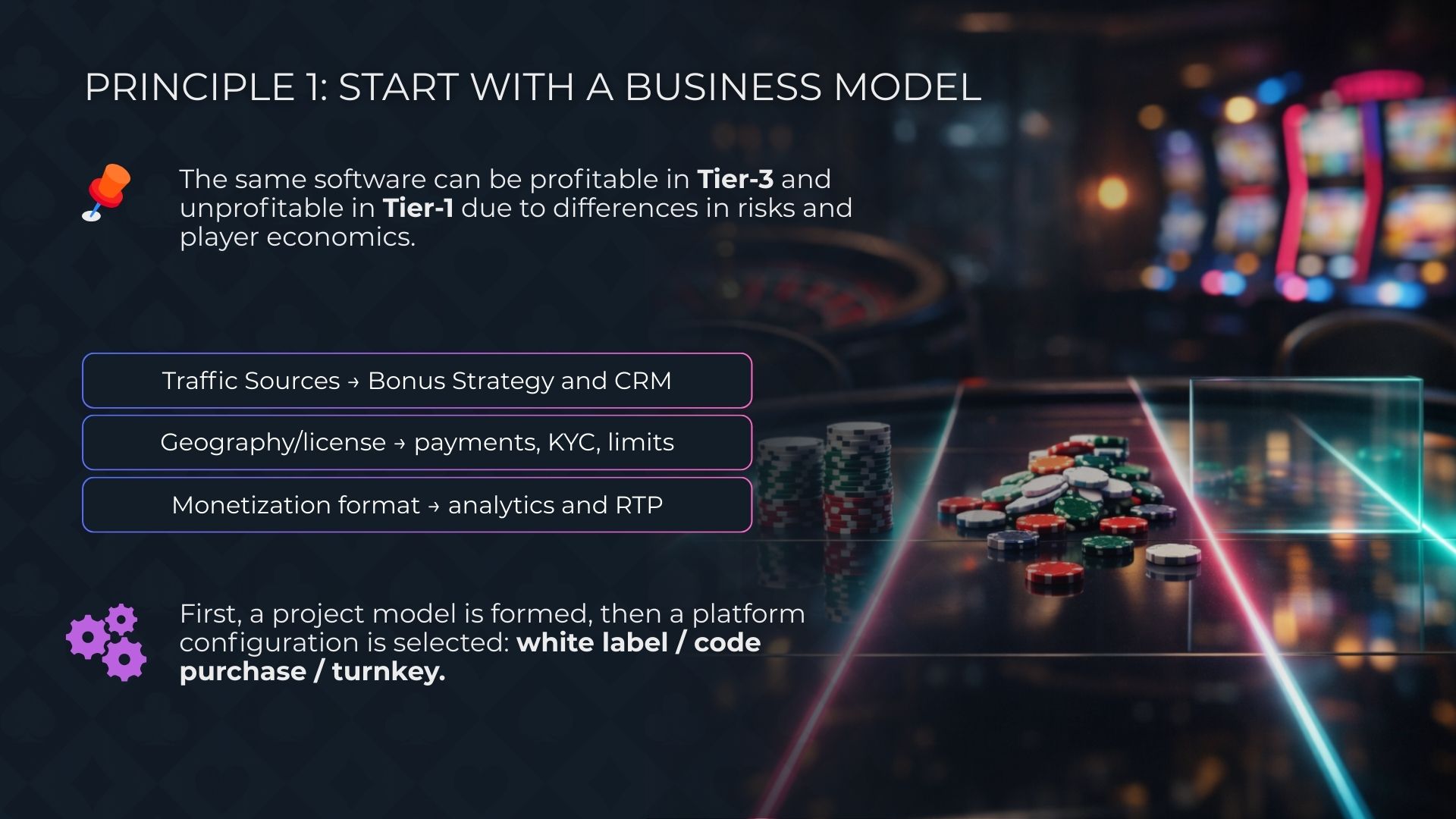
Many problems of iGaming projects arise even before launch — at the moment of choosing a casino platform without a clear understanding of the future business model. The same online casino software can be effective in Tier-3 markets and unprofitable in Tier-1 markets, even with an identical set of games and payment methods. The reason lies in different requirements for product logic, risk management, and player economics.
The business model directly determines the architecture of the casino script. Traffic sources influence the bonus strategy and CRM requirements. Geography and licensing affect the payment infrastructure, KYC, and limits. The monetization format impacts the depth of analytics and RTP management.
We embed this principle into our work with every client: first, the project model is defined, and only then is the platform configuration selected to match it. This is reflected in a modular structure, the ability to choose a cooperation format (white label casino, source code purchase, or turnkey online casino), and the configuration of key business processes without modifying the system core. This approach makes it possible to launch projects with different strategies on a single technological base without sacrificing manageability and scalability.
As a result, the platform ceases to be a universal template and becomes a tool adapted to the operator’s specific goals — from rapid market entry to systematic growth and expansion into new regions.
Related article: How Player Behavior Data Shapes Business Strategy
Principle 2. Scalability Is Designed Before Launch
Another common problem faced by online casino operators is the inability to change initial architectural decisions without stopping the project. Attempts to “grow” the platform after launch usually lead to technical debt, instability, and rising operational costs.
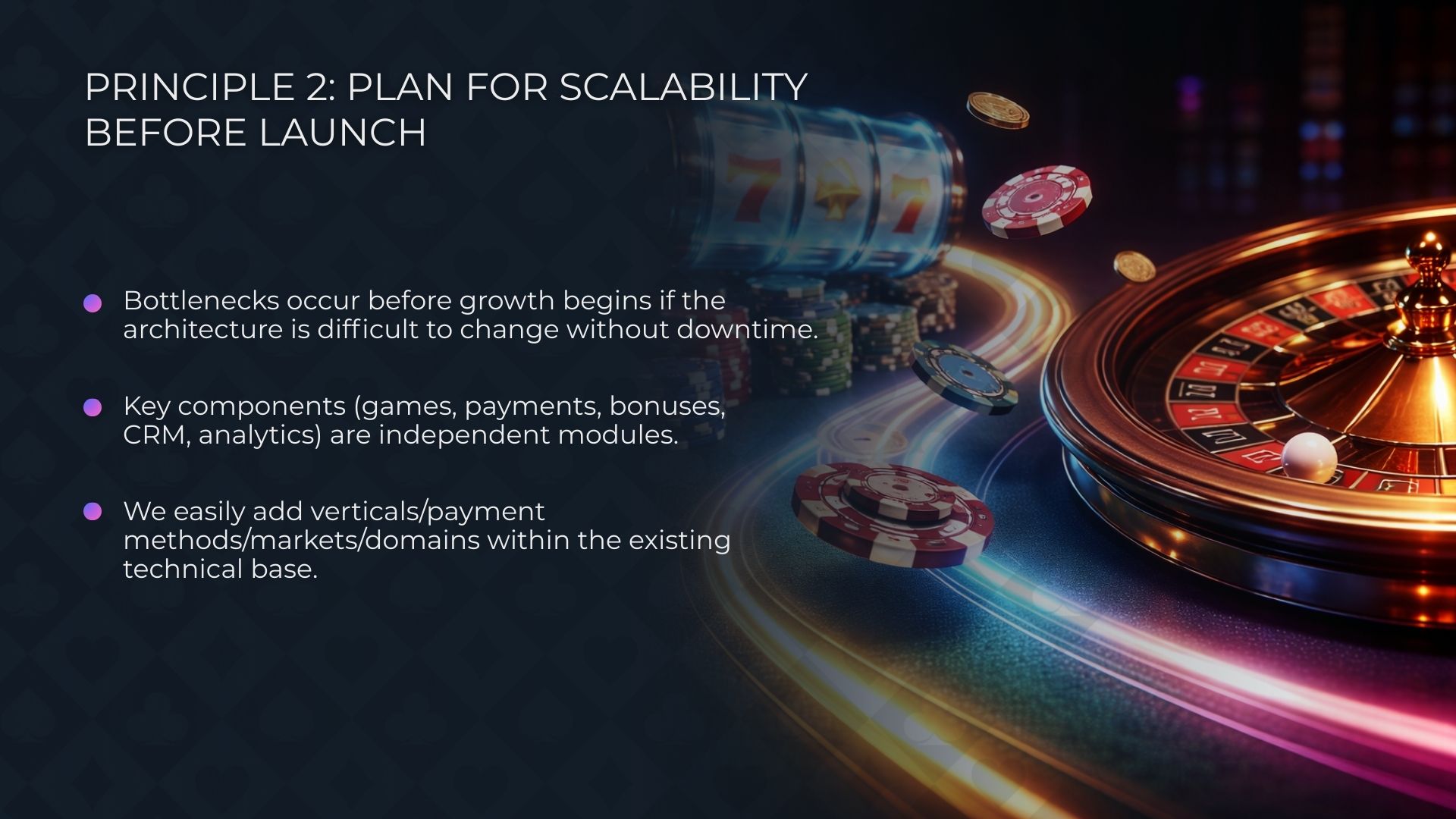
Scalability in iGaming is not only about handling load. It also refers to the ability to seamlessly add new gaming verticals, payment methods, markets, and domains without rewriting the entire system. If the online casino platform does not account for this from the outset, any expansion turns into a separate project with its own risks.
When designing casino software, we assume that the project will grow. Therefore, the core components of the platform — games, payments, bonus logic, CRM, and analytics — are developed as independent modules. This allows operators to launch with a minimal configuration and gradually expand functionality without downtime or migrations.
This approach provides the operator with strategic flexibility: testing new markets, adding sports betting or poker, deploying a multi-site structure, and scaling traffic within a single technological base. Growth ceases to be a source of risk and becomes a controlled process, supported by a reliable iGaming software provider.
Related article: Where to Launch a Casino in 2025: TOP GEOs with High Potential
Principle 3. Integrations as a Unified System, Not a Set of Connections
In iGaming projects, integrations are often perceived as an endlessly long list: game providers, payment methods, KYC services, anti-fraud tools, and so on. However, this approach quickly creates operational gaps. Disparate integrations complicate control over financial flows, increase the number of manual operations, and raise the risk of failures.
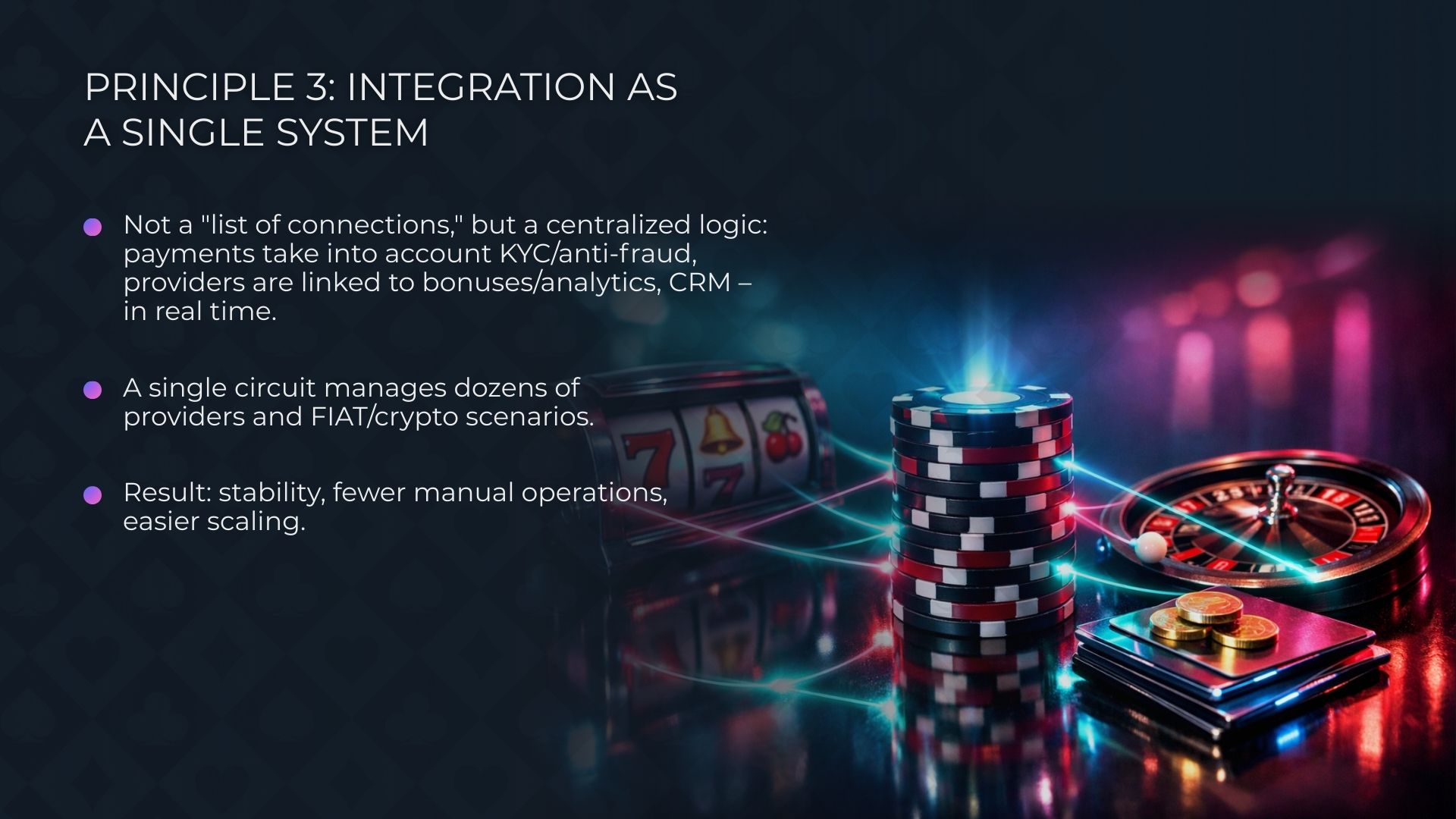
An effective casino platform is built around a unified interaction logic for all components. Payments must correctly account for KYC and anti-fraud requirements. Game providers should operate in conjunction with the bonus system and analytics. CRM must receive data in real time, not retrospectively.
In our platform, all external services are connected through a centralized architecture. This makes it possible to manage everything within a single control loop. The operator gains control over system logic rather than a collection of disconnected interfaces, which is a key advantage for any gambling software provider.
As a result, operational stability increases, scalability becomes simpler, and dependence on individual casino software providers is reduced. The integration architecture becomes a foundation for growth rather than a source of constant compromises.
Related article: Top 10 Casino Software Providers in 2025
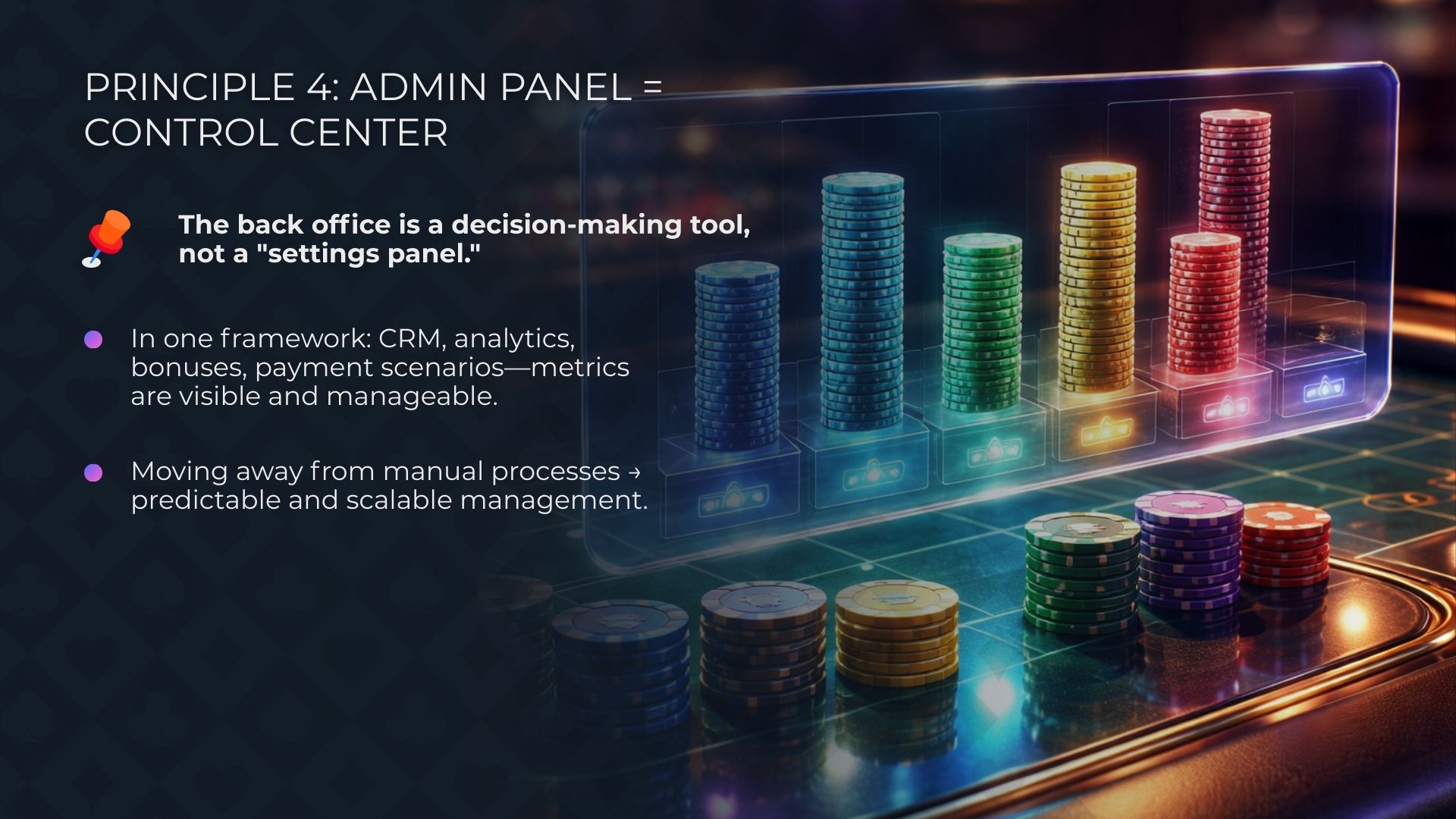
Principle 4. The Admin Panel as a Business Control Center
In most online casinos, the admin panel is perceived as a supporting tool — a place for basic settings and reports. This approach limits project manageability. As traffic and the number of players grow, the lack of centralized control quickly turns into an operational risk.
An effective back office must reflect the real economics of the project. This means access to financial indicators, player behavior, bonus effectiveness, and traffic sources in a format suitable for decision-making. Without this, marketing, risk management, and VIP operations are built on assumptions rather than data.
When designing the platform, we assume that the admin panel is a management tool, not merely an interface for technical staff. CRM, analytics, bonus management, and payment scenarios are combined within a single environment. This enables the operator to control key metrics, quickly adjust strategy, and reduce dependence on manual processes within an online casino platform.
As a result, casino management becomes predictable and scalable. Decisions are data-driven, and the casino software supports business growth instead of constraining it.
Related article: Which Metrics Are Important for an Online Casino?
Principle 5. Marketing Logic Must Be Part of the Platform
In iGaming, marketing often exists separately from the technical platform. Bonuses, tournaments, and promotions are launched as fragmented mechanics that are difficult to control and even harder to analyze. In such a model, promotional effectiveness directly depends on manual configurations and the experience of individual specialists.
In practice, a marketing strategy requires technological support. Different traffic sources impose different requirements on bonus logic, wagering conditions, and player segmentation. Without a flexible bonus engine and integration with CRM, online casino software limits growth opportunities and complicates campaign scaling.
We view marketing as an embedded layer of the platform. Bonus mechanics, tournaments, jackpots, and VIP programs are designed from the outset with analytics and rule management in mind. This allows promo scenarios to be adapted to specific markets and acquisition channels without modifying the system core, which is especially important for white label casino and turnkey casino projects.
As a result, the operator receives not a set of marketing tools, but a managed system where every promotion is measurable, repeatable, and scalable. This reduces the cost of experimentation and increases the predictability of marketing decisions.
Related article: Bonuses in Online Casinos — The Main Tool for Player Acquisition and Retention
Principle 6. Compliance and Security Are Built into the Product
Any iGaming project operates within strict regulatory requirements and risks related to payment systems, licensing, and data security. If compliance and fraud prevention are treated as external add-ons, the platform becomes vulnerable and limits the operator’s capabilities.
In our practice, the approach is the opposite: KYC, AML, anti-fraud, and license compliance are integrated into the architecture from the very beginning. The platform is capable of correctly processing payments across different jurisdictions, complying with limits and regulatory requirements, and maintaining transparent transaction audits. This reduces operational risks and eliminates the need for additional modifications when expanding into new markets.
As a result, security and compliance cease to be external controls and become part of the managed business logic. The operator receives online casino software ready to operate in both regulated and unregulated markets without compromising risk management.
Related article: Online Casino Security in 2025: How Operators Protect Their Business and Players
Principle 7. Support and Maintenance as a Factor of Sustainable Growth
The success of an online casino is determined not only by the platform launch, but also by its stable operation. Even a technically advanced solution can lose effectiveness if timely support, monitoring, and updates are lacking.
We embed maintenance as an integral part of the product. This includes 24/7 monitoring, security and functionality updates without downtime, and readiness to adapt to changes in regulatory requirements. This approach reduces operational risks and allows the operator to focus on business development rather than resolving technical issues, which is critical for any iGaming software provider.
A platform with built-in support transforms from a set of modules into a managed business tool. It ensures stability, minimizes downtime, and allows the project to scale without compromising performance quality or user experience.
Related article: How to Choose Software for an Online Casino in 2025
Conclusion. Methodology Instead of a Platform
The experience of developing and launching numerous iGaming projects shows that a successful casino is built not on a set of features or a visually appealing interface, but on systemic solutions replicated from project to project. Platform architecture, integrations, analytics, marketing mechanisms, compliance, and support form a single managed process rather than fragmented elements.
Our platform is not just software, but codified experience in launching and scaling projects. It enables adaptation of the business model to a specific market, management of growth and risks, and the achievement of long-term stability and predictable results. This approach is particularly valuable for white label online casino and turnkey online casino solutions.
Such an approach turns technology into a tool that reduces uncertainty, saves resources, and makes each new launch more controllable. We design not just a platform, but a structure capable of transforming ideas into a sustainable online casino business.