


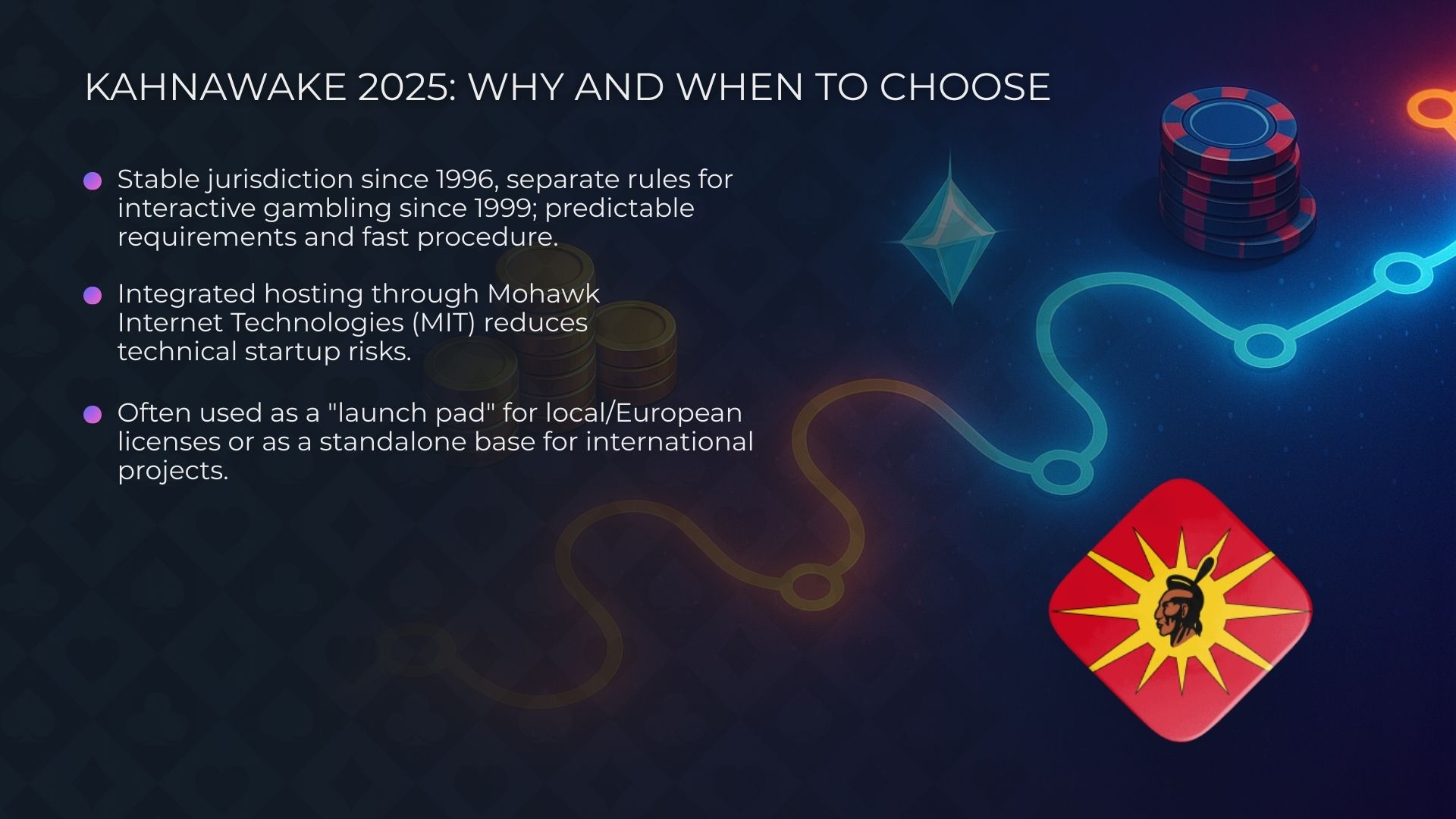
 The Kahnawake licence remains one of the most stable pillars for operators planning to enter the international online casino market. This jurisdiction is chosen for its combination of predictable regulatory requirements, strong reputation, and the speed at which an entrepreneur can complete the full licensing procedure. The Kahnawà:ke Gaming Commission has been operating since 1996 and has developed a transparent framework that allows operators to legally launch a casino, poker room, or betting platform without the bureaucratic delays typical of Europe.
For an investor, this means the opportunity to enter the industry under conditions where requirements are clearly defined in advance, and the operational infrastructure — including the use of the Mohawk Internet Technologies data center — is already integrated into the regulatory model. This is why Kahnawake is often viewed as a strategic launchpad before obtaining subsequent European or local licences, or as an independent jurisdiction for sustainable international projects.
What is the Kahnawake licence
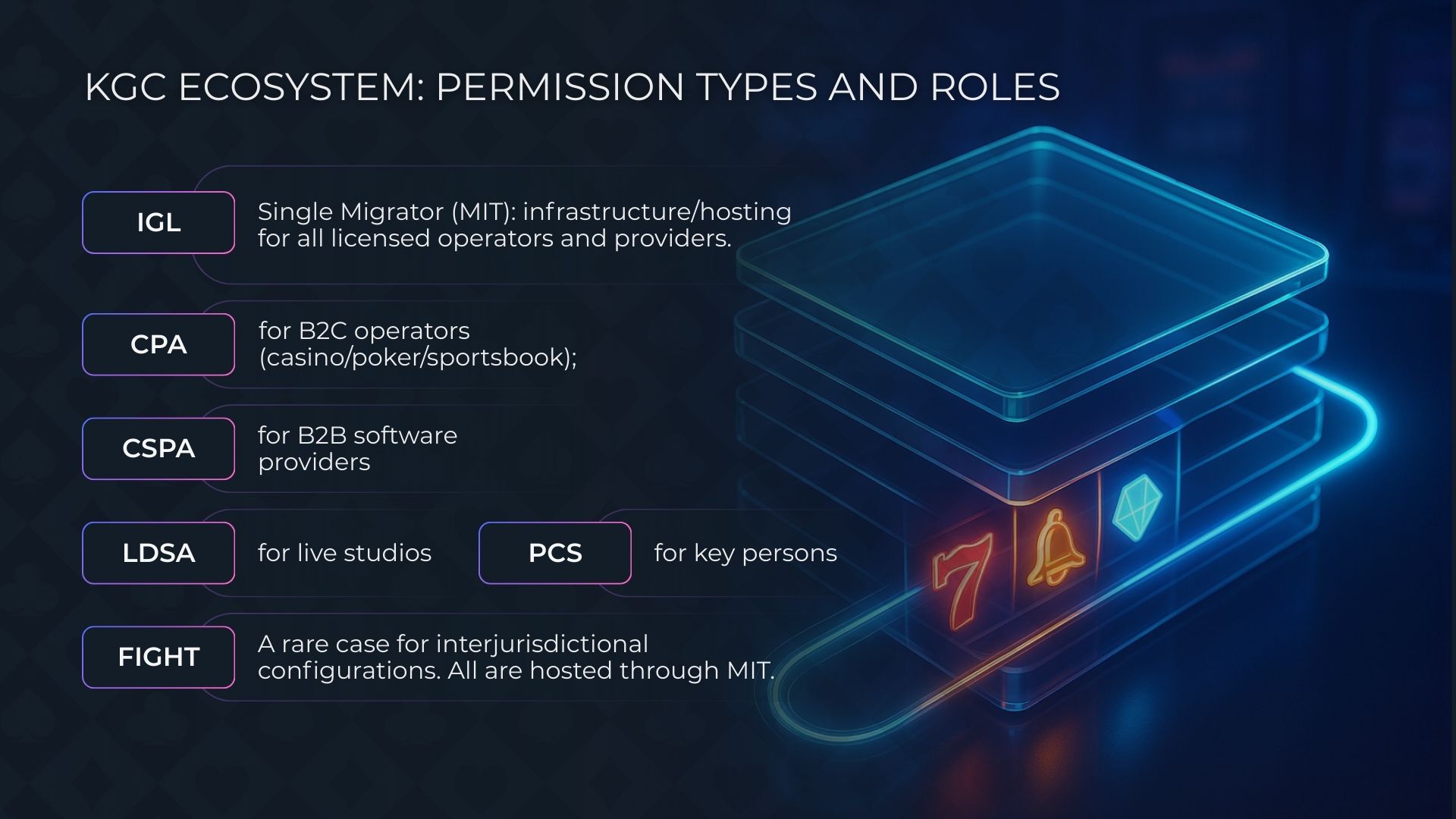
In brief: the Kahnawake licence is a set of authorizations issued by the Kahnawà:ke Gaming Commission (KGC) for the legal provision of interactive gambling services. The key document for operators is the Client Provider Authorization (CPA), while KGC also issues IGL, CSPA, LDSA, and the Key Person Licence.
KGC has been functioning since 1996, and its “Regulations concerning Interactive Gaming” have been in force since 1999; over this time, the Commission has developed a dedicated licensing model for interactive services. The most relevant authorization for operators is the Client Provider Authorization (CPA) — it grants the right to offer interactive games to players on the condition that servers are hosted within an approved facility (Mohawk Internet Technologies — MIT).
All licensed platforms are hosted through the single IGL holder — Mohawk Internet Technologies (MIT), which provides hosting management and infrastructure for operators.
KGC issues several types of authorizations, each covering a specific aspect of activity: IGL for hosting, CPA for operators, CSPA for gambling software providers, and KPL for key persons. This model offers flexibility when building B2C and B2B structures across the casino platform and igaming software ecosystem.
Types of Kahnawà:ke licences and their purpose
KGC offers several types of authorizations to cover different business models: from hosting and B2B services to full-scale casino, poker, sportsbook, and live gaming operations.
|
Type of licence |
Who it is for |
What it provides |
|---|---|---|
|
Interactive Gaming Licence (IGL) |
Hosting provider / data center |
The right to be the sole hosting provider: to host gaming platforms on servers and service CPA/CSPA/LDSA holders. It may be issued to only one holder, and since 1999 this status has been held by Mohawk Internet Technologies (MIT). |
|
Client Provider Authorization (CPA) |
B2C operators — casinos, poker, sportsbook, other interactive games |
The right to provide interactive gaming services (casino, poker, sportsbook, etc.) through MIT hosting. The applicant must comply with KYC, AML, technical, and financial standards set by the regulator. |
|
Casino Software Provider Authorization (CSPA) |
B2B: developers / providers of casino software / platforms |
The right to host and maintain software via the IGL/MIT infrastructure, as well as licence software to third-party operators. However, a CSPA holder is NOT allowed to offer games directly to end users. |
|
Live Dealer Studio Authorization (LDSA) |
Companies wishing to operate a live-dealer studio |
The right to launch live games (dealer tables, streaming) and operate as a live studio under KGC regulation. |
|
Key Person Licence / Permit (KPL / Key Person Permit) |
Individuals managing or responsible for operations (directors, compliance, operations management) within CPA / CSPA / LDSA companies |
At least one person in a company applying for CPA, CSPA, or LDSA must hold a Key Person Permit. This mechanism ensures personal accountability and transparent management. |
|
Inter-Jurisdictional Authorization (IJA) (rarely used) |
Operators licensed in another jurisdiction but seeking to use infrastructure or conduct part of their operations in Kahnawake |
Allows a company to place certain equipment or staff within MIT/on the territory of Kahnawake while its primary licence remains abroad. |
Obtain a Kahnawake gaming licence with the help of Gambling Soft
Costs and timelines: exact figures and real budgets
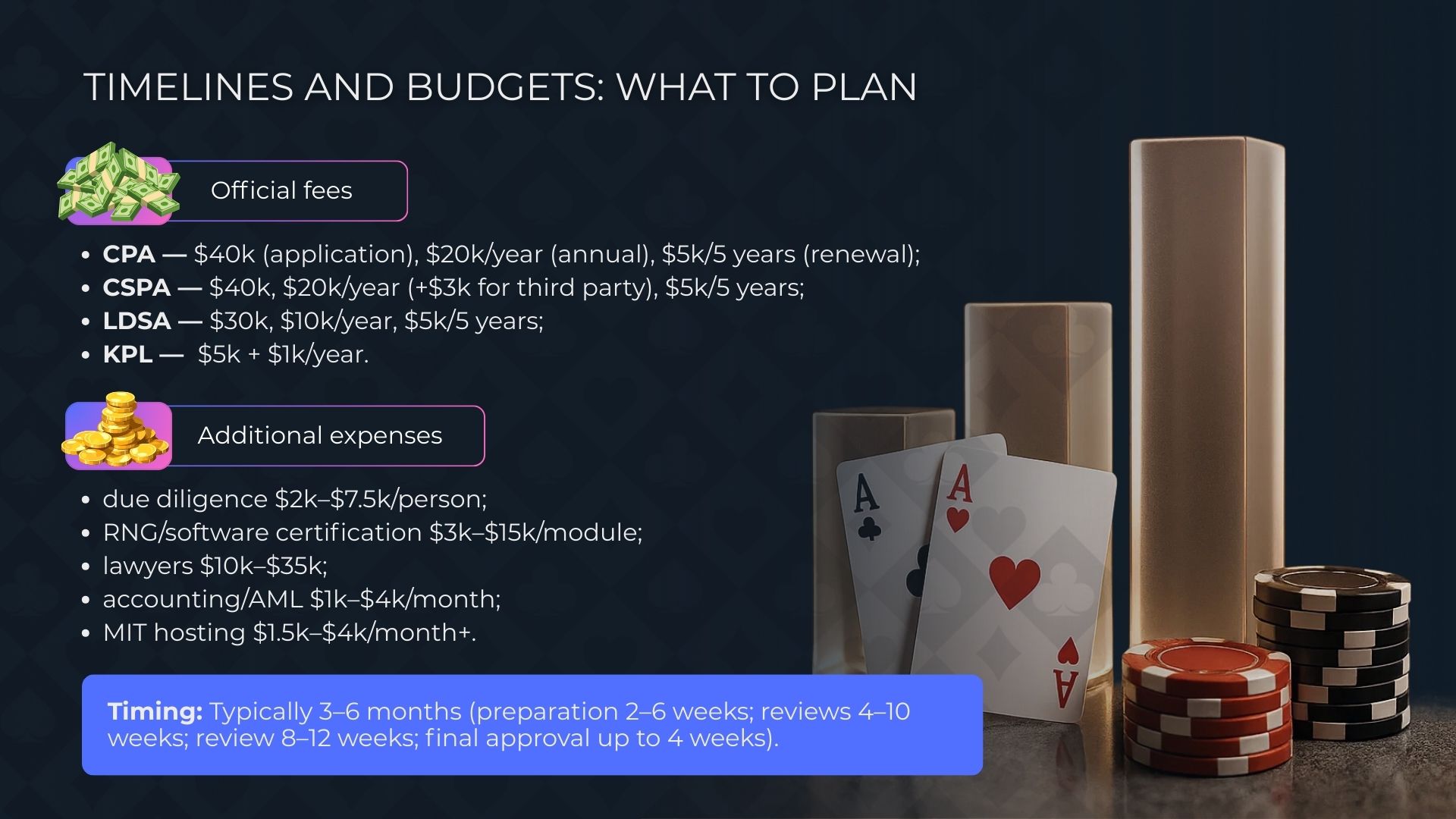
The financial structure of Kahnawake licences is transparent: the regulator publishes fixed fees for submission, annual maintenance, and renewals every five years. Below are figures from the official KGC PDF and an estimate of additional expenses relevant for any online casino platform or turnkey casino project.
1. Official KGC payments (Application-Related Costs)
These fees are mandatory and are paid directly to the regulator.
|
Licence |
Application fee |
Annual fee |
Renewal fee |
|---|---|---|---|
|
CPA |
$40,000 |
$20,000 |
$5,000 every 5 years |
|
CSPA |
$40,000 |
$20,000 (+ $3,000 per third party) |
$5,000 every 5 years |
|
LDSA |
$30,000 |
$10,000 |
$5,000 every 5 years |
|
Key Person Permit |
$5,000 |
$1,000 |
– |
2. Additional expenses (not KGC fees, but mandatory in practice)
These costs vary depending on the size of the company, service providers selected, and the structure of the project — whether it is a turnkey online casino, a white label casino, or a custom online casino platform built with igaming software providers.
Due diligence and background checks
Verification of directors, beneficiaries, and key persons:
-
$2,000–$7,500 per person, depending on the provider.
Software certification
-
RNG, RTP, technical system, and game module audits — through laboratories such as GLI or iTech Labs.
-
Average range: $3,000–$15,000 per module / RNG / platform, depending on the complexity of the online casino software.
Legal support
-
Document preparation, corporate structuring, financial models — $10,000–$35,000 for the licensing stage.
Accounting and AML/KYC compliance
-
$1,000–$4,000 per month depending on workload.
Hosting (MIT)
The cost varies according to configuration, but on average:
-
$1,500–$4,000 / month for a basic server package,
-
significantly higher for large-scale deployments.
3. Timelines
The official licensing timeframe is not defined by a specific fixed date, but the typical process includes:
|
Stage |
Actual duration |
|---|---|
|
Document preparation |
2–6 weeks |
|
Due diligence check |
4–10 weeks |
|
KGC application review |
8–12 weeks |
|
Final approval |
up to 4 weeks |
Total: from 3 to 6 months depending on structural complexity, source of funds, number of Key Persons, and completeness of documentation. For many operators working with an igaming software provider, timelines remain predictable and manageable.
Complete step-by-step process of obtaining the Kahnawà:ke licence
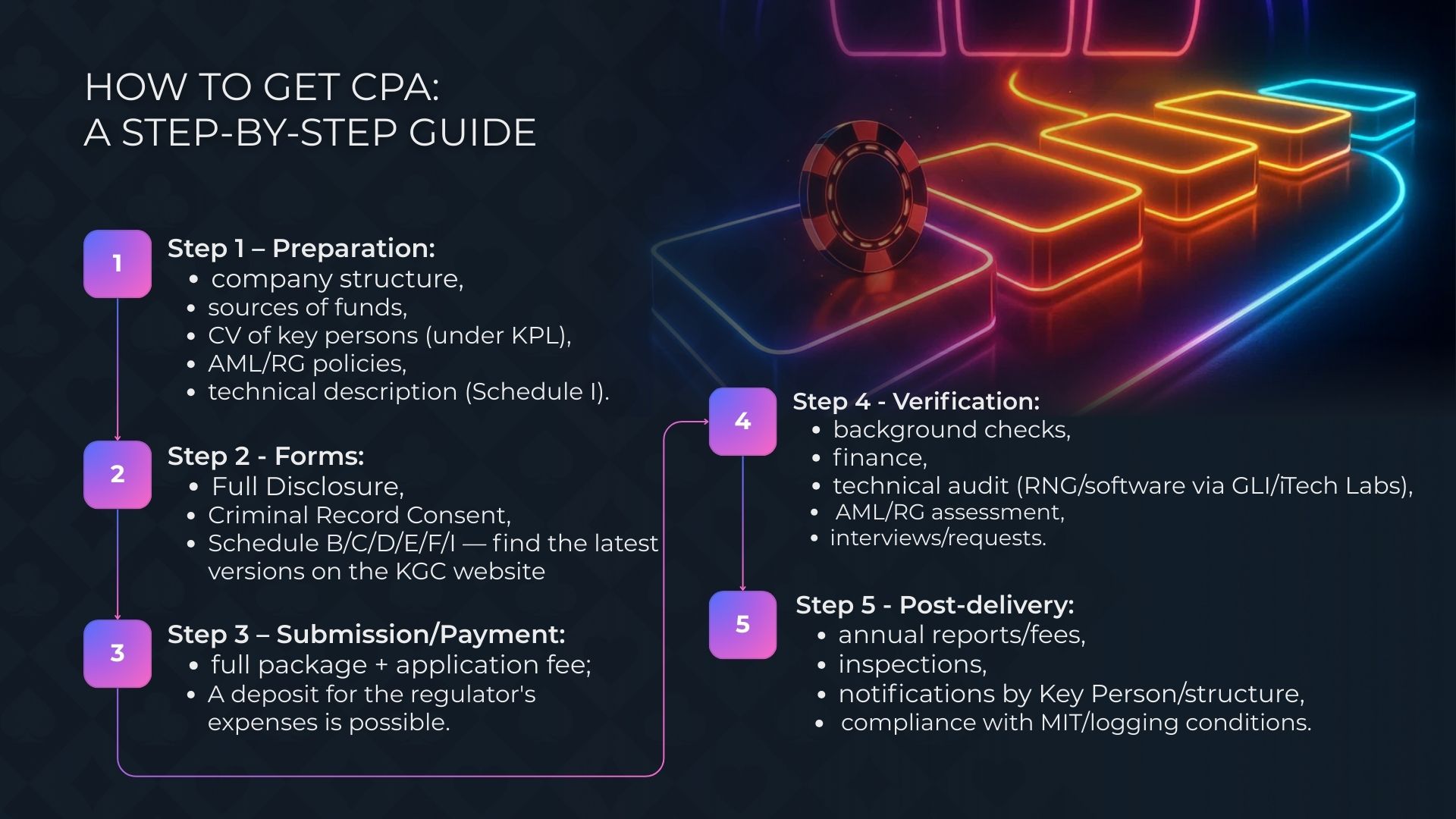
The process of obtaining a KGC authorization consists of five mandatory phases: preparation (legal and documentation), completion and submission of KGC forms with fee payments, verification (due diligence and software testing), possible issuance of a preliminary licence and final approval, followed by the post-issuance stage (annual maintenance and reporting). This structured approach is particularly valuable for operators launching an online casino platform, turnkey casino solution, or white label online casino built on certified online casino software.
Step 1 — Preparation (1–3 months)
What needs to be done:
-
Select the corporate structure and jurisdiction for company registration (typically an offshore jurisdiction or one with convenient banking support).
-
Prepare financial statements (if available) for usually 2–3 years; for a startup, provide audited/bank-verified source-of-funds confirmations and financial forecasts.
-
Create CVs/biographies for key personnel (management, compliance, CTO) — these are required for the Key Person Permit (KPL).
-
Develop and document the AML/KYC policy, the responsible gaming policy, and the complaints-handling procedure.
-
Prepare technical documentation: platform architecture, hosting details (MIT), and the control system description for Schedule I.
Strong preparation shortens review times and reduces the risk of the application being returned for revision.
Step 2 — Application forms (download from KGC)
Key forms (according to KGC structure; form names may change, so always download the latest versions from the KGC website):
-
Full Disclosure Assurance Form (confirmation of information disclosure).
-
Criminal Record Consent (consent for criminal background check).
-
Schedule B — Business Entity Information.
-
Schedule C — Personal Information (for Key Person).
-
Schedule D — Application for Client Provider Authorization (CPA).
-
Schedule E / F — Key Person Licence / Permit.
-
Schedule I — Control System Submission (technical system controls, hosting description, and oversight procedures).
Where to find them: the official KGC section “Permit Holders / Application Process and Forms.” Completed forms must be submitted together with supporting documents and payment.
Step 3 — Submission and payment
-
Assemble the full package (completed Schedule forms + attachments such as financial reports, policies, software certificates, etc.).
-
Submit the application according to the procedure described on the KGC “Application Process and Forms” page.
-
Pay the application fee applicable to your authorization type.
-
KGC may request a deposit to cover its review expenses, so ensure you have sufficient accessible funds. (Regulations mention deposit/return mechanisms and additional payments if actual review costs exceed the deposit.)
Step 4 — Review process (due diligence, software testing, interviews)
Key review components:
-
Background checks for all Key Persons and beneficiaries.
-
Financial review: sources of funds, solvency, absence of outstanding liabilities.
-
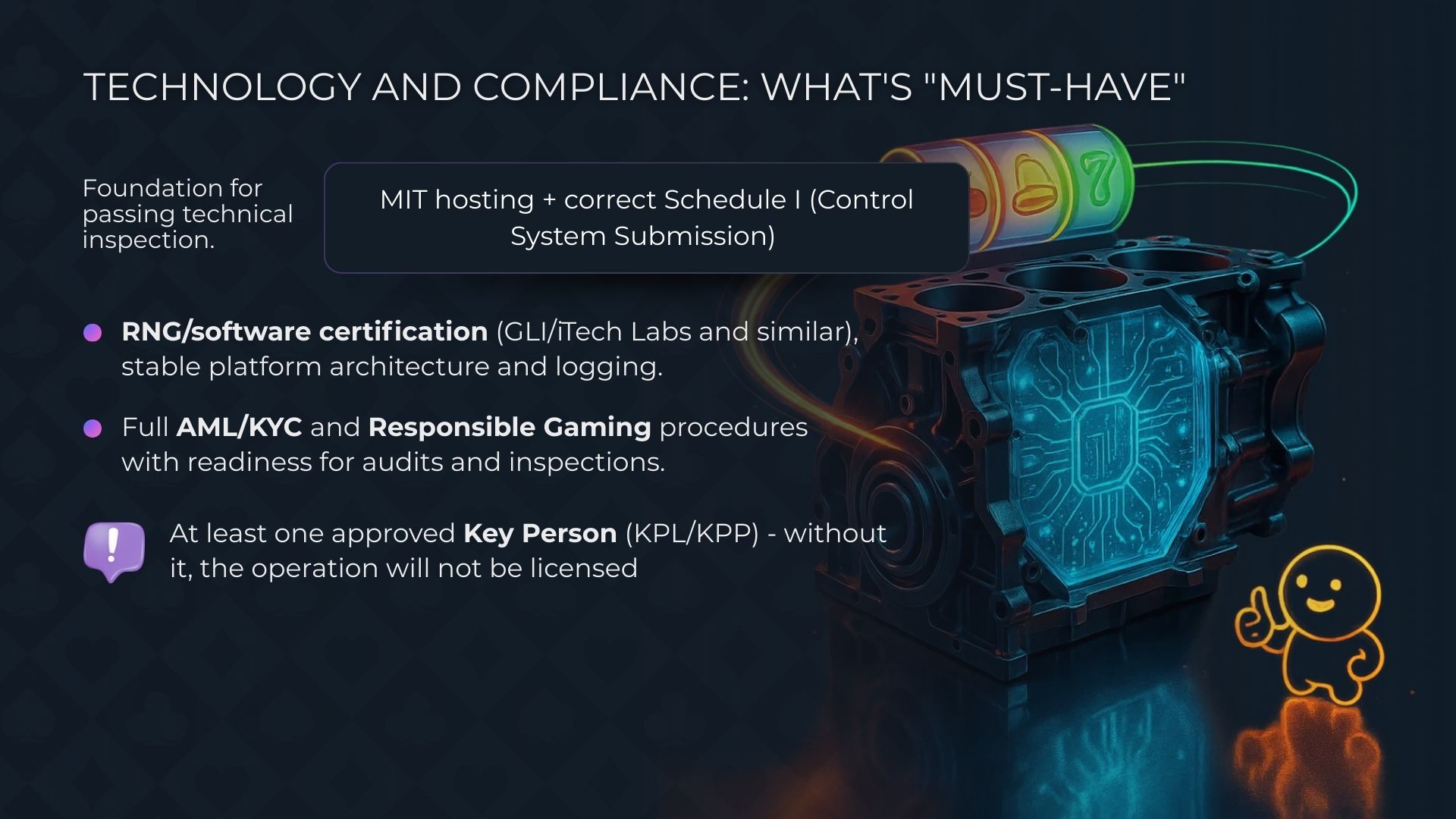
Technical assessment: control system review (Schedule I), RNG testing/software certification (via GLI/iTechLabs or equivalent).
-
Assessment of AML/KYC/Responsible Gaming compliance.
-
Interviews/requests for additional information — KGC may request clarifications and suspend processing until responses are received.
Upon successful due diligence, the KGC may issue a preliminary/initial authorization (temporary) with ongoing supervision, or a full authorization directly. Processing times vary significantly depending on the completeness of the submission; when properly prepared, it typically takes 4–12 weeks.
Step 5 — Post-issuance and ongoing compliance
Requirements after receiving authorization:
-
Submission of annual reports, payment of annual fees, and renewal according to the established schedule.
-
Ongoing AML compliance monitoring, technical audits, and potential inspections by the KGC.
-
Updates regarding Key Persons: any management changes require notification and/or a new KPL application.
-
Compliance with all conditions stated in the authorization (including MIT hosting requirements and logging). Non-compliance may lead to fines, suspension, or revocation of the license.
Why choose Kahnawà:ke: advantages and limitations
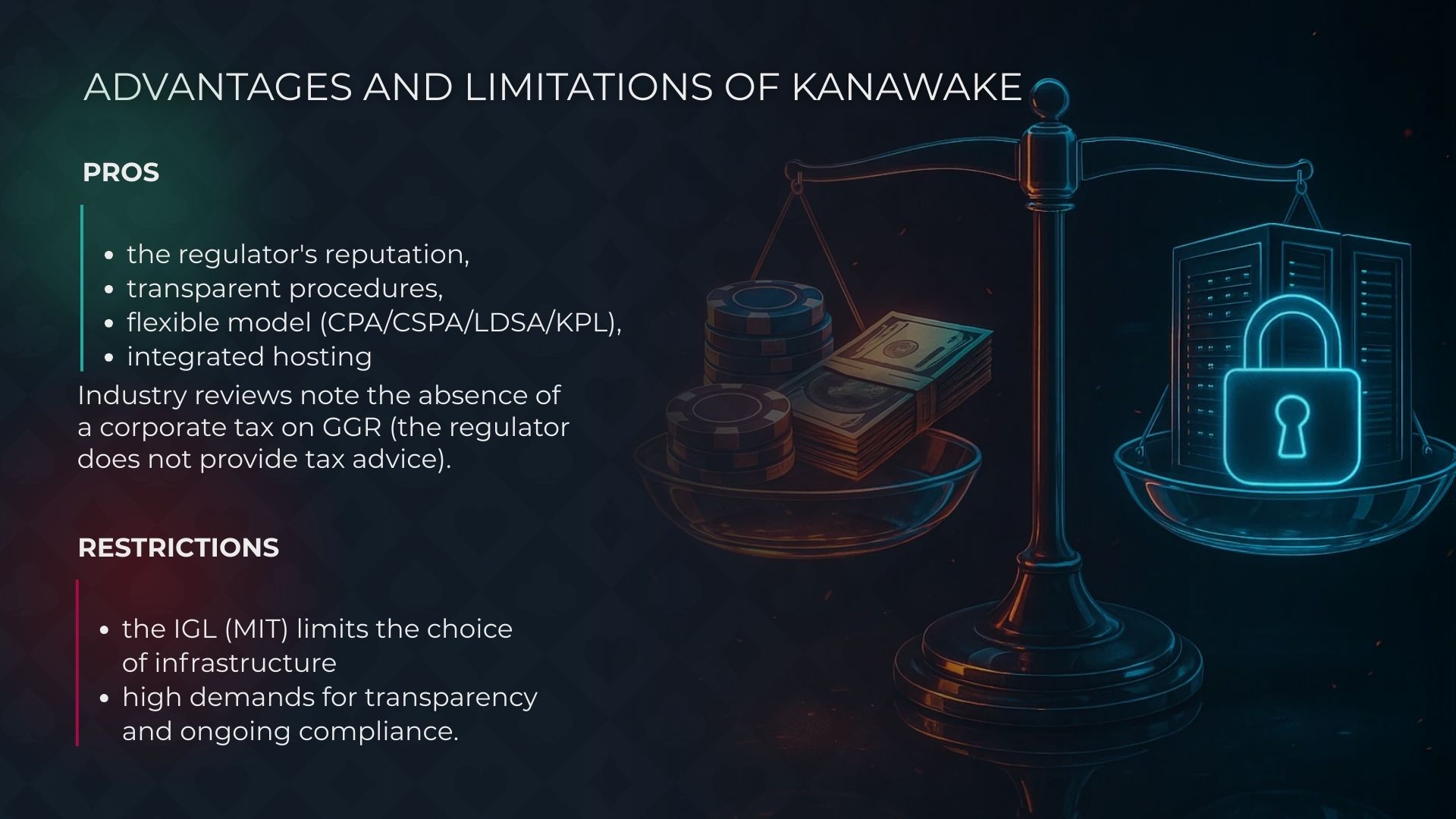
The Kahnawake Gaming Commission is suitable for operators and providers that value transparent procedures, strict AML/KYC requirements, and the ability to use the proven MIT infrastructure. B2C operators gain the ability to legally offer games, while B2B providers can license and host software through a single IGL.
Key advantages
Tax environment
Industry analytical reports consistently highlight the absence of a corporate tax on GGR for companies operating under a Kahnawà:ke license. Formally, the regulator does not provide tax advice; however, within the professional community, this factor is considered a significant competitive advantage for operators and providers.
Regulator reputation
The KGC places strong emphasis on integrity requirements, AML procedures, control over internal processes, and player protection. This is reflected in the official regulations and the Commission’s operational guidelines. In practice, this provides operators with a more stable legal framework and increases audience trust.
Flexible licensing model
The jurisdiction covers several classes: CPA (B2C), CSPA (B2B), LDSA (live studios), and KPL (Key Persons). This allows launching a variety of business models: online casinos, platforms, live content, or SaaS solutions.
Limitations and risks
Infrastructure monopoly
Only one holder of the Interactive Gaming Licence (IGL) operates in Kahnawà:ke. This fixed structure limits hosting options: all licensed companies must be hosted through a single provider.
High transparency requirements
The regulator expects full readiness for audits, ongoing AML compliance, and accurate reporting. Serious violations may result in suspension or revocation of the license.
Who the Kahnawà:ke license is suitable for
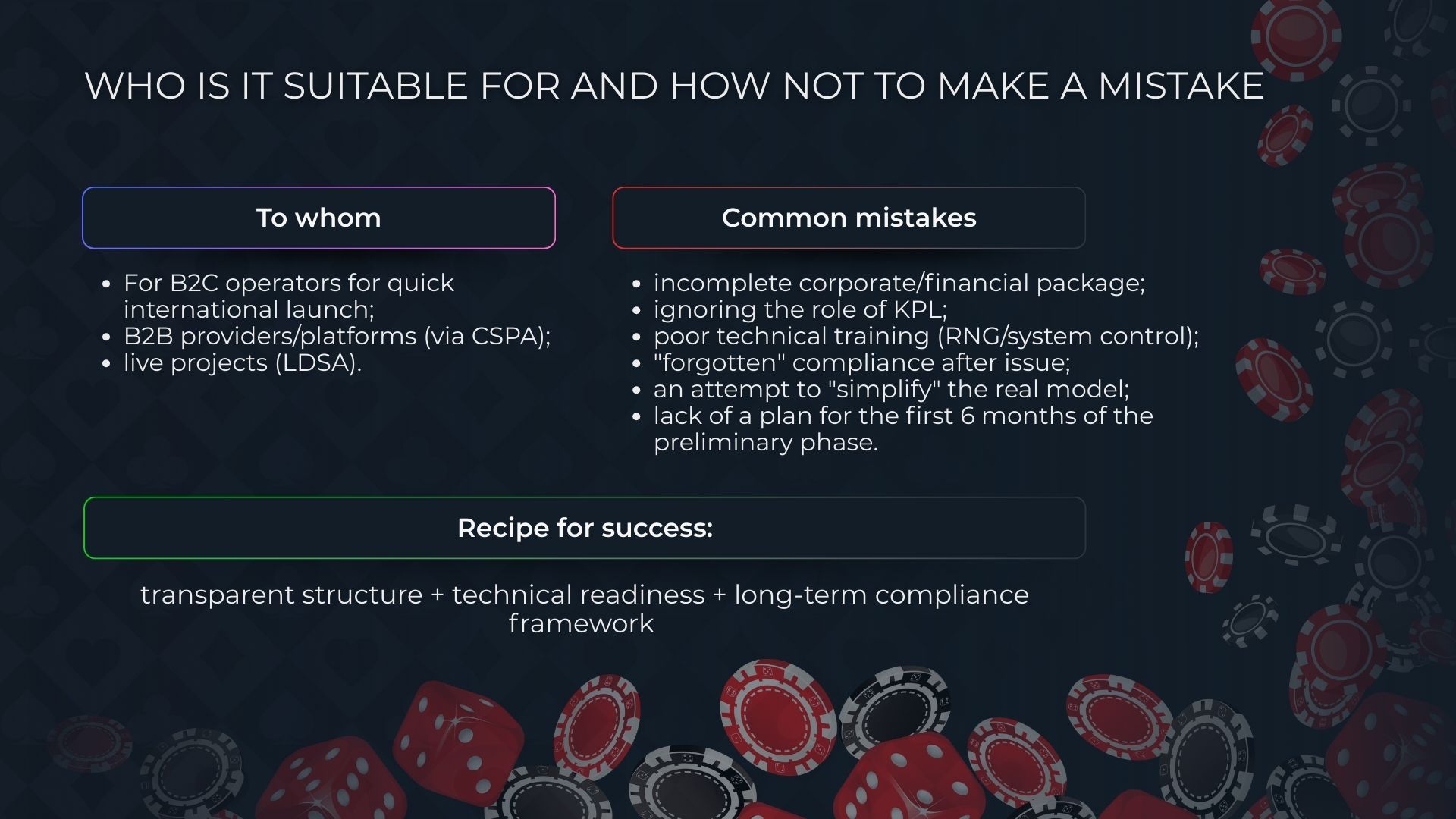
-
B2C operators that value fast market entry, high reputational stability, and absence of a GGR tax.
-
B2B providers and platforms that require a license to supply software and operate via centralized infrastructure.
-
Projects with live content that require authorization for a studio in a regulated environment.
Common operator mistakes
Insufficient preparation of the corporate package
One of the main reasons for delays is an incomplete set of documents or weak financial reporting. The regulator expects transparency in ownership structure, accurate biographical disclosures, and a clear business plan. Attempting to speed up the process by shortening the content or ignoring KGC forms is a critical mistake.
Ignoring the role of the Key Person Permit
Some teams fail to assign a “Key Person” and complete the KPL process. This leads to delays or rejection of the application: without an approved Key Person, operational activities cannot be licensed.
Errors in technical components and software testing
Projects often underestimate the requirements for RNG certification, integration of the platform with MIT infrastructure, and preparation of the Control System Submission (Schedule I). An incomplete technical package is one of the most common reasons for an application being returned for revisions.
Underestimating compliance workload after obtaining the licence
After the licence is issued, many operators shift to the operational phase and reduce attention to AML/KYC, reporting, policy updates, and monitoring. KGC conducts inspections, and non-compliance can result in fines or suspension of operations.
Attempting to “mask” the real business model
Some applicants try to simplify the project on paper, reducing the actual functionality or corporate structure. KGC quickly identifies discrepancies between declared information and actual operations — this is a common reason for refusals.
Lack of a plan for the first 6 months after receiving a preliminary licence
The preliminary licence is a trial period during which the commission assesses compliance, financial stability, and operational control. A common mistake is using this period solely for marketing launch rather than for process and infrastructure fine-tuning.
Conclusion: Key considerations for operators and mistakes to avoid
Launching a project under the Kahnawake licence is a managerial decision that requires precision at every stage. Despite the accessibility of procedures, operators often encounter problems caused by underestimating regulatory requirements, insufficient document preparation, and unpreparedness for long-term compliance support.
Strategic recommendation
For successful operation in Kahnawake, a project requires three key components:
-
Transparent corporate structure and a complete documentation package.
-
Technical readiness for software integration and certification.
-
Established long-term compliance framework.
Operators who plan these elements in advance and approach the application as a strategic project complete the procedure faster, more safely, and with lower costs.