


The Curacao gambling license remains one of the most sought-after in the global online gambling industry. Since 1996 the jurisdiction has offered operators a quick and comparatively affordable way to legalize their activities, and in recent years interest in this license has only increased. The reasons are obvious: flexible business conditions, wide recognition in the international environment and the ability to work with various payment solutions, including cryptocurrency.
In 2023–2025 the rules for obtaining a Curacao license underwent significant changes. The outdated master/sub-license system was abolished and industry supervision was transferred to a new state authority — the Curacao Gaming Authority (CGA). Operators can now choose between two license types: B2C (for online casinos and bookmakers) and B2B (for software providers and payment solution providers). This has increased the transparency and reputation of the license, while simultaneously tightening requirements for companies.
For entrepreneurs this means one thing: the licensing process has become more structured and demanding, but with proper preparation it remains accessible and fast. We will examine what exactly changed in 2025, who the Curacao license suits, what steps are required to obtain it, how much it costs and which mistakes can lead to refusal.
What’s new in Curacao regulation (2023–2025)
Until 2023, online gambling licensing in Curacao was built around a master license and sub-license system. A small number of master-license holders issued sub-licenses to operators. This model allowed rapid launches of online casinos or bookmaker platforms, but it was criticized for a low level of control and weak player protection.
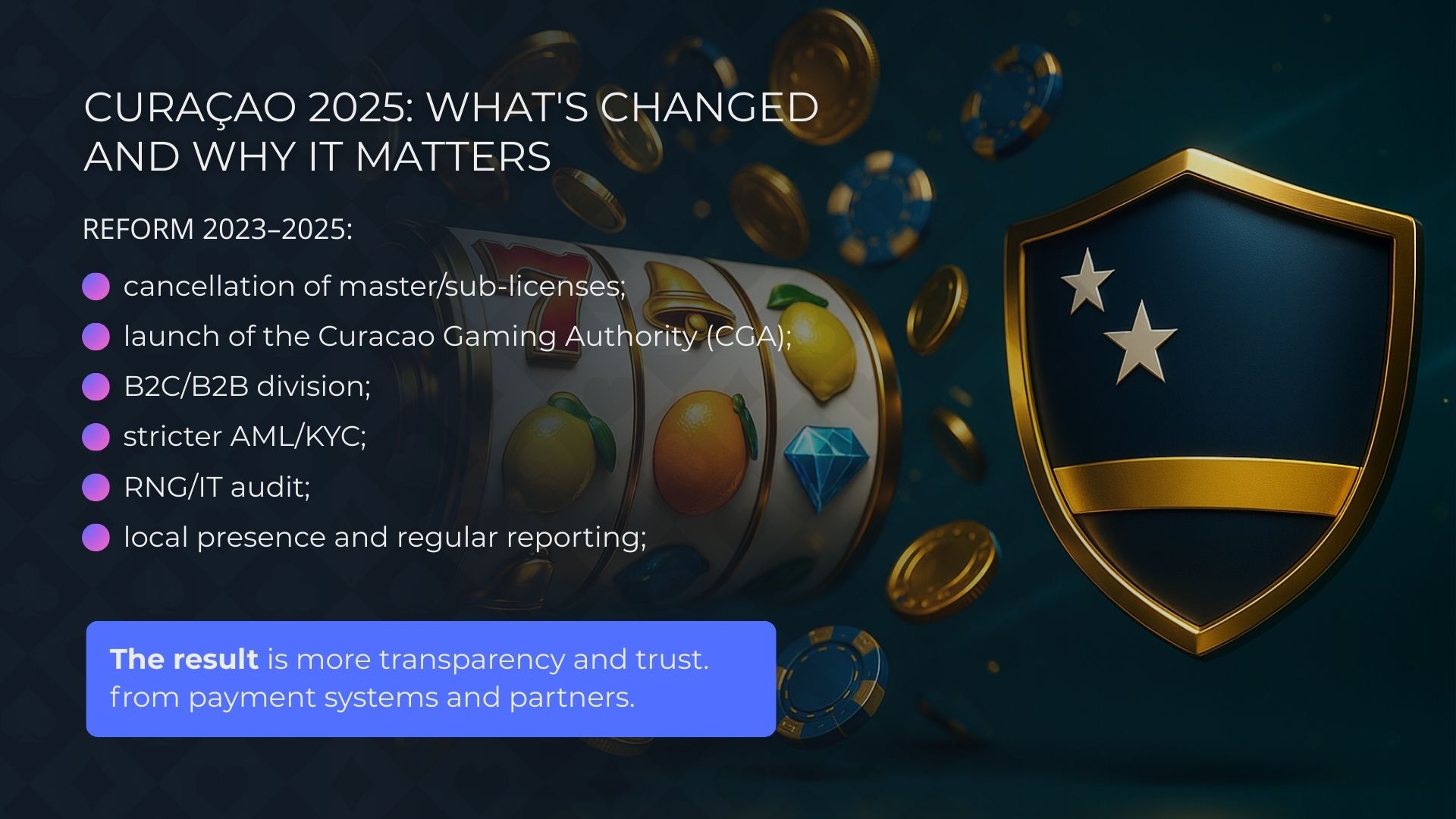
In 2023 the government of Curacao began a large-scale reform of gambling legislation. The main changes are:
- Abolition of sub-licenses. All active operators are required to undergo re-licensing under the new rules.
-
Creation of a new regulator. Supervisory functions were transferred to the state authority — the Curacao Gaming Authority (CGA), which replaced the Gaming Control Board (GCB).
-
Division of licenses. Two license types have been introduced:
-
B2C — for operators of online casinos, bookmakers, lotteries and poker.
-
B2B — for igaming software providers, payment service providers and content suppliers.
-
-
Tightening of requirements. The following are now mandatory:
-
an AML/KYC policy (anti-money laundering and player identification);
-
audit of random number generators (RNG) and IT systems;
-
the existence of a local office or representative;
-
regular reporting to the regulator.
-
-
Increased transparency. The new system has brought Curacao closer to international standards and strengthened its positions in Latin American and Asian markets.
Thanks to these changes, the Curacao license in 2025 has become not only a more reliable instrument for legalizing business but also a symbol of a serious approach to compliance. This increases trust from investors, players and payment systems, while at the same time requiring greater preparation from operators.
Who the Curacao license is suitable for
The Curacao license remains one of the most versatile solutions for companies operating in the online gambling sector. It is suitable both for new operators and for established projects that want to expand their activity in international markets.
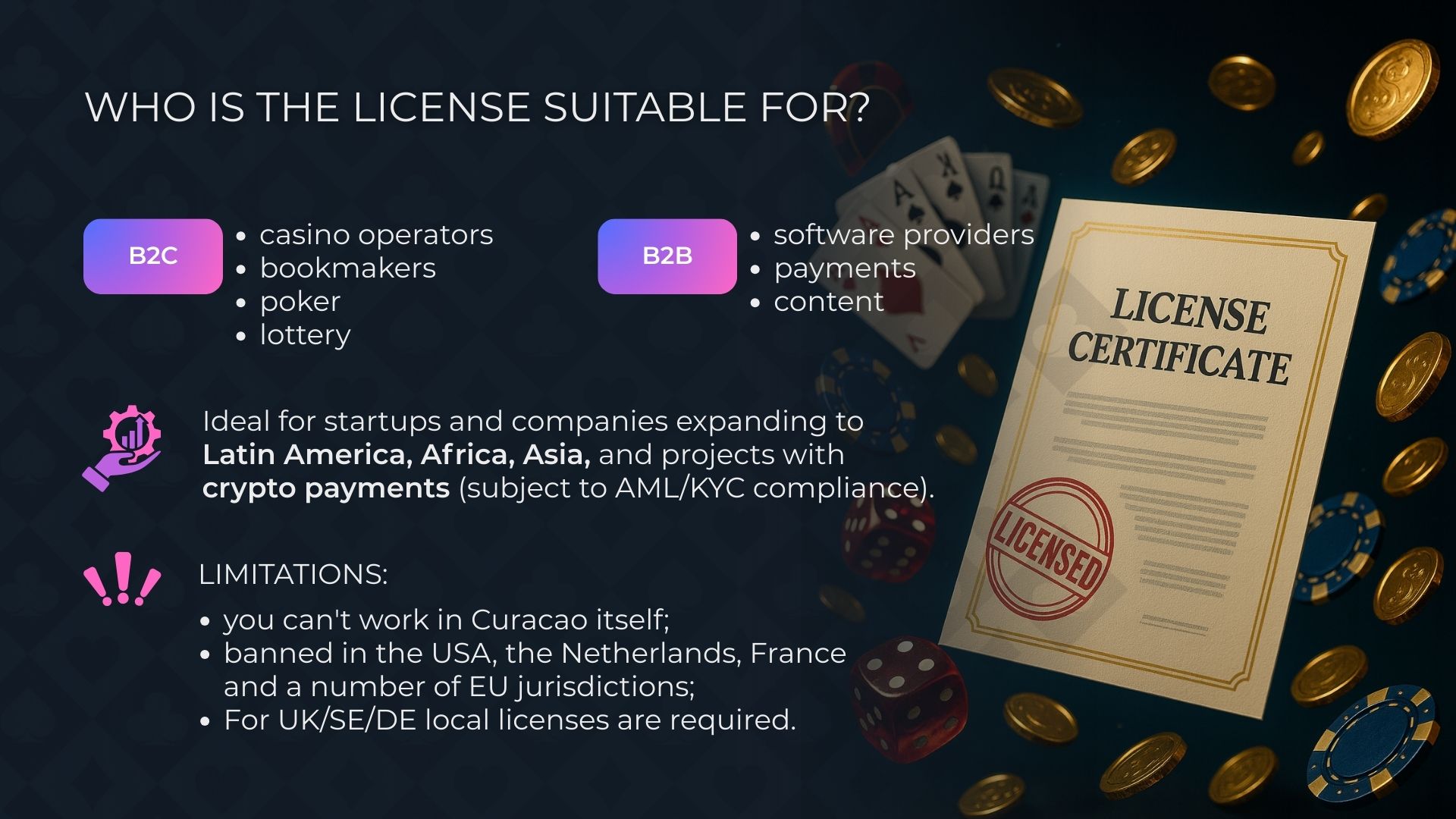
License types and their purpose:
-
B2C license. Intended for operators of online casinos, bookmakers, poker rooms, lotteries and bingo. It allows accepting players directly and operating online casino platforms.
-
B2B license. Suitable for igaming software providers, payment solution providers, live-game studios and other companies that serve operators.
Who benefits from a Curacao license:
-
Startups. This is one of the most accessible options for market entry, with a process that takes less time than in the EU or the UK.
-
Operators working in Latin America, Africa and Asia. In these regions the Curacao license is perceived as legitimate and facilitates cooperation with payment systems and affiliate programs.
-
Companies planning to work with cryptocurrency. The regulator allows the use of digital assets provided AML/KYC procedures are observed.
Limitations:
-
The license does not permit operation within Curacao itself.
-
It is forbidden to accept players from a number of countries, including the USA, the Netherlands, and France, as well as some EU jurisdictions.
-
To access markets with strict regulation (for example, the UK, Sweden, Germany) additional national licensing will be required.
Thus, the Curacao license is optimal for those who want to quickly launch an online casino or bookmaker project, enter developing markets and legally accept payments, but who do not plan to operate in strictly regulated European countries or the USA.
Step-by-step plan to obtain a Curacao license
Obtaining a Curacao license in 2025 has become a more formalized process. Applicants are now required to prepare documents thoroughly, establish local presence and comply with technical standards. Below is a complete checklist of steps.
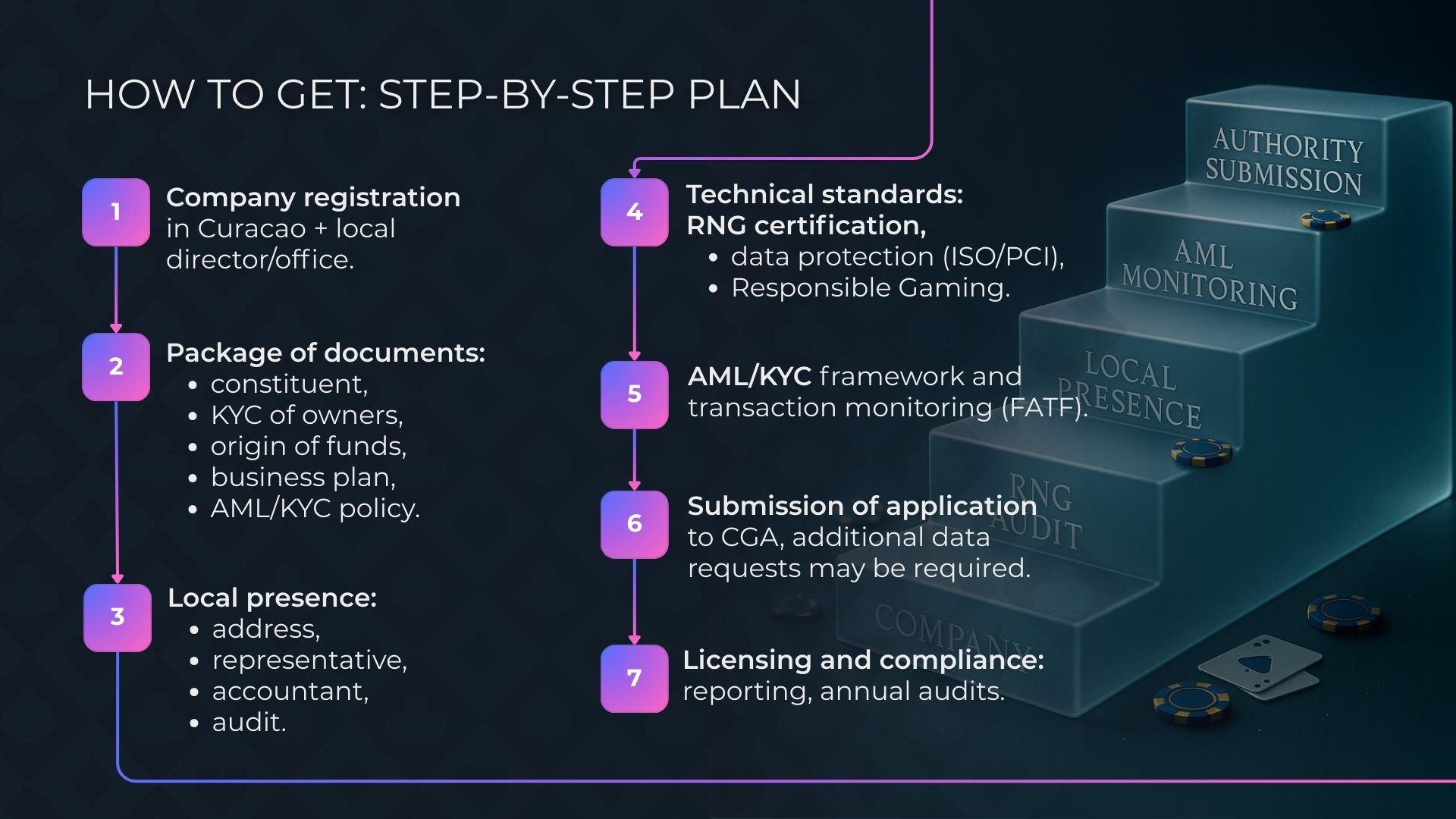
Step 1 — Company registration
-
The company must be registered in Curacao.
-
100% foreign ownership is permitted, but at least one local director or representative is required.
-
A legal address and an office within the jurisdiction are required.
Step 2 — Document preparation
The required package of documents for the application:
-
constitutional documents of the company (Articles of Association, Certificate of Incorporation);
-
passports and proof of address of all beneficiaries and directors;
-
financial statements or proof of sources of funds;
-
business plan (description of the platform, types of games, target markets);
-
AML/KYC policy and internal compliance documentation.
Step 3 — Local presence
-
A registered office in Curacao is mandatory.
-
A local representative must be appointed to liaise with the regulator.
-
The company must have a local accountant and undergo audits by accredited specialists.
Step 4 — Technical standards
-
Certification of RNG (Random Number Generator) for all gaming products.
-
Data protection systems must comply with international standards (ISO 27001, PCI DSS).
-
Availability of responsible gaming tools (self-exclusion, deposit limits).
Step 5 — AML/KYC and compliance
-
An internal AML/KYC policy is mandatory.
-
All players must undergo identity verification (ID check, proof of funds).
-
Transactions must be monitored in accordance with FATF requirements.
Step 6 — Application submission
-
The application is submitted via the official portal of the Curacao Gaming Authority (CGA).
-
Processing time: 2–3 months (longer in individual cases).
-
During the process the regulator may request additional information or documents.
Step 7 — License issuance and ongoing compliance
-
Upon approval the applicant receives a license (B2C or B2B).
-
Validity: indefinite, but annual confirmation of compliance is required.
-
An annual audit of financials and IT systems is mandatory.
-
Regular reporting to the CGA and maintaining up-to-date AML/KYC procedures are required.
Thus, the process of obtaining a Curacao license requires comprehensive preparation, but remains one of the fastest and most accessible compared with European jurisdictions. With all requirements met an operator can enter the market in just a few months.
How much the Curacao license costs
The cost of a Curacao license consists of several mandatory and related expense items. In 2025 it has risen compared to the “old model” before the reform, but it still remains more affordable than European jurisdictions (for example, Malta or the UK).
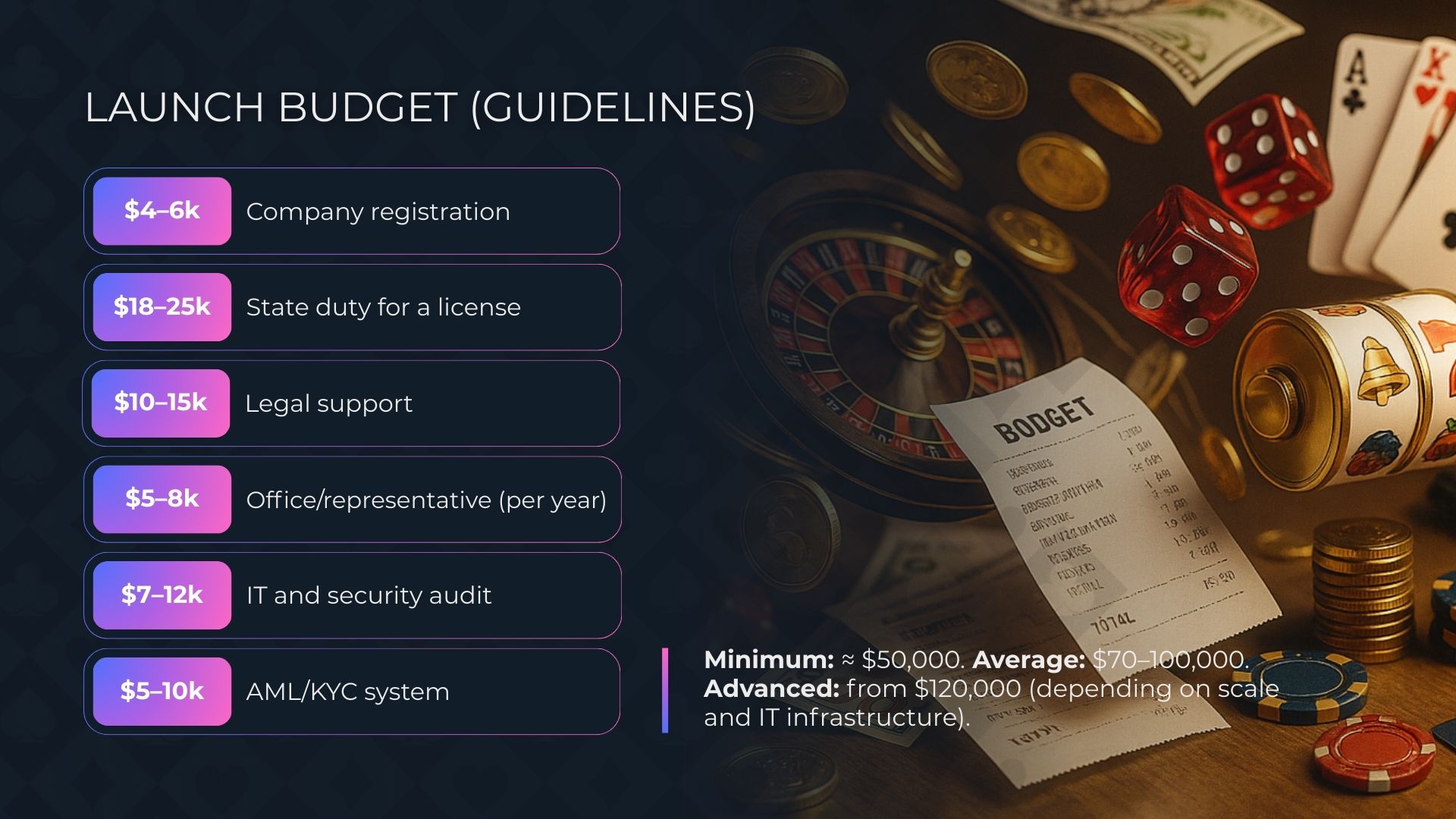
Main expenses
|
Item |
Average cost range (USD) |
Comment |
|---|---|---|
|
Company registration |
4 000 – 6 000 |
Includes preparation of constitutional documents, company registration and office setup. |
|
State fee for the license |
18 000 – 25 000 |
Paid at the time of application. Amount depends on the license type (B2C or B2B). |
|
Legal support |
10 000 – 15 000 |
Consulting, compliance support, document preparation for the CGA. |
|
Local office and representative |
5 000 – 8 000 annually |
Includes the services of a resident director and a local accountant. |
|
IT and security audit |
7 000 – 12 000 |
RNG certification, infrastructure verification for compliance with standards. |
|
AML/KYC system |
5 000 – 10 000 |
Implementation of software for player verification and transaction monitoring. |
Overall budget
-
Minimum: around 50 000 USD (for a small start with a limited number of games).
-
Average level: 70 000 – 100 000 USD (including technical improvements and outsourced compliance).
-
Advanced level: from 120 000 USD (for large-scale projects with an in-house team and expanded IT infrastructure).
Additional expenses
-
Annual audit and renewal of registration: from 10 000 USD.
-
Payment systems: connecting a PSP may require a deposit or commission.
-
Licensing of games from third-party providers: depends on quantity and brands.
For a full launch of an online casino under a Curacao license in 2025 an entrepreneur should plan for at least 50–70 thousand dollars. This makes the jurisdiction accessible for a start, but requires careful financial planning.
Timeframes for obtaining a Curacao license
One of the main advantages of the Curacao license remains the relatively fast processing time.
Average timeline for obtaining the license
-
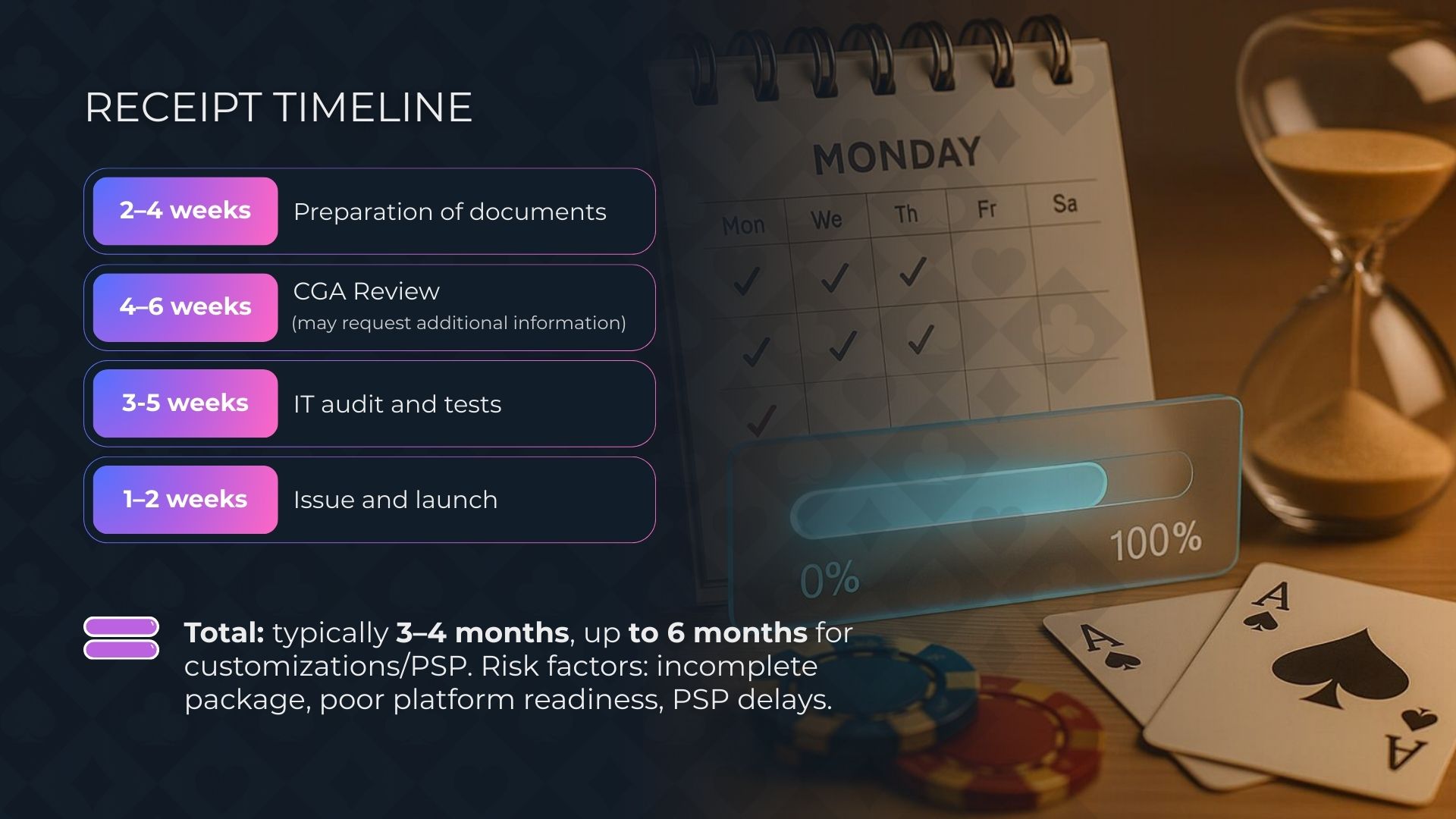
Preparatory stage (2–4 weeks).
-
Company registration in Curacao.
-
Appointment of a local director and accountant.
-
Collection of corporate documents and personal data of owners.
-
-
Application submission and regulator review (4–6 weeks).
-
Review of documents by the Curacao Gaming Authority (CGA).
-
Verification of capital sources, owners’ reputations and the business plan.
-
If necessary, a request for additional documents.
-
-
IT audit and platform testing (3–5 weeks).
-
RNG certification and certification of game providers.
-
Verification of infrastructure for compliance with security standards.
-
Configuration of AML/KYC systems.
-
-
License issuance and launch (1–2 weeks).
-
Receipt of the official permit.
-
Connection to payment systems and setup to accept deposits.
-
Total duration
On average, obtaining a Curacao license takes:
-
from 3 to 4 months with full readiness of documents and platform,
-
up to 6 months if the project requires IT improvements or if compliance issues cause delays.
Factors affecting the timeline
-
Completeness and correctness of submitted documents.
-
Availability of a ready platform and certified software (casino software / online casino software).
-
Speed of owners’ responses to regulator requests.
-
Connection of banks and PSPs: sometimes this takes longer than the license itself.
An entrepreneur should plan the launch of an online casino under a Curacao license at least 4–5 months before market entry. This will help avoid missed deadlines and address compliance matters in advance.
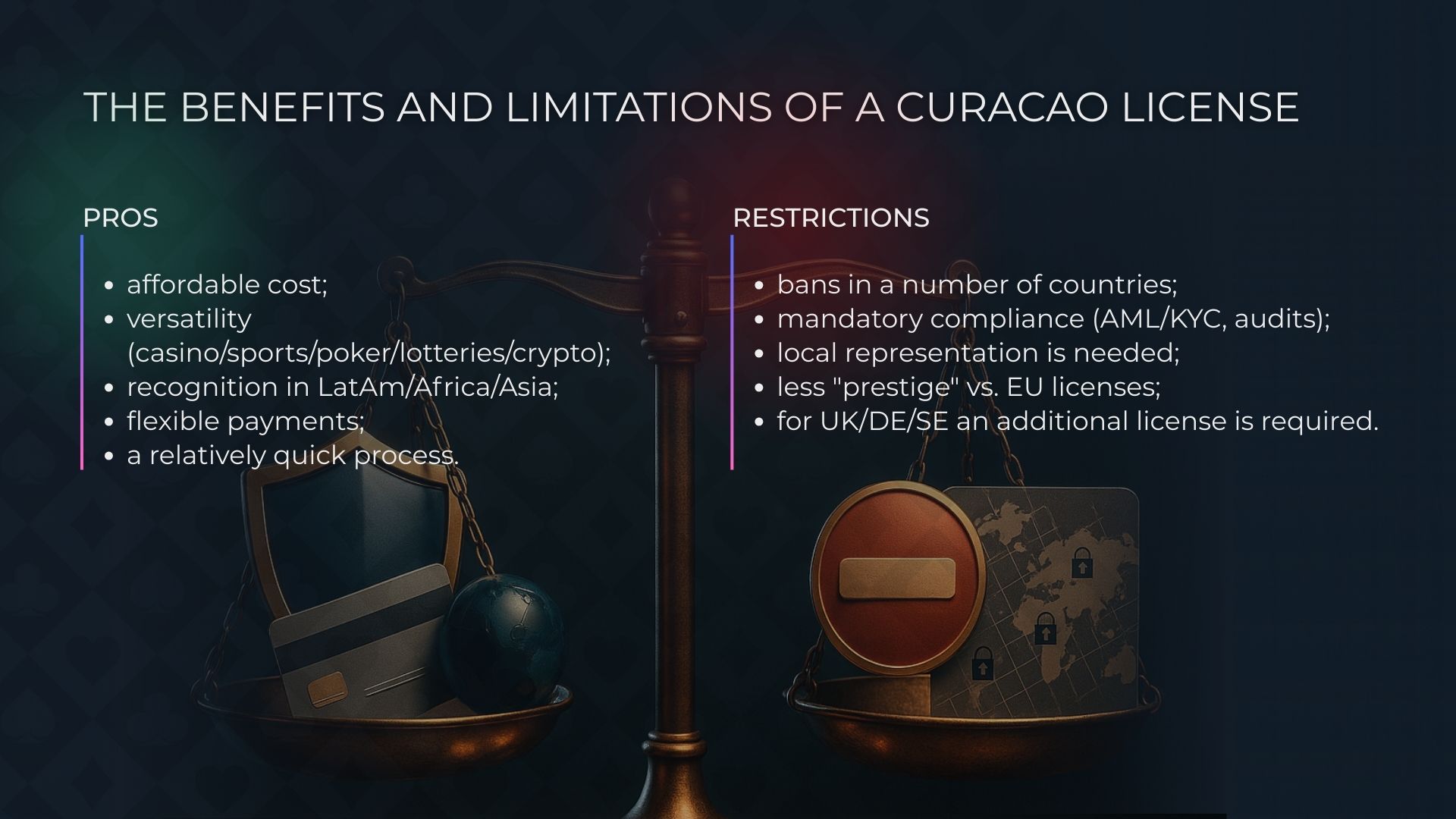
Advantages and limitations of the Curacao license
| Main advantages | Limitations and nuances |
|---|---|
| Cost accessibility. Obtaining the license is cheaper than in most European jurisdictions while covering a wide range of gambling activities. |
Does not apply to the Curacao market. Players from the jurisdiction itself cannot be served under this license. |
| Versatility. One license enables operation across casino games, sports betting, poker, bingo and lotteries — supporting various casino software and online casino platform models. |
Ban for certain countries. The license does not permit activity with players from the USA, the Netherlands, France and some other regions. |
| Simplicity for international operations. The license is recognized in Latin America, Africa and Asia, facilitating entry into promising markets. |
Stricter compliance requirements. After the reform mandatory KYC, AML, and IT audits have been introduced, increasing costs and timelines. |
| Flexibility in payment processing. Operators can integrate international PSPs and also use cryptocurrency payments. |
Lower prestige compared to EU licenses. To operate in the UK, Germany or Sweden additional licensing will be required. |
| Relatively fast process. With correctly prepared documents it is possible to obtain a license in 3–4 months, which is faster than Malta or the UK. |
Requirement for local representation. The law requires appointment of a resident director and local accounting. |
Conclusion: is Curacao the right choice to launch a casino?
The Curacao license remains one of the most popular jurisdictions for launching online casinos and other gambling platforms. It combines affordability, relatively fast processing and the ability to operate on international markets, including Latin America, Africa and Asia.
The 2023–2025 reform has made the licensing process more transparent and reliable: sub-licenses were abolished, strict compliance requirements were introduced, AML/KYC procedures and IT audits became mandatory. This has increased the license’s prestige but also increased the time and cost of launching a project.
For entrepreneurs this means the following:
-
Fast start and international legality. The license allows entry into broad markets without the need for complex European permits.
-
Transparency and trust. The new system increases confidence among players, payment systems and investors.
-
Need for preparation. Success depends on correct document preparation, local presence and compliance with procedures.
In conclusion, the Curacao license is suitable for startups and mid-sized operators focused on emerging markets and cryptocurrency solutions. For companies targeting strictly regulated European countries and the USA, it can serve as a first step in legalization, after which additional national licensing will be required.