


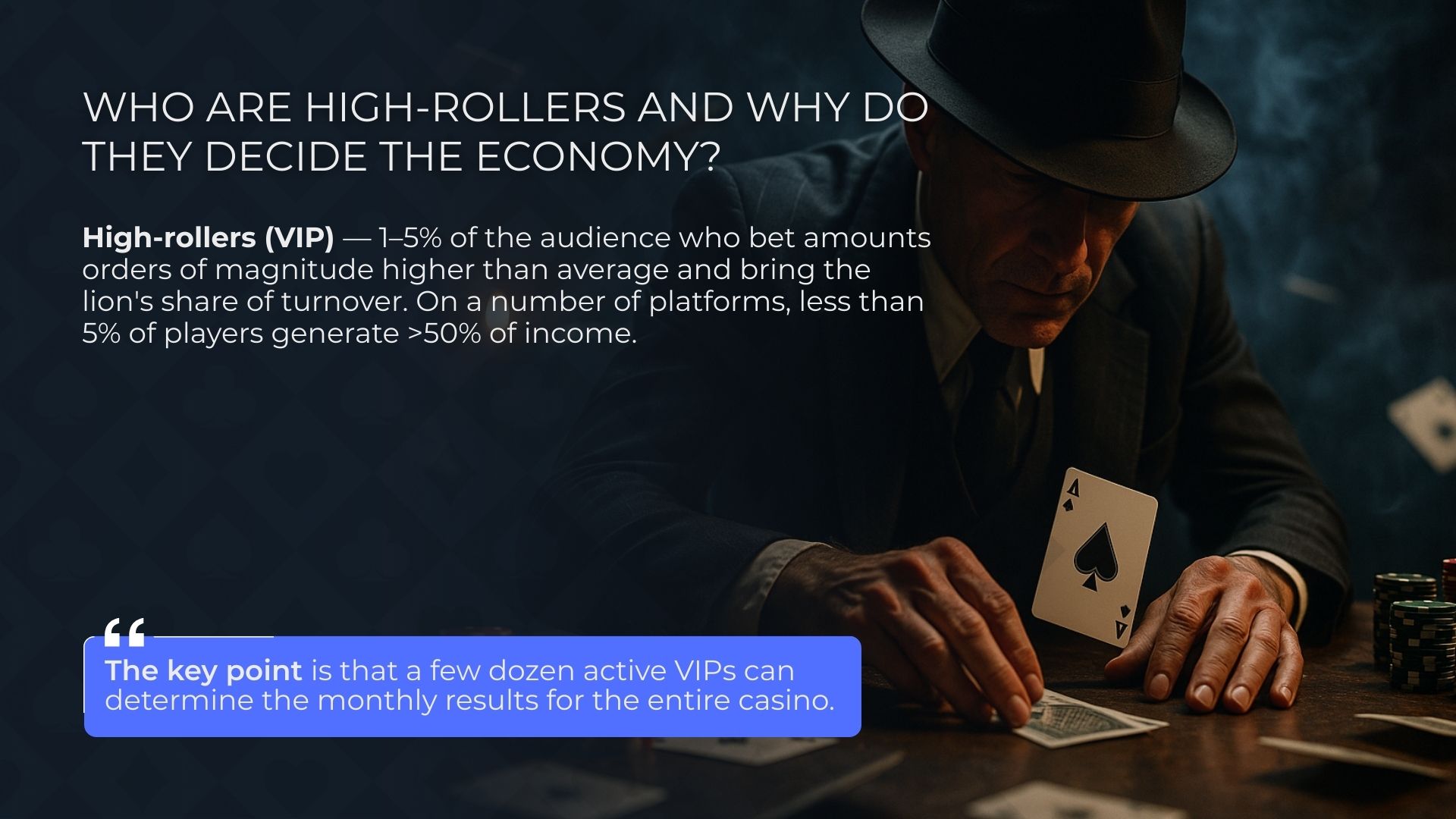
 There are players on whom some gambling platforms almost entirely depend. They place bets dozens or even hundreds of times higher than the average user and receive special treatment from casinos — personal managers, exclusive bonuses, and private tournaments. They are called high-rollers or VIP players.
Such players are rare — only 1–5% of the audience — yet they generate half of the revenues for many platforms. Understanding their behavior and motivation is the key to business growth and stability.
In this article, we will explore who high-rollers are, how online casinos build entire programs around them, what risks and opportunities they bring, and why this segment remains the core profit driver in iGaming.
Who Are High-Rollers in Online Casinos
High-rollers are a special category of players for whom gambling means more than just entertainment. They wager tens or even hundreds of thousands of dollars — and they do it regularly. In the industry, they are often called whales for a reason: a single player of this type can bring a casino as much revenue as several hundred regular users combined.
According to H2 Gambling Capital, less than 5% of players account for more than 50% of online casino revenues. Imagine: just a few dozen active high-rollers can determine whether a casino has a successful month.
This is why it is critical to understand their mindset and behavior if you plan to launch your own online casino. It is not just a statistic — it is a fundamental rule of how iGaming works.
A vivid example: a VIP player may choose a casino simply because it offers a dedicated manager who tracks their bets and provides tailored conditions. The slightest inconvenience or payout delay can drive such a player to a competitor, causing losses of tens of thousands of dollars.
The Economics of High-Rollers: Why Casinos Bet on VIPs
High-rollers are not just people who wager large sums. Their behavior and motivation create a unique ecosystem within an online casino.
Age and Social Status:
-
Most often between 30–50 years old.
-
Successful entrepreneurs, investors, and high-income individuals.
Financial Habits:
-
Ready to place wagers that are dozens of times higher than the average bet.
-
Value fast transactions and the ability to manage large sums without restrictions.
Gaming Preferences:
-
Prefer table games that require skill and strategy: poker, baccarat, blackjack, roulette.
-
Appreciate exclusive tournaments, private tables, and personalized playing conditions.
Motivation and Psychological Drivers:
-
The thrill and intellectual challenge matter more than the winnings themselves.
-
Value exclusivity, status, and personalized attention from the casino.
-
Expect VIP treatment: personal managers, expedited payouts, and tailored bonuses.
Behavioral Characteristics:
-
Loyalty to a casino is shaped by comfort, experience, and a sense of privilege.
-
Quickly switch to competitors if they feel conditions have worsened.

Economic Importance of High-Rollers
High-rollers are the players who generate the bulk of online casino revenues. Though few in number, they strongly influence how much a platform earns.
Revenue Contribution
-
Less than 5% of players can generate over 50% of an online casino’s revenue.
-
A single high-roller may spend from $50,000 to $1 million annually, depending on the jurisdiction and casino conditions.
-
In some cases, one VIP can account for up to 10% of the platform’s monthly turnover.
Why This Benefits Casinos
-
Launching VIP programs helps retain these players. Even retention investments of up to 20% of annual VIP turnover pay off many times over.
-
ROI from a single VIP is often higher than from hundreds of regular users combined.
A Clear Comparison
Imagine a platform with 10,000 active players:
-
9,550 average players generate $100,000 in monthly revenue.
-
50 high-rollers generate $120,000, even though they make up only 0.5% of the audience.
Thus, just a few dozen players can determine the financial success of the entire platform.
Why Understanding the Economic Model Matters for Investors
-
When analyzing an online casino business project, an investor must assess how dependent revenues are on the VIP audience.
-
This understanding allows for building strategies: how much to allocate to retention, marketing, and personalization of the VIP experience.
-
Ignoring high-rollers can lead to inaccurate financial forecasts and misvaluation of the project.
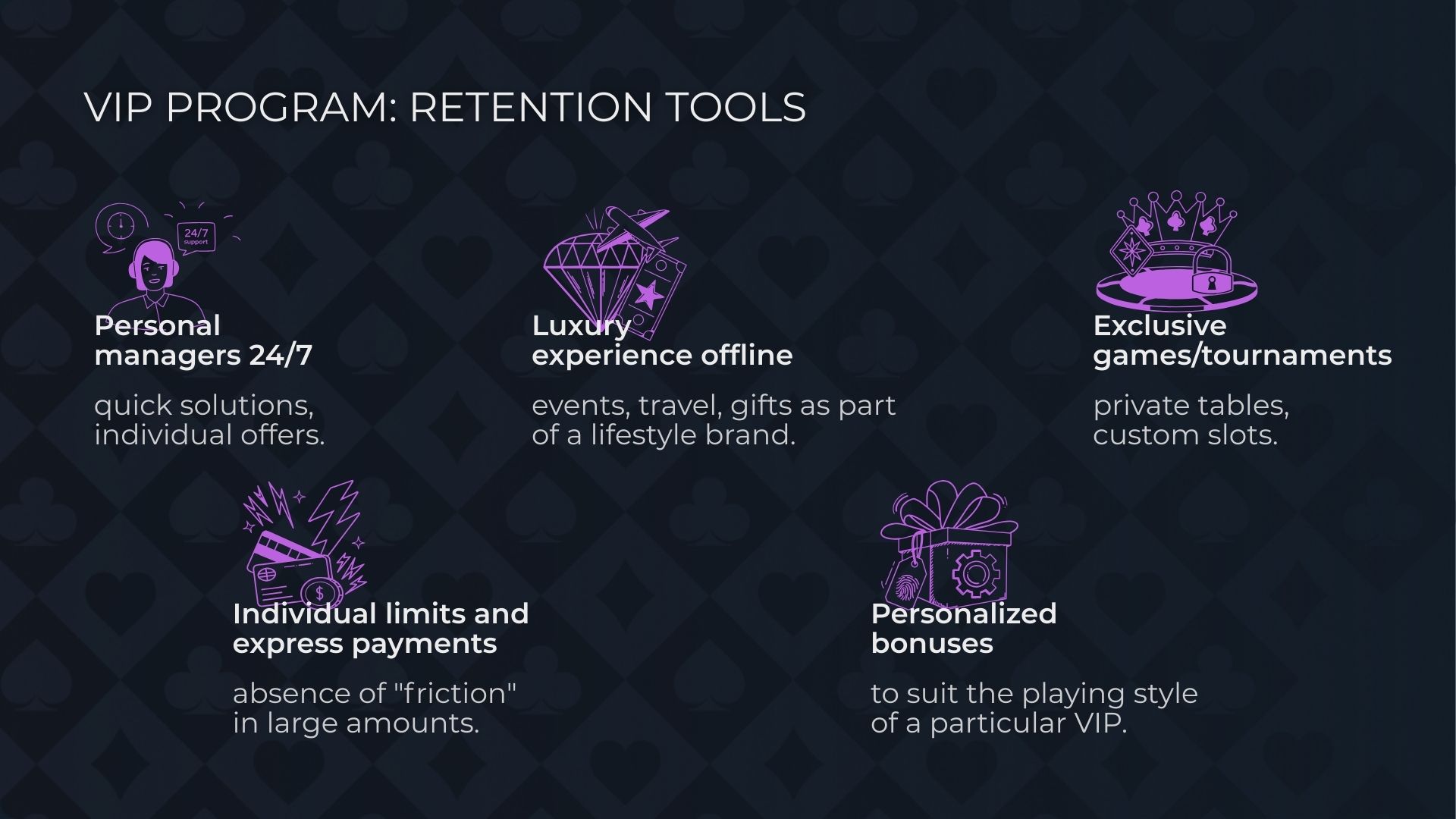
VIP Programs and Retention Tools
|
Tool |
Description |
Practical Effect |
|---|---|---|
|
Personal Managers |
Dedicated manager for each VIP, 24/7 support, tailored bonuses |
Boosts loyalty, ensures quick response to requests, strengthens trust |
|
Custom Limits and Transaction Conditions |
Higher deposit and betting limits, faster payouts of large winnings |
Retains big players, reduces risk of churn to competitors |
|
Exclusive Games and Tournaments |
Private tables, closed tournaments, custom slot machines |
Increases engagement and turnover, enhances sense of exclusivity |
|
Personalized Bonuses and Promotions |
Bonuses aligned with the playing style and preferences of each VIP |
Boosts betting frequency, raises average spend, builds emotional attachment |
|
Luxury Experience and Offline Privileges |
VIP events, tournaments, trips, exclusive gifts |
Fosters long-term loyalty, builds a lifestyle brand, attracts new players through referrals |
Risks and Challenges for the Industry
Working with VIP audiences is highly profitable but also brings serious challenges.
1. Dependence on a Small Group of Players
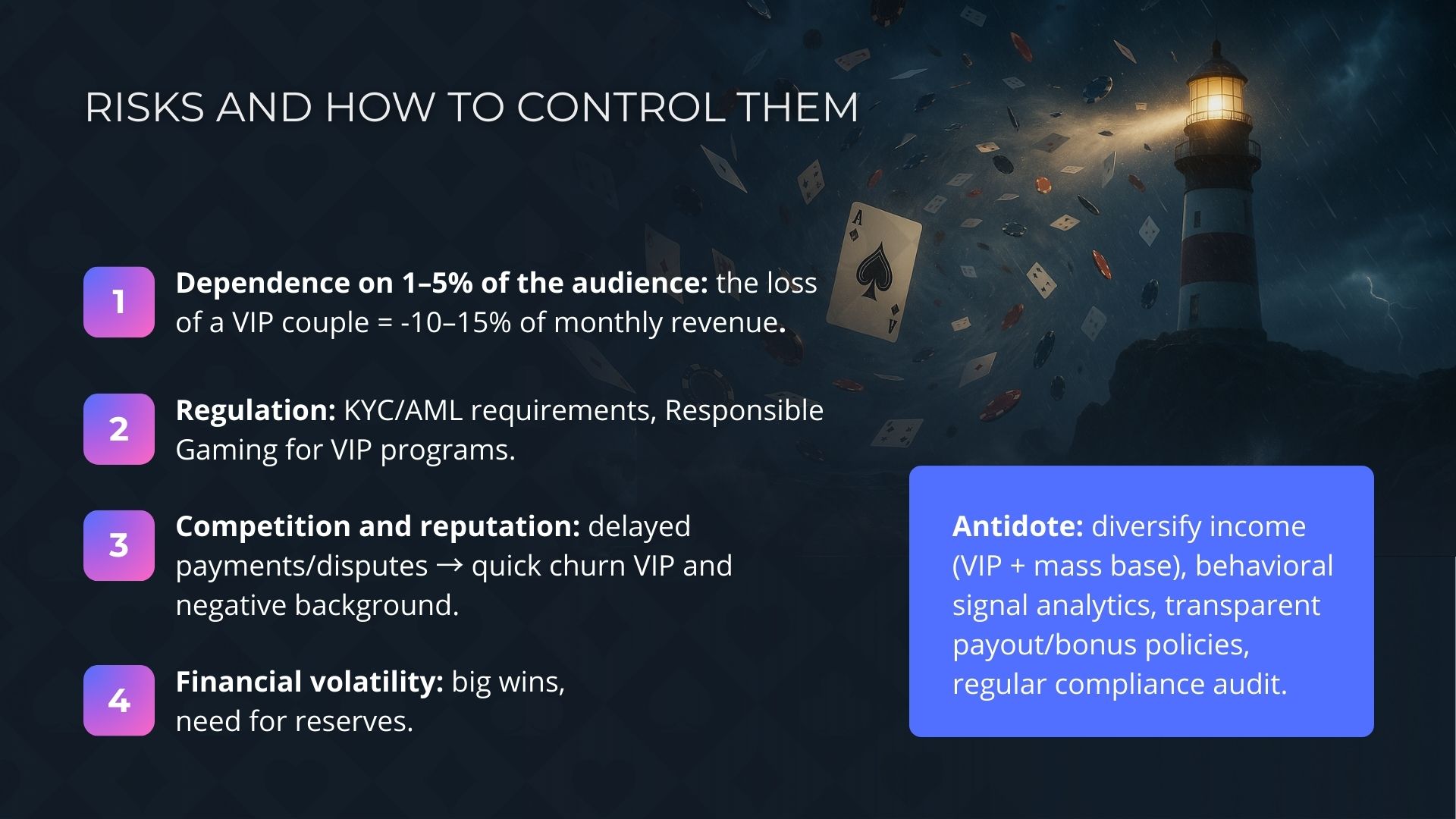
High-rollers make up just 1–5% of the audience but generate up to 50% of revenues. Losing even a few key clients can cut monthly income by 10–15%.
2. Regulatory Restrictions
Regulators closely monitor VIP programs: responsible gaming policies, AML, and KYC compliance are mandatory. Violations can result in fines and restrictions.
3. High Competition
VIP players easily switch to competitors if offered better conditions. Casinos must continuously upgrade offers and service quality to retain them.
4. Reputational Risks
Any mistakes in VIP management — delayed payouts, disputed bonuses, or scandals — can undermine trust not only among VIPs but across the player base.
5. Financial Volatility
High stakes create unstable revenue streams. Casinos must plan budgets strategically and reserve funds for potential large wins.
How to Mitigate Risks:
-
Diversify revenues by balancing VIP and mass-market audiences.
-
Use analytics to forecast VIP behavior.
-
Ensure transparency and full compliance with regulations.
-
Continuously improve VIP services without aggressive pressure.
Conclusion: Why the VIP Segment Defines Online Casino Success
High-rollers are not just big spenders. They are strategic clients around whom an entire online casino business model is built. Their financial impact is disproportionate: a few dozen players can generate up to half of a platform’s revenue, making them a critical asset for both investors and operators.
The economic importance of the VIP audience requires a personalized approach: tailored bonuses, private tables, dedicated managers, and offline events are essential retention tools. At the same time, working with high-rollers carries risks — dependency on a small group, regulatory requirements, competition, and financial volatility.
For sustainable success in iGaming, it is vital not only to attract VIPs but also to develop long-term retention strategies using analytics, personalization, and adherence to responsible gaming standards.
Forecast for the Coming Years:
-
The industry will enhance personalization of VIP experiences using AI and Big Data.
-
Cryptocurrency and multi-channel solutions will become standard for high-rollers.
-
Online casinos will increasingly integrate offline events and luxury offerings, turning the VIP experience into a full-fledged lifestyle segment.
Thus, understanding the VIP segment is not just a matter of statistics but a cornerstone of business strategy. Casinos that master VIP retention and relationship-building will secure a competitive advantage and long-term financial stability.