


 The year 2026 is becoming a strategic turning point for the gambling industry. The online gambling market continues to grow, but the nature of this growth is changing fundamentally. The phase of extensive scaling driven by cheap traffic, aggressive bonuses, and rapid entry into new markets is gradually giving way to a mature model where product architecture, regulatory resilience, data, and operational efficiency play a decisive role.
This material is based on an analysis of industry research and analytical reviews (Future Market Insights, Business Research Insights, SiGMA, SCCG), as well as a synthesis of the practices of iGaming operators and B2B providers. The purpose of this article is to provide a systematic understanding of the key trends of 2026 and to demonstrate the practical conclusions businesses should draw from them.
The Global Online Gambling Market in 2026
Market Size and Growth Rates
According to estimates by analytical agencies, the global online gambling market in 2026 is approaching the $90–100 billion mark. The compound annual growth rate (CAGR) remains at approximately 9–11%.
At the same time, the key factor in development is not so much the absolute growth of the market as the change in its structure.
The main contribution to the dynamics is made by existing markets and operators who increase revenue by improving player retention, developing ecosystem products, and optimizing unit economics. Rapid growth through the simple scaling of advertising budgets is becoming increasingly inefficient.
Qualitative Growth Instead of Quantitative
The market is entering a maturity phase where the following are paramount:
-
The depth and sustainability of monetization,
-
Long-term player LTV,
-
The ability of the business model to adapt to regulatory, payment, and marketing restrictions.
For new projects, this implies a higher barrier to entry. For existing operators, it means the need to revise growth strategies and abandon short-term tactics focused exclusively on traffic.
The Significance of Market Maturity for Business
In 2026, companies that think systemically will prevail. Competitive advantage is shifting from marketing to product architecture and data management quality.
Regulation as the Primary Structural Trend of 2026
The regulatory environment is becoming the key factor shaping the online gambling market. Virtually all studies agree that it is regulation that defines the strategic constraints and opportunities for operators in 2026.
Tightening Licensing and Advertising Requirements
In many jurisdictions, oversight is increasing regarding:
-
Advertising and communications with players,
-
Affiliate marketing,
-
Transparency of bonus terms,
-
Financial flows and reporting.
Regulators increasingly demand a local presence, technical integration with state systems, and stricter compliance with AML and KYC standards.
Responsible Gambling as a Business Factor
Responsible Gambling (RG) is ceasing to be a formal licensing element and is becoming an operational and product factor. In 2026, it directly affects:
-
User experience and interface design,
-
CRM strategies and player segmentation,
-
Marketing scenarios and permissible engagement triggers.
Operators that implement early risk detection mechanisms and transparent self-exclusion tools gain not only regulatory resilience but also increased trust from players.
Related topic: Responsible Gaming and Profit: Why Online Casinos Should Integrate RG
Impact of Regulation on Product Economics
Regulation is becoming part of the product architecture. It affects conversion, average check, play frequency, and acquisition costs. To ignore this factor in strategic planning in 2026 is to invite systemic risks.
Artificial Intelligence and Automation in iGaming
Real-World AI Use Cases in 2026
By 2026, artificial intelligence becomes a standard element of the operational infrastructure of iGaming projects, rather than an experimental technology. The key shift lies not in the emergence of new algorithms, but in their systemic integration into the core business processes of operators.
The most sustainable and proven AI application scenarios include:
-
Player behavioral analytics,
-
Fraud and abuse detection,
-
Automation of first-line support and processing of standard requests,
-
Personalization of offers and bonuses.
AI and Responsible Gambling
AI is gaining particular importance in the field of Responsible Gambling. Algorithms are used to analyze gaming patterns, identify potentially problematic behavior, and adapt communications with the player. This approach meets both regulator expectations and long-term business interests.
AI as Part of Infrastructure
The key shift of 2026 is that artificial intelligence is increasingly used not for maximizing short-term metrics, but for the stability of the business model. The practical value of AI is expressed in:
-
Reducing operational costs through the automation of routine processes,
-
Increasing the accuracy of management and product decisions,
-
Supporting compliance with growing regulatory requirements.
Related topic: Practical Scenarios for the Application of AI
Product Evolution: From Online Casino to Ecosystems
Product Convergence
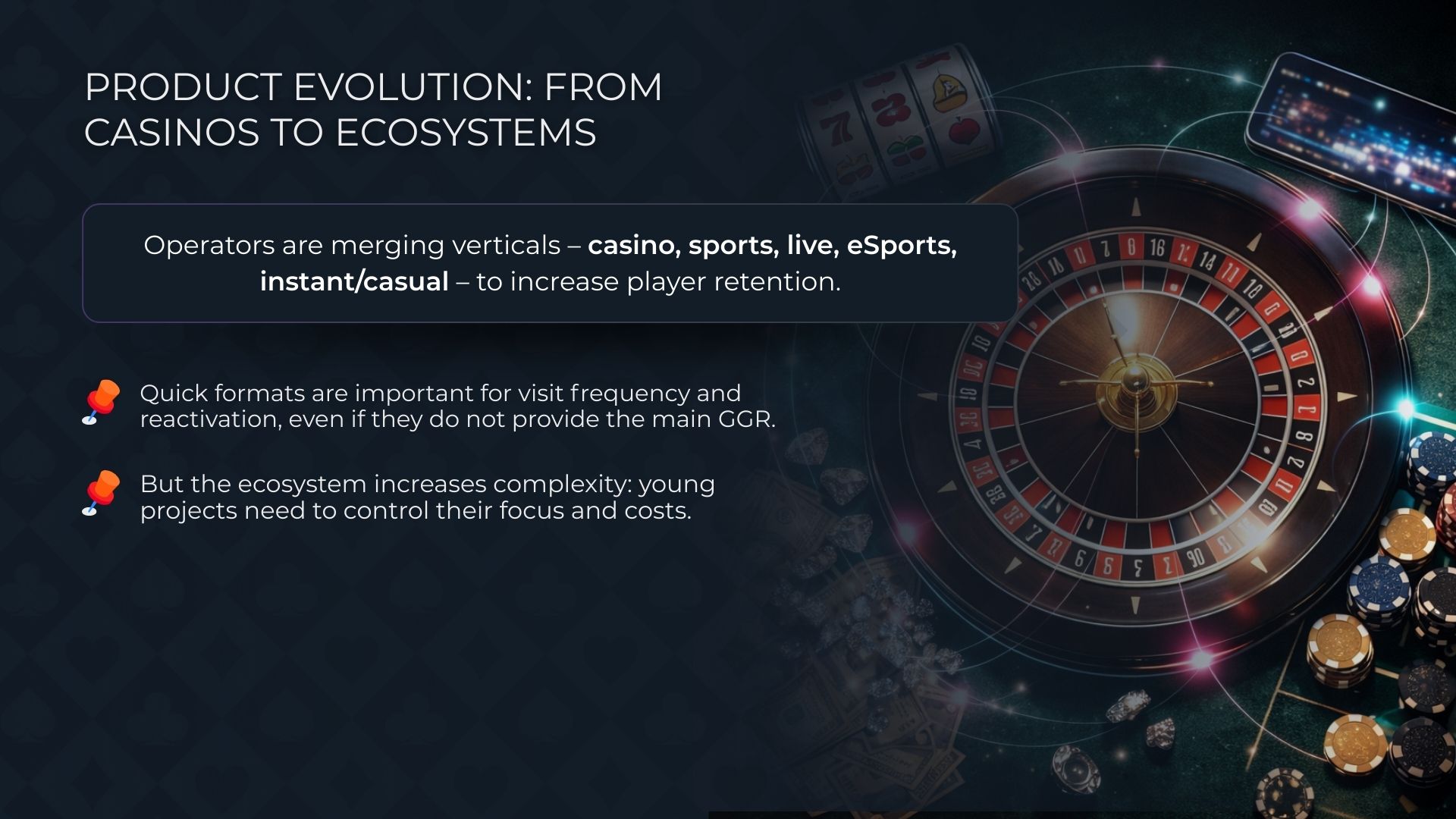
By 2026, most mature iGaming operators move away from a single-product model and develop toward ecosystems. This is manifested in the integration of the following verticals within a single online casino platform:
-
Online casino,
-
Sports betting,
-
Live casino,
-
eSports directions,
-
Casual and instant games.
The goal of this strategy is to increase the lifetime of the player within the ecosystem and reduce dependence on a single revenue source. For entrepreneurs planning to purchase a casino, the ecosystem approach allows for risk reduction and increased LTV.
Hybrid Formats and Retention
In 2026, the role of fast and simple gaming formats oriented toward short sessions and mobile consumption is growing. Such products are primarily used as a tool for:
-
Increasing visit frequency,
-
Reactivating inactive users,
-
Smoothing out seasonal activity fluctuations.
While hybrid and casual formats rarely become the primary source of GGR, they play a vital role in supporting retention and the overall stability of the ecosystem.
Why a Single-Product Fails
Projects built around a single product prove to be vulnerable to:
-
Changes in regulation,
-
Increased competition,
-
Fluctuations in user demand.
The ecosystem approach is gradually becoming the market standard, especially for large operators. However, in 2026, the flip side of this model is also becoming more apparent: for young, niche, or capital-constrained projects, an ecosystem can lead to increased operational costs, loss of focus, and deterioration of unit economics.
iGaming Marketing in 2026: The End of Cheap Traffic
By 2026, the market finally exits the era of scalable and predictable paid traffic. Growing competition, advertising platform restrictions, and regulatory pressure mean that the cost of player acquisition is rising faster than their average business value.
Marketing in iGaming is increasingly becoming a task of economic management rather than simple traffic volume increases.
Rising CAC and Pressure on Affiliates
Increased control from regulators and advertising platforms makes traditional acquisition channels less stable. Affiliate marketing faces particular pressure: operators are increasingly held directly responsible for the actions of partners, including content, promises, and acquisition methods.
Consequently, affiliates are not disappearing but are transforming from a mass channel into a limited, more manageable, and capital-intensive tool that requires compliance oversight and long-term relationships.
SEO, Content, and Brand
In 2026, SEO and expert content acquire strategic importance—not as a source of quick traffic, but as a long-term intangible asset. High-quality content and a strong brand allow companies to:
-
Reduce dependence on paid channels,
-
Increase trust among users and regulators,
-
Accompany the player throughout their entire lifecycle—from the first touch to retention.
However, SEO in iGaming requires significant investment in expertise, authorship, and adherence to E-E-A-T principles, making it a tool for mature operators.
User Data and Personalization
Against the backdrop of tracking restrictions and a cookie-less environment, first-party data becomes the foundation of marketing effectiveness. CRM, advanced segmentation, and personalized communication scenarios allow for increased returns from the existing base without aggressive pressure on the user.
In 2026, personalization is increasingly aimed not at maximizing activity, but at optimizing the frequency and relevance of communications, which directly impacts retention and long-term LTV.
Mobile-first and UX as a Profit Factor
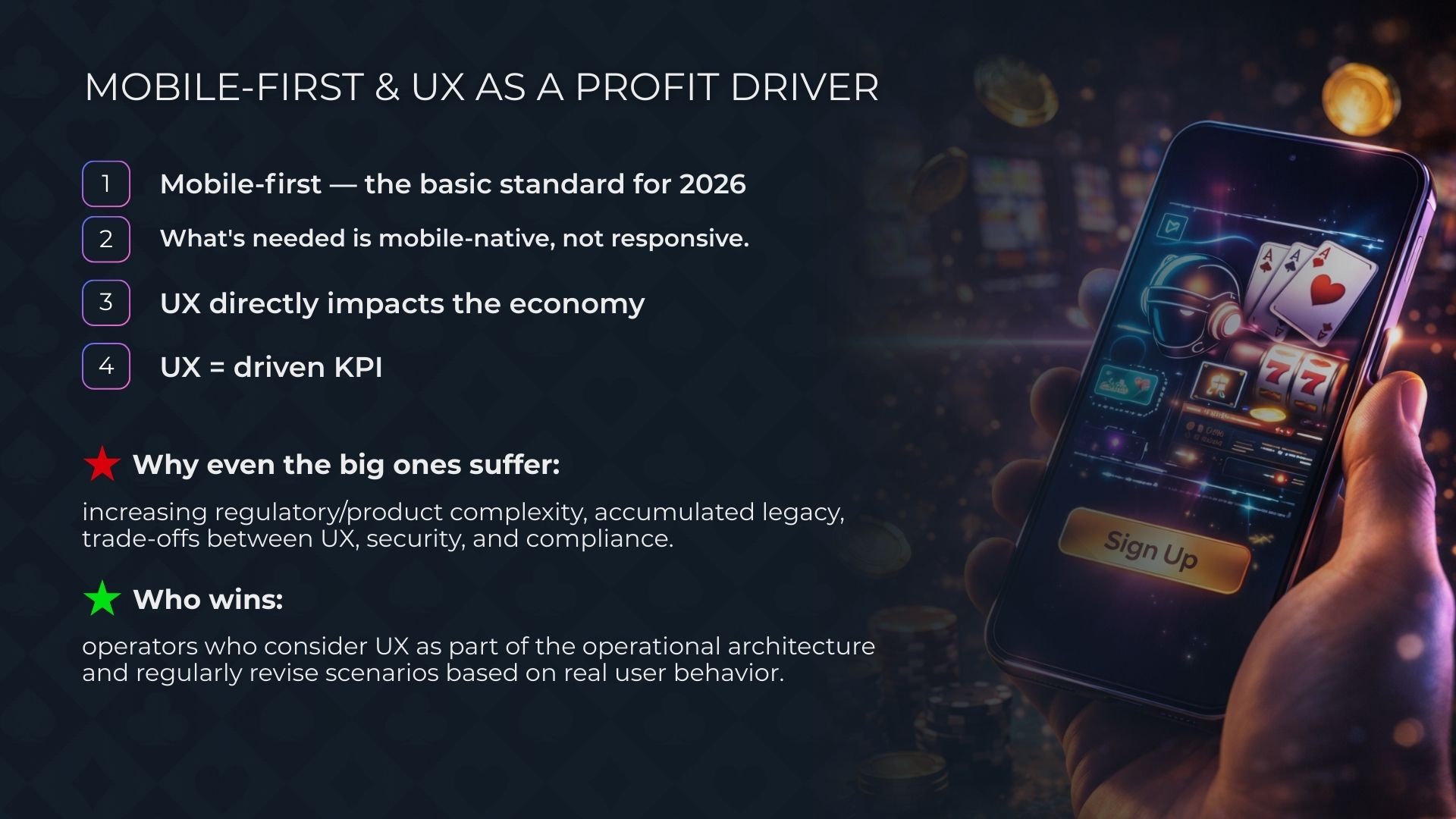
By 2026, mobile consumption becomes the standard for online gambling: the majority of user sessions, deposits, and repeat visits occur via mobile devices. In these conditions, mobile-first ceases to be a competitive advantage and turns into a basic requirement for any viable product provided by a gambling software provider.
This is not merely about having a responsive version, but about designing mobile-native user scenarios, including registration, KYC, deposits, and the gaming process itself.
UX and Retention
In 2026, the user experience directly affects the product’s economics. Flaws in onboarding, delays in payment scenarios, and cluttered interfaces increase churn at early funnel stages, reducing the actual LTV of the player and project margins.
UX is no longer an aesthetic category but a managed economic factor influencing acquisition payback speed and retention efficiency.
Why UX Remains a Problem Even for Major Operators
Even mature iGaming projects continue to face systemic UX problems. In most cases, the reasons are not a lack of expertise, but rather:
-
Increasing product and regulatory complexity,
-
Accumulation of legacy solutions,
-
The need for compromises between UX, security, and compliance.
In 2026, the winners are operators who view UX as part of their operational architecture and regularly review user scenarios based on real audience behavior rather than internal assumptions.
Growth Geography: Promising Markets of 2026
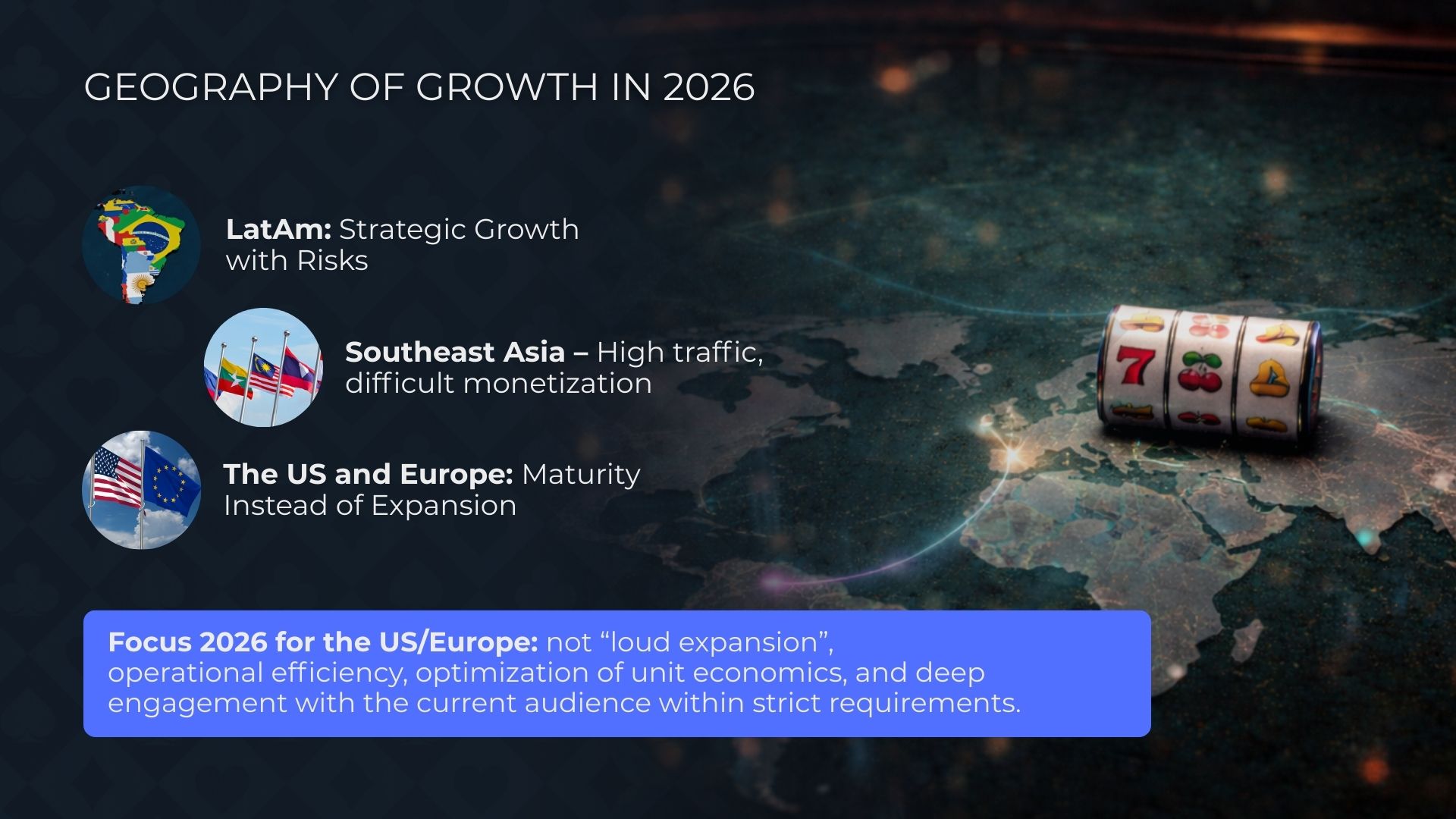
In 2026, the geography of online gambling growth becomes less uniform. Scaling potential is increasingly determined by the regulatory model, acquisition economics, and the level of operational maturity of the market.
Latin America
Latin America remains one of the key growth regions, though its potential is realized amidst active regulatory transformation. Individual countries are transitioning from grey models to licensing, which creates both new opportunities and additional barriers to entry.
Successful operation in the region requires deep local expertise, adaptation of products and marketing to national characteristics, and a readiness to work under changing rules. In 2026, LatAm is a market of strategic growth with elevated operational risks.
Southeast Asia
Southeast Asia is characterized by a high mobile audience and significant traffic volumes, yet remains a complex region from a monetization standpoint. Low ARPU, cultural nuances, and an inconsistent legal environment make classic licensed models less effective.
The region is primarily of interest for ecosystem and hybrid approaches, where the focus is on interaction frequency, simple gaming formats, and alternative engagement scenarios rather than maximizing revenue per user.
USA and Europe
The USA and Europe remain mature markets with high competition and significant entry costs. In the USA, the key factor remains the fragmentation of regulation at the state level, while in Europe, it is the growing requirements for compliance and responsible gambling.
In 2026, the primary potential of these markets lies not in aggressive expansion, but in increasing operational efficiency, optimizing unit economics, and working more deeply with the existing audience within strict regulatory frameworks.
Key Risks for the iGaming Business in 2026
By 2026, risks in iGaming are rarely isolated and increasingly form an interconnected system of constraints directly affecting business development strategy. Managing these risks becomes part of the management model rather than operational routine.
-
Increased regulatory pressure;
-
Dependence on external marketing platforms;
-
Uncontrolled use of AI;
-
Technological complexity and rising costs.
In 2026, the ability to identify, assess, and manage risks becomes the hallmark of mature operators. Companies that integrate risk management into strategic planning gain not only stability but also a long-term competitive advantage in an increasingly complex market provided by an experienced igaming software provider.
Related topic: Risk Management in iGaming
What 2026 Means for the iGaming Business: Practical Conclusions
Practice shows that a viable iGaming business in 2026 is characterized by the following traits:
-
Regulatory resilience built into the product and operational processes,
-
Data-driven decision-making rather than intuitive marketing hypotheses,
-
Conscious development of a product ecosystem with controlled complexity and costs,
-
Investment in long-term growth channels that reduce dependence on external platforms.
Models based exclusively on aggressive traffic acquisition and bonus mechanics continue to lose effectiveness and increase strategic risks.
Conclusion
The gambling industry in 2026 is a mature technological market where companies with architectural thinking, operational discipline, and a strategic planning horizon win. Sustainable growth is ensured not by the scale of expansion, but by the quality of the product, processes, and management decisions.
For business, this means the need to prepare for the future today—by building a platform capable of adapting to changes in the regulatory environment, user behavior, and acquisition economics. In an increasingly complex market, this readiness becomes the key competitive advantage.