


The crypto casino segment is no longer seen as an experimental niche. It is a rapidly developing market with its own infrastructure, a loyal audience, and a flexible monetization model that is deeply integrated into the Web3 economy.
While traditional online casinos continue to compete within regulated frameworks, crypto projects operate on different principles: technological openness, anonymity, instant settlements, and enhanced financial interoperability. These advantages make it possible to enter underserved markets, reduce operational costs, and create more flexible user scenarios.
In 2025, launching a crypto casino is no longer a matter of boldness — it is a matter of calculation. Investors and operators view the crypto segment as a gateway into the broader Web3 gaming ecosystem, while entrepreneurs see it as an opportunity to bypass the barriers of traditional iGaming and build a next-generation project.
In this article, we will examine real market growth mechanisms, current business models, and technological approaches that underpin successful crypto casinos. No surface-level commentary or outdated examples — only what truly matters when making strategic decisions.
Current Market Landscape: Beyond the Hype
The growth of crypto casinos over the past two years is not merely the result of blockchain’s popularity or the trend toward decentralization. It reflects a deeper shift in demand structure, player behavior patterns, and the availability of new technological solutions.
First, the geography of traffic is changing. While most major brands compete for players in strictly regulated jurisdictions, crypto platforms are expanding into fast-growing and underserved markets such as Latin America, Southeast Asia, and Africa. In these regions, traditional payment tools are limited, and cryptocurrencies are perceived not as speculative assets but as core payment instruments. This is where the highest growth rates in player engagement and customer lifetime value are observed.
Second, the product structure is evolving. Players no longer see a casino as a standalone platform. They expect the gaming environment to be part of an ecosystem — with participation in DAOs, ownership of NFT assets, token exchanges, and community interaction. This fosters a stable user base with high levels of organic retention.
Third, business models are improving in quality. The move away from primitive faucet casinos and direct Stake clones is accompanied by the emergence of projects with well-developed economies, innovative mechanics, and long-term growth strategies. Some of these are already perceived as independent Web3 brands rather than simply gaming sites.
The key takeaway: in 2025, crypto casinos are not a trend but an infrastructural growth driver for a new class of digital products. The competition is no longer about quick traffic acquisition, but about creating platforms that can scale through network effects, digital ownership, and decentralized communities.
Monetization Model: How Crypto Casinos Earn in 2025
The financial model of a crypto casino in 2025 is not just a set of fees and bets. Successful projects rely on a multi-layered monetization architecture that combines tokenized incentives, decentralized financial instruments, and digital ownership models. Below are the key components that underpin today’s revenue ecosystems.
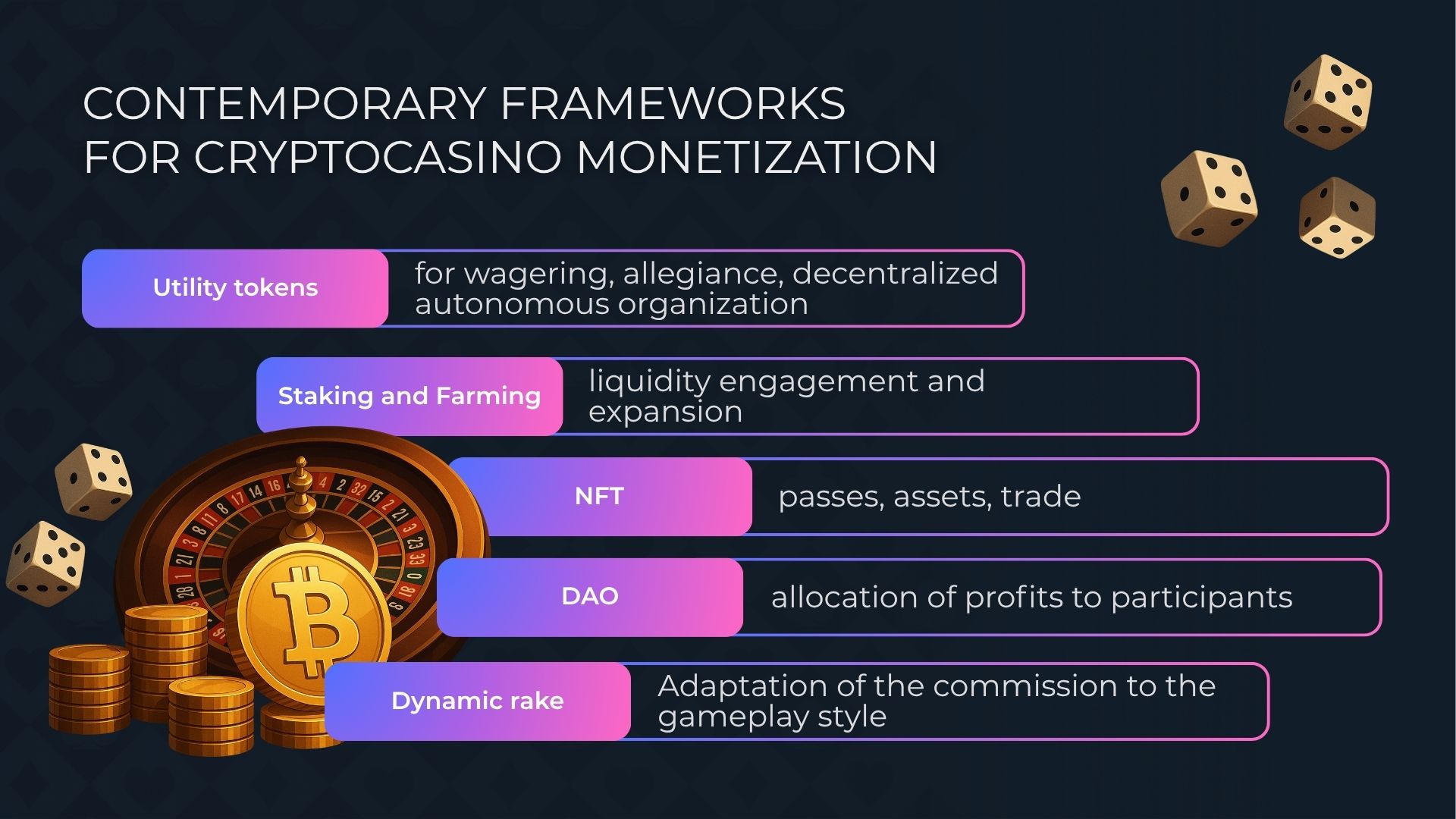
Main Revenue Streams of Crypto Casinos
|
Component |
Brief Description |
Purpose & Impact |
|---|---|---|
|
Native Utility Token |
Used for betting, bonuses, loyalty tiers, and DAO participation |
User retention and internal economy |
|
Staking & Farming |
Rewards for locking tokens or joining a liquidity pool |
Increases engagement and TVL stability |
|
NFT Mechanics |
Game assets, VIP feature access, secondary market trading |
Additional monetization and user engagement |
|
DAO & Profit Sharing |
A share of revenue distributed to token holders or active participants |
Attracts and retains long-term participants |
|
Dynamic Rake |
Flexible commission based on player behavior and status |
Gamifies betting and lowers entry barriers |
Mini Case: How Monetization Works in Practice
Platform A launches the A-Coin token with limited issuance and full integration into the gaming process. Bets and in-game transactions are conducted exclusively in A-Coin.
Users receive increased cashback when holding the token for more than 30 days. Staking access unlocks monthly profit distribution.
In parallel, a series of NFT passes is issued, granting access to exclusive tournaments with zero rake and higher prize pools. On the secondary market, NFTs are traded by active players, generating additional capital turnover.
This model combines operational and financial incentives, creating a closed-loop economy and enabling traffic recirculation.
Technological Architecture: How to Launch a Crypto Casino in 2025
A successful crypto casino launch requires more than adapting a traditional gambling product to cryptocurrencies. It involves designing the entire architecture with Web3 logic, decentralization, and financial transparency in mind.
In 2025, the minimum set of technological components includes the following:
Infrastructure
-
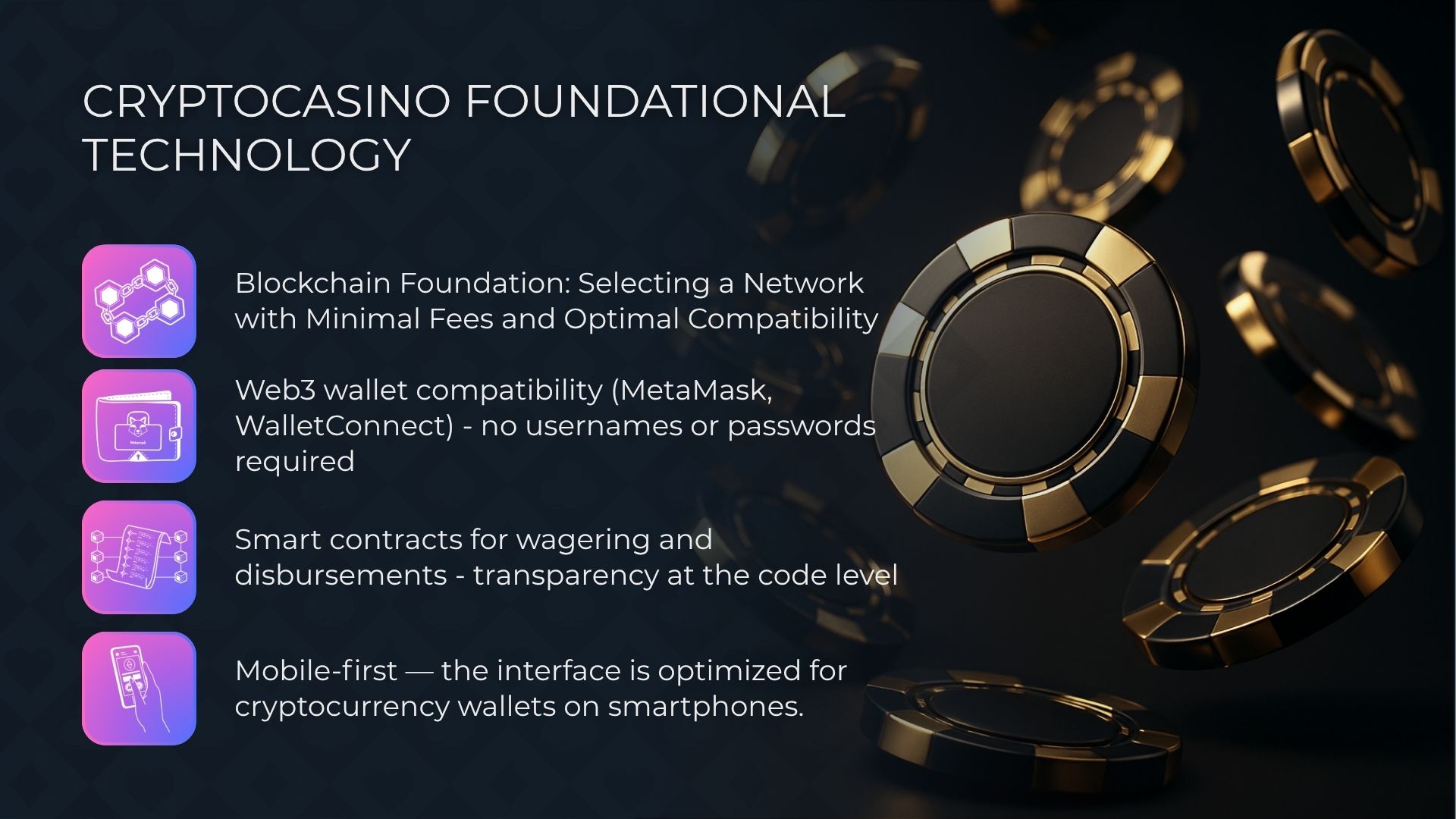
Blockchain Stack: the choice of network (Ethereum, Polygon, BNB Chain, Layer 2 solutions) determines transaction costs, scalability, and DeFi integrations.
-
Wallets: mandatory support for non-custodial wallets (MetaMask, Trust Wallet), ideally integrated via WalletConnect.
-
On-Chain Transparency: using smart contracts for bets and withdrawals increases trust and reduces regulatory risks.
UX & Game Mechanics
-
Secure Access: authentication via Web3 wallets, without username/password.
-
Instant Deposits/Withdrawals: direct interaction with DeFi protocols or stablecoin integration (USDT, USDC, DAI).
-
Interactivity: gamification of the user journey, NFT rewards, and access tiers based on activity.
-
Mobile-First: responsive interfaces for mobile wallet interaction — a standard for the new audience.
Adapting to the Web3 Audience
-
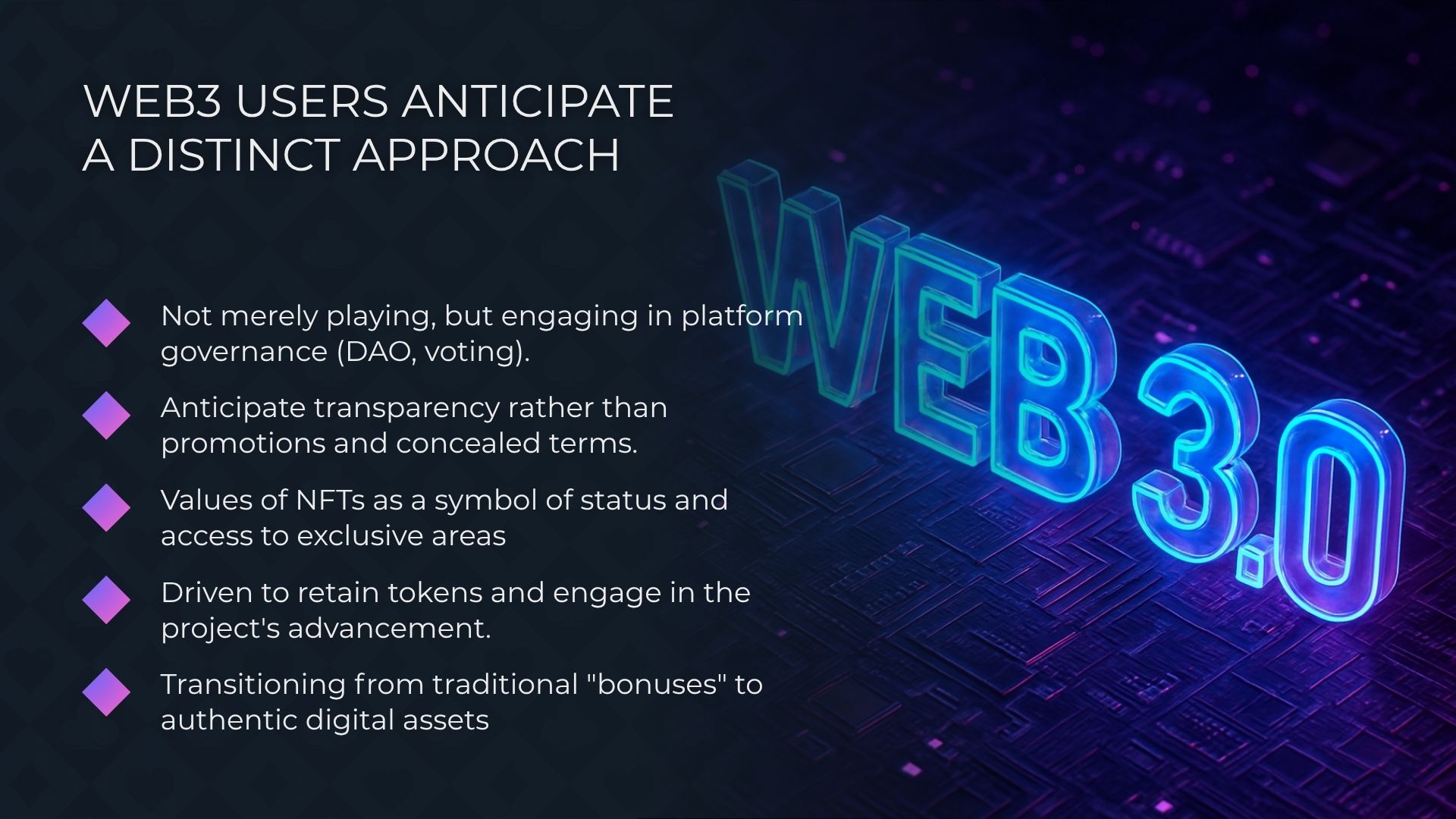
Crypto casino users are highly knowledgeable in DeFi and expect transparency rather than hidden terms.
-
Traditional retention tools (bonuses, free spins) are giving way to DAO voting, token-based incentives, and community engagement.
-
The focus is shifting from “VIP status” to NFT-based access and community roles.
Launching a crypto casino today means moving from the role of operator to that of an ecosystem organizer. The technical foundation must be flexible, while the user journey should be transparent, secure, and intuitive for an audience accustomed to DeFi products. The business model is built not only on betting revenue but also on engaging users in the project’s economy from their very first click.