


 Artificial intelligence has become a defining tool for competitiveness in online casinos: decision-making speed, risk-control accuracy, player behavior prediction, the effectiveness of personalized mechanics, and the scalability of operational processes.
Over the past two years, the role of AI in iGaming has changed: it has evolved from a standalone module into a technological layer that influences the entire player lifecycle — from registration to returning to the platform. Operators integrating machine-learning models into marketing, security, and product management reduce costs and increase LTV without raising traffic expenses. Such capabilities have become a crucial advantage for any casino platform, whether it is part of a white label online casino solution or a fully independent online casino platform.
Below are the areas that have a direct impact on platform profitability. In this article, we will examine practical AI application scenarios that have already demonstrated economic efficiency in real-world cases.
1. Personalization and Player Lifecycle Management
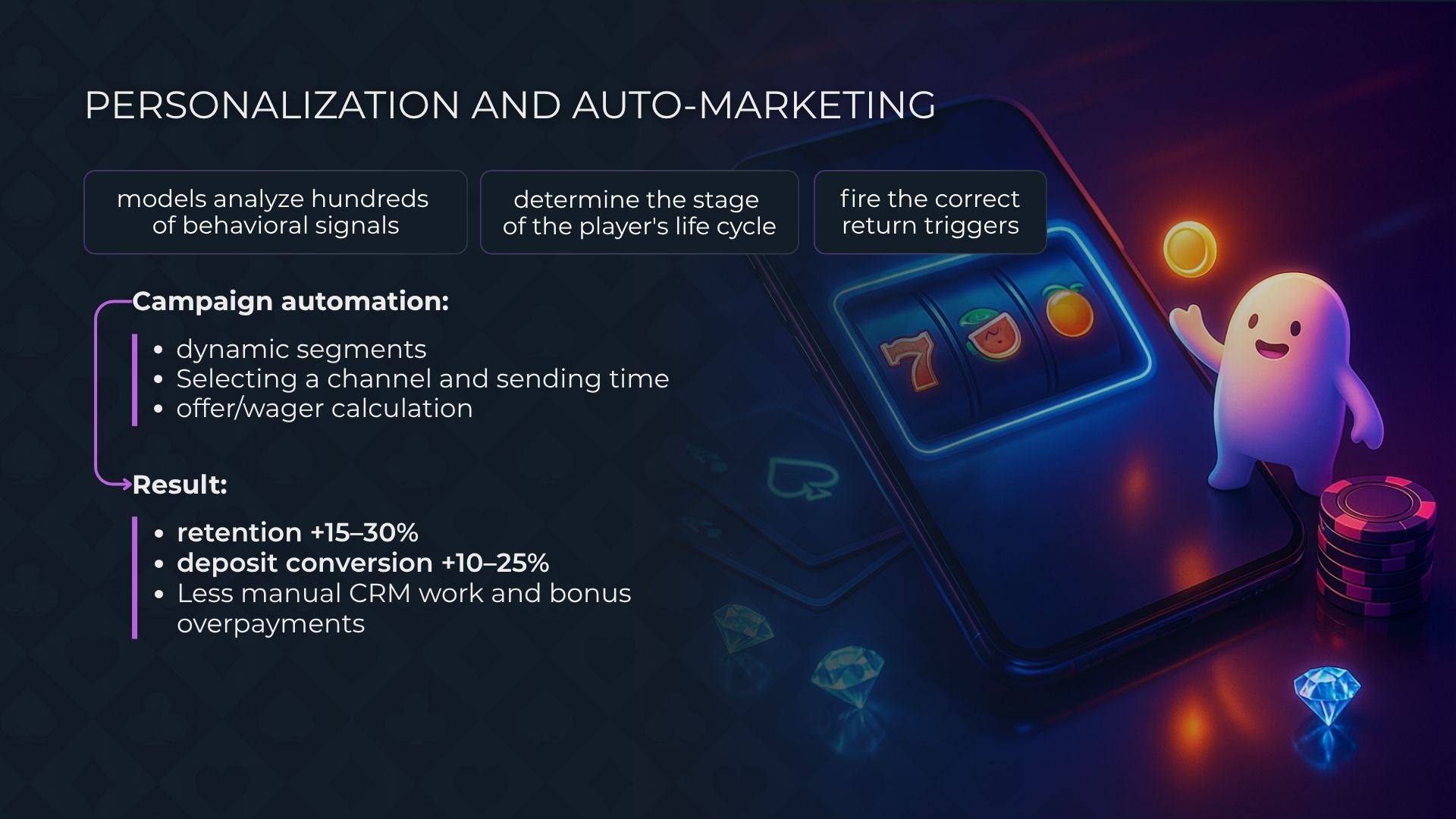
AI models analyze player behavior across hundreds of parameters: deposit frequency, preferred providers, session duration, bonus sensitivity, and response to communications. Based on these data points, the system determines the current lifecycle stage (active player, cooling-off, high churn risk) and generates individualized recommendations.
What this gives the operator:
-
Retention growth of 15–30%: relevant offers bring players back without aggressive pressure.
-
Higher LTV through dynamic bonus models and personalized promotions.
-
Motivation budget optimization: the system does not distribute bonuses broadly but offers them to those who are likely to return after an incentive.
-
Accurate triggers: AI detects when a player is close to churning and automatically activates a re-engagement campaign.
2. Anti-Fraud, AML, and Comprehensive Security
Security is not only a regulatory requirement but also a key factor in the stable economy of any casino. Fraud, bonus abuse, multi-accounting, and money laundering cause operators direct financial damage. For many casino software providers and igaming software provider companies, advanced AI models have become an essential component of modern casino software architecture.
AI systems minimize these risks:
-
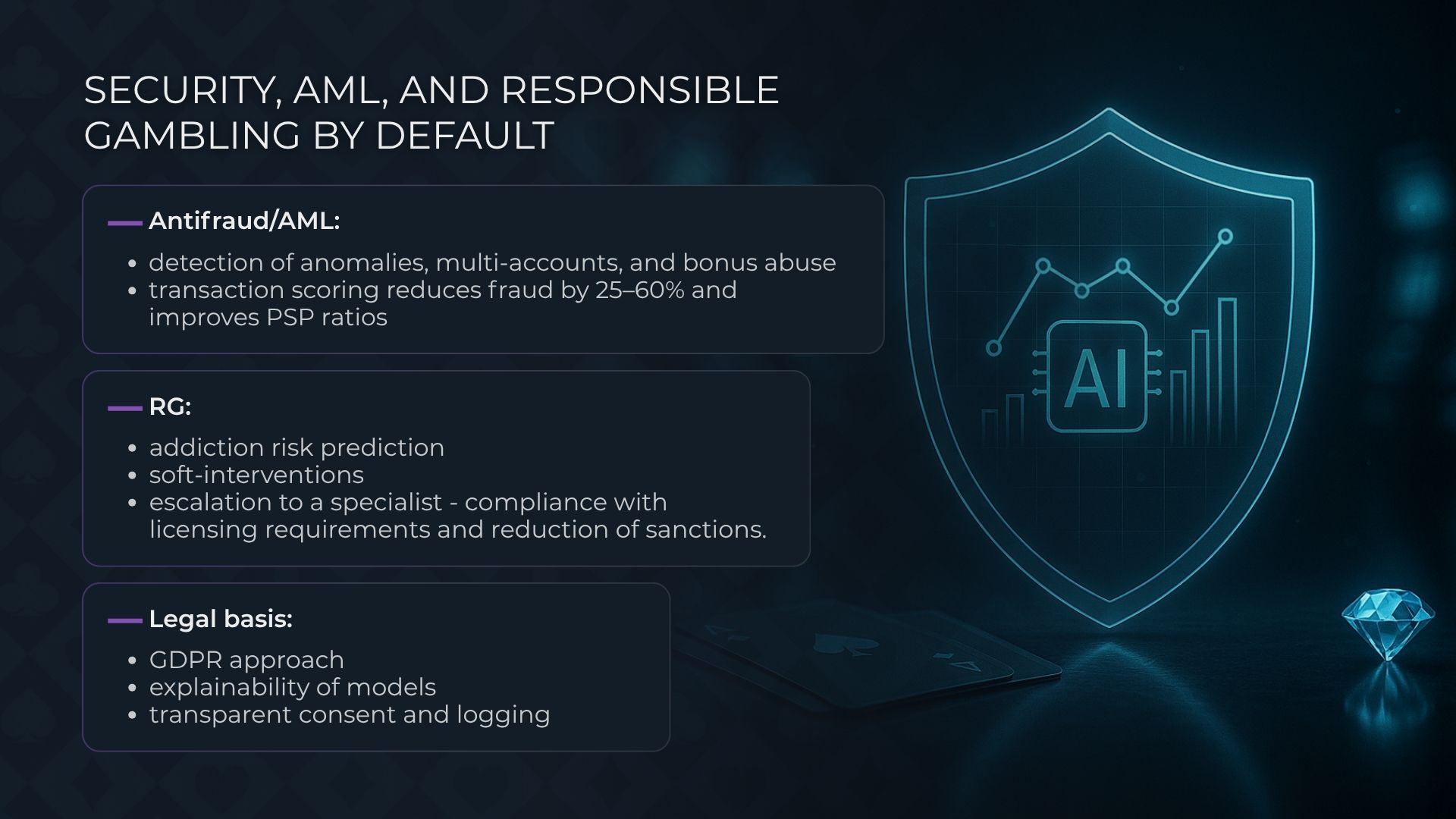
Anomaly detection: instant identification of multi-accounting, fraudulent schemes, and suspicious payout chains.
-
Automated transaction risk scoring (AML scoring).
-
Bonus abuse monitoring — clustering players by behavior type and detecting irregular patterns.
-
Reduced compliance workload: AI pre-filters cases, allowing staff to review only complex situations.
What changes for the operator:
-
Fraud reduction by 25–60%, depending on the market.
-
Minimized losses related to withdrawals.
-
A “cleaner” customer base increases PSP trust and accelerates the integration of new payment methods.
Related topic: Casino Security in 2025
3. Marketing Automation: Segmentation, Triggers, Messaging, Offer Calculation
Marketing in iGaming consists of dozens of daily campaigns that are difficult to manage manually. AI platforms eliminate this burden and make communications more precise.
How it works:
-
Creating dynamic segments based on behavioral patterns.
-
Automatic selection of the communication channel (push, email, SMS, in-app).
-
Generating personalized offers: bonus percentage, wagering requirements, validity period.
-
Choosing the optimal sending time when the response probability is highest.
Measurable results:
-
Deposit conversion increase by 10–25% due to more relevant offers.
-
Reduced manual workload for the CRM team.
-
Lower bonus costs as the system eliminates unnecessary “overpayments.”
Related topic: How to Attract and Retain Players in Your Casino?
4. Generative AI in Game and Interface Development
Generative models accelerate content production — from slot graphics to UI elements. Manufacturers are increasingly focusing on this area:
-
Creating visual assets, characters, backgrounds, and animations.
-
Generating slot themes and storylines.
-
Fast UI adaptation for local markets: colors, layout, linguistic nuances.
-
Prototyping user interfaces for further refinement by the operator.
Why operators need this:
-
Rapid testing of game concepts without studio expenses.
-
Ability to create unique tournament events with custom visuals.
-
Interface updates without long production cycles.
5. Real-time Player Behavior Analytics
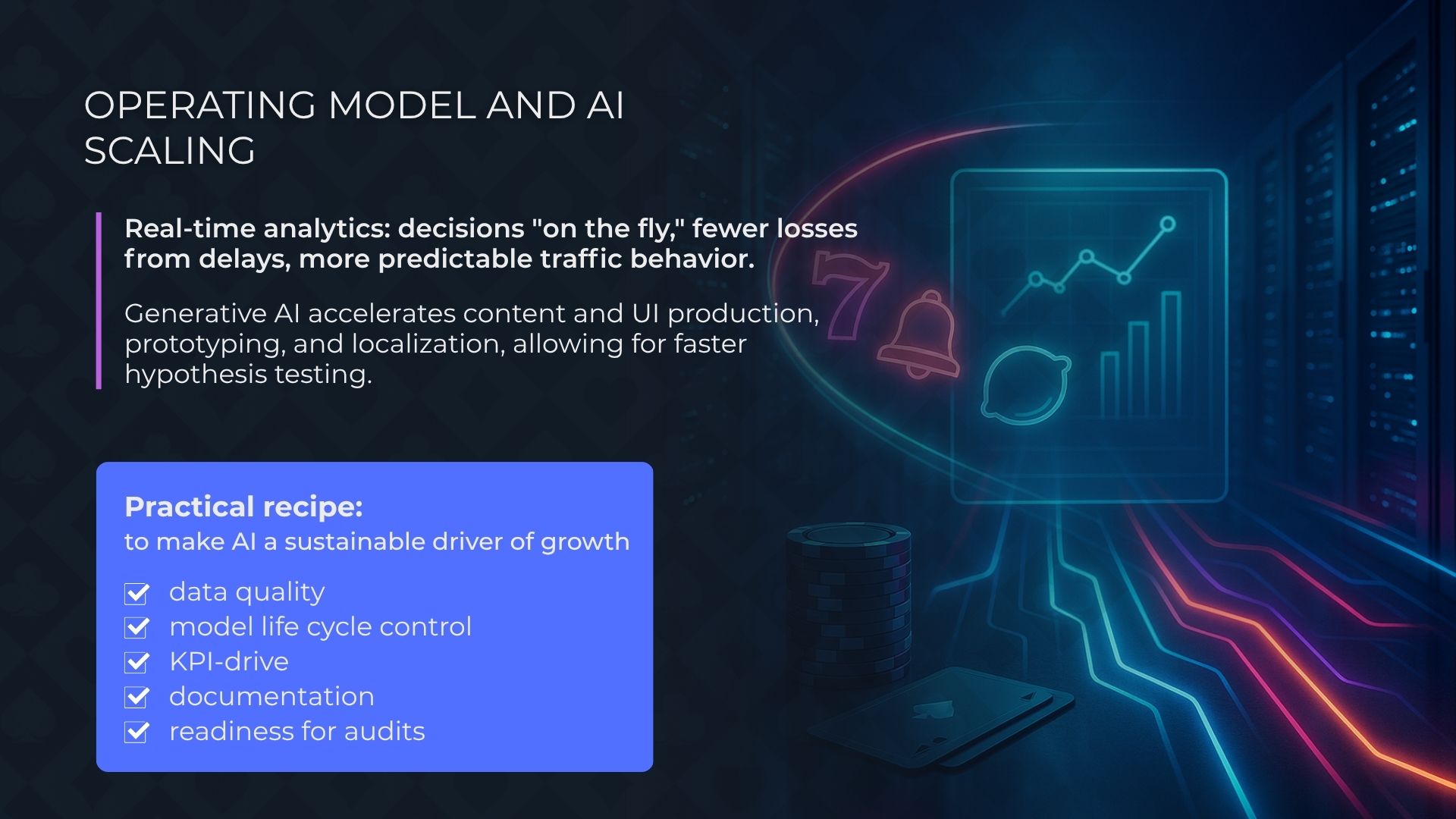
AI processes data in real time and instantly reacts to user behavior. This changes the platform management logic: decisions are no longer made “after the fact,” but at the moment of the event.
Key scenarios:
-
Automatically identifying “hot” segments ready to make a deposit.
-
Managing limits, bet speed, and digital wallets.
-
Monitoring games with irregular statistics (abnormal win distribution, suspicious activity).
-
Preventing technical incidents: models detect deviations and signal failures before players complain.
What the operator gains:
-
Fewer losses from delays and errors.
-
More predictable traffic behavior.
-
Ability to quickly adapt offers and UX to current player activity.
Related topic: How Player Behavior Data Shapes Business Strategy
6. Odds Management and Forecasting (for Sports Betting)
Sports betting is a mathematical discipline. Using AI gives operators a significant advantage, especially in markets with high competition among bookmakers and where online casino software or turnkey casino ecosystems integrate sportsbook modules.
Capabilities:
-
Forecasting outcome probabilities based on multimodel analysis.
-
Real-time odds adjustment as events unfold.
-
Detecting arbitrage bets.
-
Automated margin management for maximum profitability.
Results:
-
Stable margin regardless of market activity.
-
Minimized losses from aggressive betting strategies.
-
Higher product competitiveness in equal markets.
Related topic: Want to Launch Your Own Bookmaking Platform? What You Need to Know in 2025
7. Chatbots and Support Automation
AI assistants already handle a significant portion of support requests, reducing the load on human operators.
Use cases:
-
Handling standard inquiries (withdrawals, bonuses, verification).
-
Contextual hints within the interface.
-
Automatic ticket classification.
-
Escalation to a live agent in non-standard situations.
Practical benefits:
-
Reduced operational costs.
-
Faster response times, improving retention.
-
Compliance with Responsible Gambling standards: the bot can warn about risky behavior.
8. Responsible Gambling: Monitoring and Early Intervention
Responsible Gambling is no longer a formal requirement. AI helps operators meet regulatory obligations and protect players.
What AI does:
-
Predicts the risk of developing gambling addiction.
-
Identifies problematic patterns: aggressive deposits, sudden increases in playtime.
-
Initiates soft interventions: warnings, reminders about limits.
-
Escalates cases to a specialist when risk thresholds are exceeded.
What the operator gains:
-
Compliance with licensing and PSP requirements.
-
Lower probability of sanctions.
-
Improved brand reputation.
Related topic: Responsible Gambling and Profit: Why Online Casinos Should Integrate RG in 2025
Legal and Regulatory Risks
The use of artificial intelligence technologies in online casinos is directly linked to compliance with data processing rules, Responsible Gambling requirements, and algorithm transparency regulations. For an operator, this is not a formality: non-compliance may result in licensing denials, blocked advertising channels, and restrictions from payment providers. Therefore, AI implementation must be supported by proper documentation, legal procedures, and full lifecycle control of the models.
GDPR and Personal Data Protection
The European GDPR framework remains a benchmark even for operators outside the EU. Most licenses and PSPs require adherence to similar standards.
An operator must:
-
process only the data that is strictly necessary;
-
explain the purpose, methods, and scope of AI-model usage;
-
ensure the player’s right to access, correct, and delete their data;
-
guarantee the security of storage and transmission channels.
AI systems complicate GDPR compliance: operators must control training datasets and prevent the accidental accumulation of sensitive attributes.
Algorithm Transparency
Regulators are strengthening requirements for Explainable AI. This is crucial for systems affecting the player’s financial decisions:
— limits,
— restrictions,
— antifraud scoring,
— automated risk-behavior detection.
The operator must be able to describe model logic and prove that algorithms do not discriminate against players or violate their rights.
Consent for Data Processing
Players must clearly understand that their behavior is used for personalization, antifraud analysis, and Responsible Gambling mechanisms.
This includes:
-
a clear user interface for consent;
-
explicit mention of AI usage;
-
the ability to withdraw consent;
-
no hidden data processing without notification.
Consent must be logged — this is essential during license audits.
Responsible Gambling Reporting
Models assessing problem-gambling risks must include:
-
documented intervention rules;
-
risk levels;
-
notification and restriction algorithms;
-
escalation procedures to support staff.
Licensing authorities require reports on system performance, including the number of interventions, decision justifications, and effectiveness metrics.
Expert Conclusion
Effective AI implementation in an online casino requires a systematic approach: data quality, model control, and algorithm transparency. Operators who build integrated processes for personalization, antifraud, and marketing gain a sustainable advantage in player retention and cost optimization.
The key success factor is managing AI as a business tool — measurable KPIs, transparent decision logic, strict regulatory compliance, and readiness for rapid scaling.
This approach transforms technology from an experimental asset into a real driver of growth and competitiveness for any online casino platform, white label casino, or igaming software provider.