


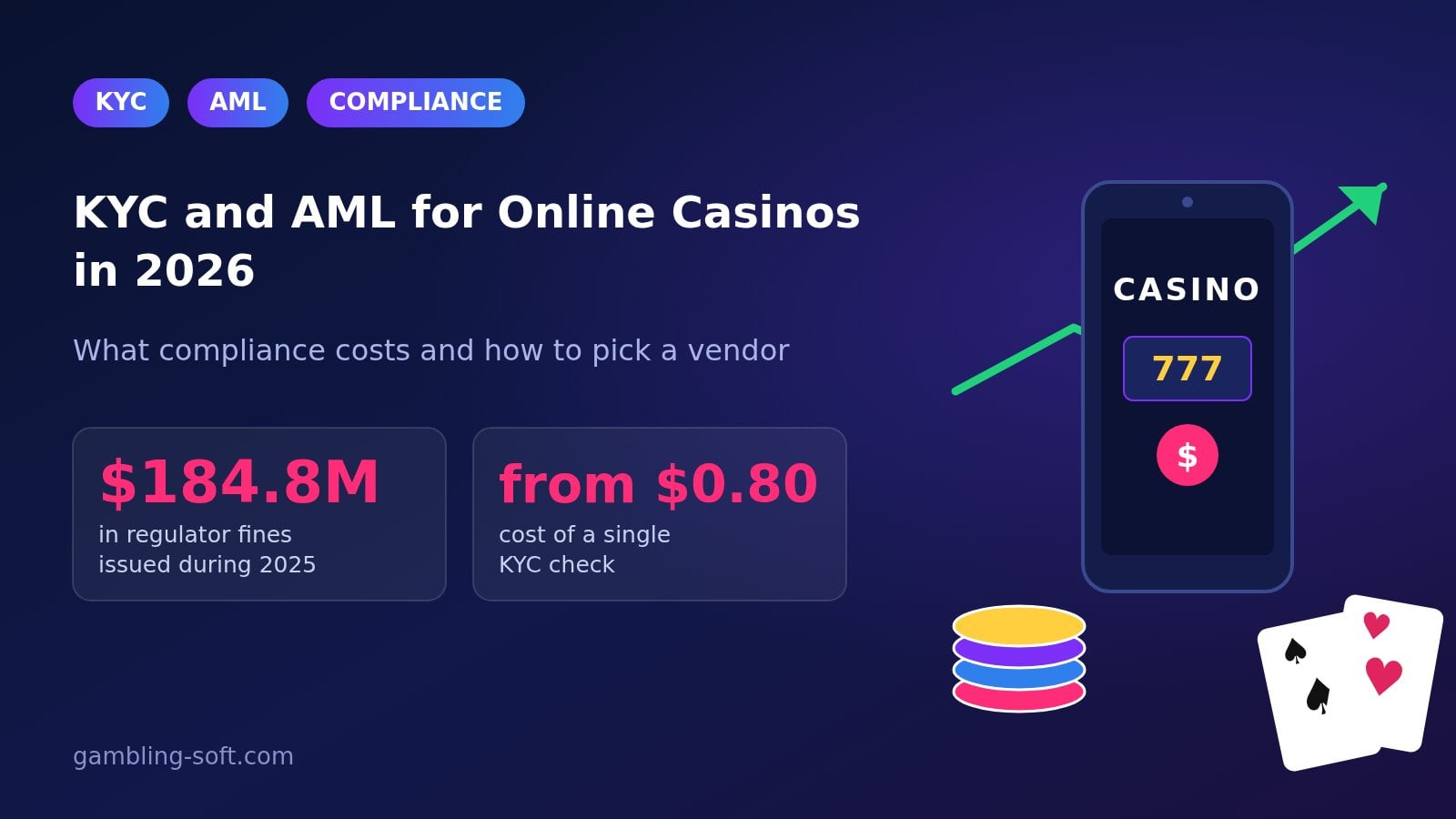
Regulators fined gambling operators at least $184.8 million in 2025. The UKGC alone took action against 13 operators between May and December, topped by a record £10 million penalty for Platinum Gaming (the Unibet brand) over AML gaps. So if you are budgeting a casino launch and compliance is still a line item marked “later” — this article is for you. Here is what a KYC/AML stack looks like in 2026, what checks actually cost, and how I’d go about choosing a vendor.
The fines are real money now
Videoslots got off with £650,000. Spreadex paid £2 million. Gamesys — £6 million plus a mandatory third-party audit on top. And that is just one regulator in one country.
I have watched the same movie many times: a new operator wants traffic first, verification “sometime after launch”. Then the payment provider sends its first source-of-funds request, and suddenly it is all hands on deck — frozen settlements, hundreds of accounts to review manually, and a compliance process being written overnight. Building it before launch is cheaper. Every single time.
What goes into a casino KYC/AML stack
The 2026 minimum: document verification with liveness detection, sanctions and PEP screening, transaction monitoring, and a source-of-funds procedure for your VIPs. Plus a named human who owns all of it — several jurisdictions now require a dedicated compliance officer by law, not as a nice-to-have.
One practical note: identity verification and AML screening are often two separate contracts. Sumsub and iDenfy cover both from one dashboard. A cheap document checker glued to a standalone screening tool looks thrifty on paper and almost always costs more in maintenance.
What checks cost in 2026
A full KYC check runs anywhere from $0.55 to $3. Published rates: Veriff from $0.80 per check on the self-serve tier ($1.39 at the standard rate), iDenfy at $1.35, Sumsub at $1.85. Screening is billed separately — ComplyAdvantage’s starter plan is $99.99 a month for up to 2,000 monitored profiles.
The devil is in the billing model. Veriff charges for every completed session, rejected ones included. iDenfy bills only for approved verifications. With a 20–30% rejection rate — normal for tier-3 geos — that difference adds up fast. Always ask what exactly triggers a charge: an attempt, a session, or an approved user.
Enterprise contracts with monthly minimums typically start at $1,000–2,000. Under 3,000–5,000 registrations a month? Skip the commitment and go pay-as-you-go.
Jurisdiction requirements worth knowing
Curacao under the LOK
The LOK has been in force since late 2024, and by 2026 the CGA is checking homework for real. Verification is mandatory for transactions from roughly NAf 4,000–5,000 (EUR 2,000–2,500), you need a regulator-approved compliance officer, and FIU reporting runs through goAML. The old “KYC on withdrawal, if we remember” era is over.
Brazil
The toughest onboarding among mass markets. Face Match with liveness detection is mandatory at registration and first deposit, and Ordinance 722 adds periodic re-authentication on withdrawals. Add local data hosting and ISO 27001 certification. Not every vendor handles Brazilian documents and CPF validation well — test before you sign.
The UK and EU
The UKGC looks past identity verification to affordability checks, and that is where operators burn: KYC formally passed, yet nobody asked a player depositing £50,000 where the money came from. The fines above tell you how that ends.
How I shortlist a vendor
Document coverage for your specific geos comes first. A vendor with a slick demo may still fail on Nigerian NIN slips or older Argentine DNI cards. Ask for approval rates in your target countries, not a global average.
Then the rest: verification speed (anything over two minutes kills deposit conversion), the billing model, a sandbox and a sane API, and how edge cases get resolved — is there manual review, and what does it cost?
Run a pilot on 500–1,000 real checks before committing to an annual contract. The recurring horror story: a great per-check price locked in for a year, and a month later half the selfies from your main geo are failing liveness.
Budget: a worked example
Take a casino with 10,000 registrations a month, of which 6,000 reach verification. At $1.35 per approved check that is $8,100. Screening and monitoring add $100–500 a month at the start. A compliance officer: from EUR 1,500 monthly outsourced, EUR 4,000–5,000 in-house in the EU. Call it $10,000–12,000 a month for a mid-sized project — plan your unit economics around it from day one.
There is a shorter road. With white label solutions the KYC flows and AML policies come pre-configured under the platform’s licence — compliance ships as part of the package. In turnkey casino development we integrate your chosen KYC vendor and draft AML policies for your jurisdiction during the build. And wiring verification into deposit-level anti-fraud rules is a matter of properly configured payment solutions.
FAQ
Can you launch without KYC at all?
Technically yes, on a no-KYC crypto model. In 2026 that means a narrow pool of payment providers, banking headaches and a standing risk of blocks. For a licensed, white-market business the short answer is no.
One vendor for all markets or several?
Up to 5–7 geos, one strong vendor is usually enough. Beyond that, routing starts to make sense — say, a Brazil specialist for Face Match plus a primary vendor for everything else.
How long does KYC integration take?
Three days to two weeks via SDK, rules setup included. The slow part is never the tech — it is agreeing on AML policies and enhanced due diligence thresholds.
What happens if you cut corners on compliance?
See the first section: £650,000 and up. And a fine is not the worst case. Worse is a payment provider freezing your funds “pending review” while the review stretches into month six.