


Updated 30 September 2026. Author: Gambling Soft team.
Short answer: Start with an aggregator: one API and one contract give you hundreds of studios, and the extra cost is usually 1-4% of GGR on top of the studio rate of 8-15%. Connect directly only the two or three studios that drive most of your turnover, once volume makes that margin worth 6-10 weeks of work per integration. The Gambling Soft platform comes with game aggregation already integrated, starts from $7,500 and launches in 7 business days (see prices).
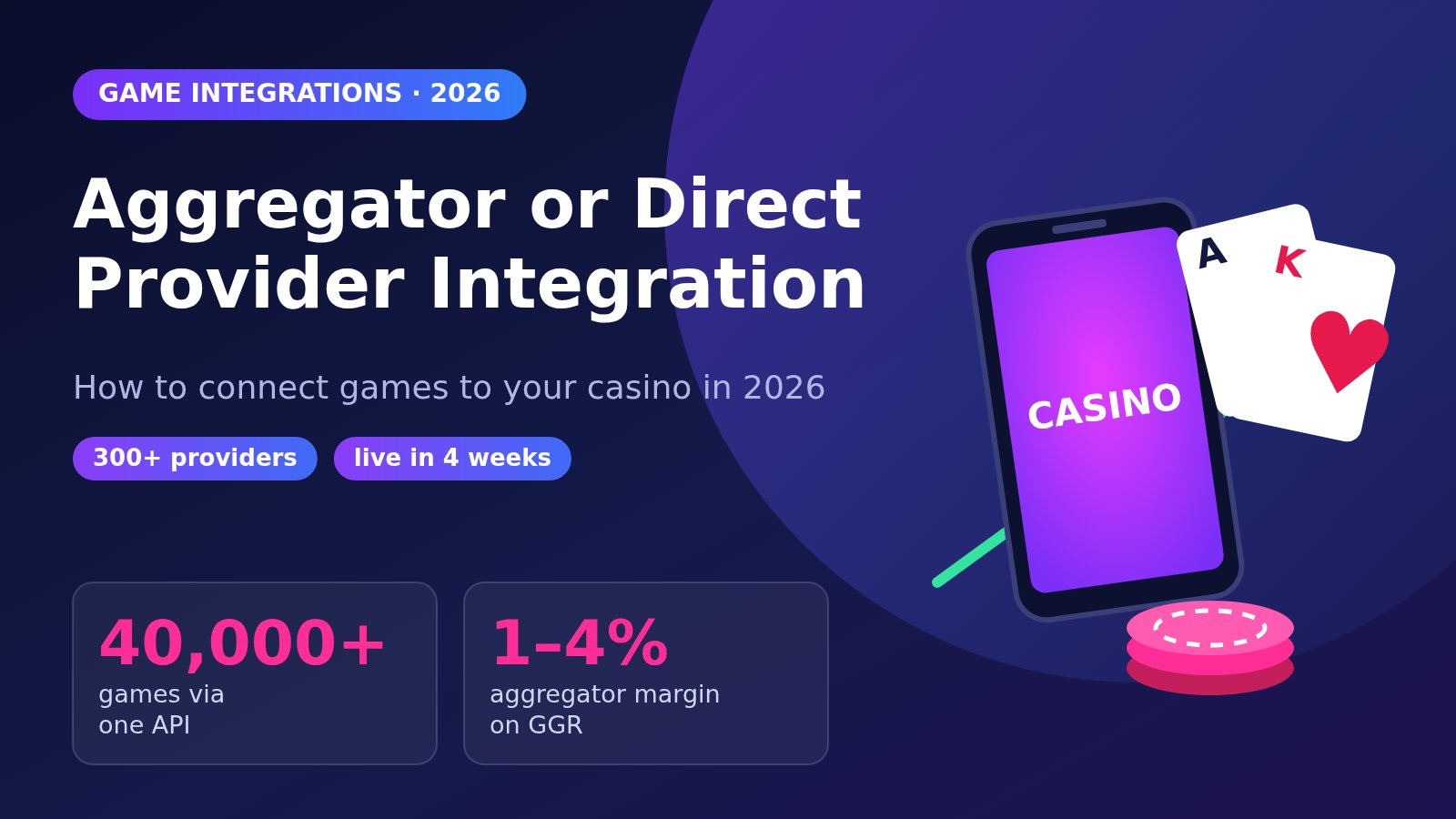 The question I field more than any other from new operators sounds technical but isn’t: how many game studios should I connect, and how? What they’re really asking about is money and headaches. Pick the wrong model and your first six months go one of two ways: you overpay for flexibility you don’t use, or you keep patching integrations that were supposed to just work.
So let me lay it out plainly, minus the sales gloss. I’ve launched casinos on direct integrations, on a single aggregator, and on a blend of both. Each route carries a price tag you don’t see on day one.
The question I field more than any other from new operators sounds technical but isn’t: how many game studios should I connect, and how? What they’re really asking about is money and headaches. Pick the wrong model and your first six months go one of two ways: you overpay for flexibility you don’t use, or you keep patching integrations that were supposed to just work.
So let me lay it out plainly, minus the sales gloss. I’ve launched casinos on direct integrations, on a single aggregator, and on a blend of both. Each route carries a price tag you don’t see on day one.
Two models, and the choice is not cosmetic
It comes down to two paths. Wire up studios one at a time (your own contract, your own protocol, separate certification with each) or plug into an aggregator that hands you hundreds of studios behind a single API. The aggregator sounds like the obvious winner. It usually is, but not always. Going direct keeps the margin in your pocket and gives you a straight line to the studio, yet every new brand of games is its own mini-project. An aggregator saves you months of dev work, then takes a slice of revenue and quietly becomes your one point of failure. Which side wins depends on your stage and how many studios you’ll actually run.What it really costs in 2026
Money first, because this is where the illusions live. A studio’s base rate is a revenue share on GGR. Small-to-mid operators typically sit at 8-15%; push serious volume and it slides to 5-8% (2026 market rates). The aggregator layers its own margin on top, usually 1-4% of GGR on the traffic it routes. Do the math: if the studio charges 12% and the aggregator adds 2%, you’re paying 14% on gross revenue from those games. Regulated markets often use a different shape: a fixed fee plus a percentage, say a $10,000 setup and 5% GGR, so both sides share the certification and compliance risk. Now direct integration. It looks cheaper on paper: “we only pay the provider, no markup.” True, until you count the build. A mid-size operator carrying 20 direct integrations budgets 6-10 weeks of engineering per provider, plus QA, legal review, and certification that runs into tens of thousands of euros a year per jurisdiction. Multiply by studios, then by markets. That revenue-share saving evaporates fast.When direct integration actually pays off
Don’t read this as “direct is dead.” It isn’t. There are cases where it beats an aggregator outright. Say you run heavy traffic and most of your volume flows through two or three top studios. A direct deal saves you that 1-4% on every spin, and at scale that’s not loose change, it’s a department’s budget. You also get a direct line to the studio’s product team: earlier access to releases, room to negotiate exclusives, custom jackpots, promo mechanics branded to you. Through an aggregator those things move slower, if they’re on the table at all. The honest flip side: staffing a team that maintains a dozen direct integrations and tracks certification in every market is not something most shops can carry. It’s operational weight, not a one-off task.The aggregator: one API, and its weak spot
Here the numbers speak. SOFTSWISS serves 40,000+ games from 300+ providers through a single integration, with a claimed 99.999% uptime and certification across 24 markets. Slotegrator’s APIgrator lists 30,000+ games from 180 providers. Hub88 offers 12,000+ games from 150+ studios. Aggregators now hold roughly 35% of the global iGaming platform market, and that market is pegged near $655 billion for 2026. What you get: one contract, one protocol, one place for reporting, compliance, and support. A prepared operator can push a full catalogue live in four weeks, versus 6-10 weeks for a single direct studio. Here’s what the sales decks skip. The aggregator is a single point of failure. Their API goes down and every game you have goes dark at once, not just one studio’s. You inherit their roadmap: which new titles get added, and when, isn’t your call. And that margin, small as it is, bleeds off every bet, forever, not once. On a two- to three-year horizon I’ve watched that “rounding error” grow into a line item nobody wants to defend.The hybrid most mature operators land on
Nearly every operator I know who’s outgrown the startup phase runs a hybrid, and the logic is simple. The top two or three studios that drive the bulk of turnover get wired in directly, because the margin saving there outweighs the maintenance hassle. Everything else (the long tail of hundreds of titles, niche providers, fresh releases you want to A/B test) comes through the aggregator. You hit both targets: margin where the money spins, speed and reach where variety matters. We usually design for this at the platform stage so nobody has to re-plumb integrations on a live product later.Timelines and the rakes people step on
A few things that cost more than they look. First, certification. Games certified for Curaçao don’t automatically travel to regulated Europe. Every new market is its own testing cycle, and an aggregator only softens that: you still need certificates tied to your licence. Second, integration quality beats integration count. I’ve seen a project where games were “connected,” yet bonus-round math and bet accounting leaked badly enough that reporting didn’t reconcile for weeks. Put uptime SLAs and downtime penalties in the contract. Without them, “99.999%” is just a nice line in a pitch. Third, don’t chase the game count on the shelf. Forty thousand titles sounds impressive, but an average casino earns its turnover on 150-300 games. The rest is catalogue decoration. Tune the top performers rather than boast about the total.What I’d tell you at launch
If you’re just opening and don’t have an in-house integrations team, start with an aggregator. Fast, predictable, all the risk sitting in one contract. That 1-4% markup won’t even register next to what you’re spending on marketing and licensing. Once volume grows and it’s clear which two or three studios actually feed the till, wire those in directly and shift to a hybrid. That’s the natural way a project matures, not a “launch mistake.” And if you’d rather not untangle it yourself, that’s exactly the job worth handing to a turnkey build, so the integrations sit right from day one.FAQ
Which is cheaper: an aggregator or direct integration?
At small-to-mid volume, the aggregator, because you skip tens of thousands of euros in build and certification cost per provider. At high volume on your top studios, direct wins: the aggregator’s 1-4% GGR margin, spread across scale, outweighs the one-time cost of connecting.How many providers does a casino need to launch?
Don’t chase the number. Fifteen to thirty strong studios with solid slots and a couple of live providers is plenty to open with. Your turnover will come from 150-300 games anyway, not the thousands in the catalogue.How fast can I go live through an aggregator?
A prepared operator launches a catalogue in 4-8 weeks, and some aggregators (SOFTSWISS, for one) quote from four weeks. A single direct studio takes 6-10 weeks plus certification.Can I combine both approaches?
Yes, and most mature operators do. Top studios go direct for margin; the long tail of content comes through an aggregator for speed and reach. That hybrid is the industry default.What should I check in an aggregator contract?
Uptime SLAs with downtime penalties, correct pass-through of bets and bonus rounds into reporting, the list of markets certified for your licence, the real size of the margin above the provider’s rate, and clean exit terms.Still assembling your stack? A ready-made casino software package comes with game aggregation already integrated, so you go live faster.
Read also
See also
- Online casino software pricing 2026 (full price list)
- How much does it cost to start an online casino in 2026
- Best turnkey casino software providers 2026: 10 compared
- Casino software comparison: Gambling Soft vs 9 vendors
- White label casino vs source code
- Ready-made casinos with source code
- Turnkey online casino: packages from $7,500 and the 7-day launch
- White label casino solutions
- iGaming platform features
- How to start an online casino in 2026: 7 steps