


What Pay Per Head actually is, and why it’s back in fashion
A guy emailed me last month with a familiar problem. He had a crew of about 40 mates who bet with him on WhatsApp, a spreadsheet held together with hope, and zero budget for a real platform. Should he buy a White Label? No. He should look at Pay Per Head first, and so should most people in his shoes. PPH is old technology dressed up nicely. It started with offshore shops in Costa Rica and Panama who rented betting software to local bookies. In 2026 that same idea ships as a proper SaaS product: mobile app, live betting, a call centre, decent reporting. The provider hands you a turnkey book, and you pay a flat weekly fee for every active player. No revenue share, no percentage of turnover. A price per head. That’s the whole pitch. The market underneath it is enormous and still climbing. Grand View Research puts global sports betting at roughly $123.4 billion in 2026, doubling to $236 billion by 2033. Precedence Research is more bullish still: $124.88 billion this year on the way to $325 billion by 2035, an 11.2% compound growth rate. Pick whichever forecast you trust — they all point the same direction.How the money moves
Let me walk a real scenario, because this model only clicks once you see the cash flow. You’re the agent. You’ve got 50 regular players. You sign with a PPH provider, and every one of those players gets an app and a site under your brand. Odds, lines, grading, support — the provider runs all of it. Your job is two things: the relationships and the bank. You collect deposits and pay out wins yourself, usually in cash or bank transfer, off-platform. The software is rented; the risk is entirely yours. When your players win, that money leaves your pocket. When they lose, it stays there. The revenue math is almost insultingly simple: players × bets × your hold. A private agent’s hold typically runs 3–15%, while the big regulated books survive on 5–10% of the vig. Say your 50 players each stake $500 a week and your hold lands at 8% — that’s $2,000 of gross margin. Then the provider takes their cut, and this is where the model earns its keep.What it costs in 2026
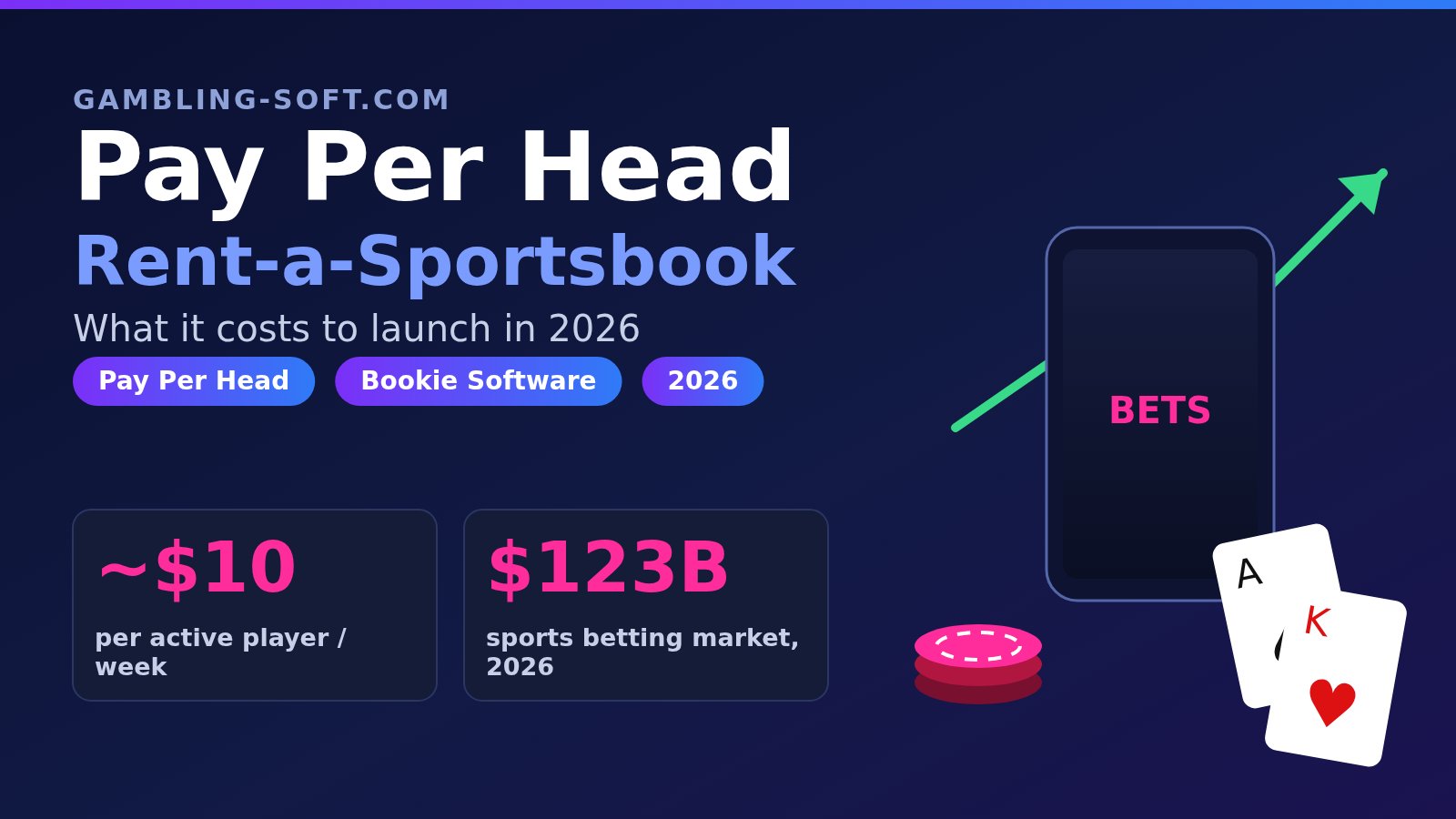
The industry standard sits around $10 per active player per week. The spread is wide, though. Budget tiers open at $3–7. Premium packages with a casino module, a custom app and deep reporting climb to $15–25 a head. Here’s the detail beginners miss: you pay only for active players — anyone who placed at least one bet that week. A dormant account costs you nothing. That single rule is what separates PPH from White Label, where fixed monthly costs land on your desk whether anyone bets or not. Back to our example. 50 active players × $10 = $500 a week to the provider. Your margin was $2,000. You keep around $1,500 weekly, with no spend on development, licensing or servers. It’s not hard to see why people entering the niche cold gravitate to this. One warning I give everyone: steer clear of anything under $5 a head. Below that line you almost always find half-baked software, sloppy lines, and a site that buckles at kickoff. In this business a site that dies mid-match isn’t an inconvenience — it’s a customer walking out the door for good.PPH versus White Label, told straight
It irritates me when PPH gets sold as a “White Label killer.” They solve different problems. Pay Per Head is cheap to start and asks almost nothing of you up front — no licence in the basic case, no payment stack of your own, no dev team. It’s the perfect way to test a hypothesis and land your first hundred players. But it has a ceiling. Industry experience says a single agent hits a wall somewhere near 500 active players, the point where manual cash handling, comms and risk management simply stop scaling. White Label is about scale and about owning a brand rather than renting one. It costs several times more, carries higher monthly fees, and often means splitting profit with the supplier. In exchange you own the product, you own the player data, and you grow without an artificial cap. My standing advice: start on PPH, prove your unit economics with real money, and once you’re brushing 300–400 active players, move to turnkey development and a platform of your own. I’ve watched operators fail doing the opposite — commissioning an expensive custom build for 20 players they hadn’t signed yet.The parts nobody puts on the sales page
Now the awkward bits. First, legal status. The classic offshore PPH setup lives in a grey zone, especially around the US market. If you’re building a licensed, regulated business in a specific jurisdiction, pure PPH probably won’t fit — you’ll need a licence and a compliant payment rail. What works for a neighbourhood bookie doesn’t graft onto a regulated product without a rebuild. Second, you carry the entire book. The provider banks their $10 per head no matter what. The cash gap, when two players catch a hot streak, is yours to cover. Without disciplined risk management and a reserve of eight to ten weeks of book turnover, one bad Sunday can end an undercapitalised agent. Third, payments. Taking deposits and pushing out withdrawals is the tightest bottleneck in the whole thing. The moment you outgrow cash and want to accept cards or crypto, you’ll need real payment solutions with anti-fraud and traffic split across providers. That’s usually the exact moment agents realise they’ve outgrown renting.Who it’s genuinely right for
Short version: anyone who already has an audience and wants to monetise it fast and cheap. A local fan community. An affiliate tired of shipping traffic to someone else’s brand for a thin revenue share. A casino operator curious about the sports vertical who doesn’t want to fund a separate build — handy, since plenty of PPH platforms now bundle a casino script, so bolting slots onto the book costs almost nothing. Who should skip it? Anyone planning to launch straight into a regulated jurisdiction with a public brand and paid advertising. There the cheap start becomes a dead end.FAQ
How much cash do I need to start on PPH? Technically almost nothing to get in the door — no licence at the start, no development. The real starting capital is your bankroll, the reserve you pay winners from. I wouldn’t launch with less than eight to ten weeks of your book’s turnover on hand. For 50 players that’s roughly a $15,000–25,000 cushion. What exactly am I paying the provider for? Platform rental: a branded site and app, lines and odds, automatic bet grading, an agent dashboard with reports, often a call centre and live betting. You pay a fixed sum per active player per week — around $10 on average in 2026. Is PPH legal? It depends on the jurisdiction, and there’s no one-size answer. The classic offshore arrangement sits in a grey area in many countries. If you want a fully compliant business, aim for a licence and a regulated platform rather than pure PPH. I’m not a lawyer — work this through with a specialist for your specific country before committing. When should I leave PPH for my own platform? Three signals usually line up: you’re nearing 400–500 active players, the per-head fee is eating a visible chunk of margin, and the rented software’s limits are starting to pinch. That’s when moving to your own turnkey platform pays for itself — you stop paying per head and start owning an asset.My bottom line
Pay Per Head isn’t a magic button. It’s a springboard — a cheap, fast, honest way to find out whether you actually have an audience and whether you can hold a book without blowing up. Sign your first hundred players on it, get your cash handling and risk discipline tight, run the real unit economics. Then take the brand and the data in-house. The model is good precisely up to the point where you outgrow it, and that might be the best thing you can say about any starter tool.Prefer to launch fast rather than build? You can buy casino software as a turnkey platform and go live in days.