


Updated 29 September 2026. Author: Gambling Soft team.
Short answer: In Mexico an online casino can only run as an extension of a land-based gambling permit issued by SEGOB, through a Mexican company (SA de CV or S. de RL de CV) that partners with a permit holder. The main taxes are IEPS at about 20-30% of the operator’s gross revenue and 30% ISR on profit, plus state charges. On the software side, the Gambling Soft platform starts at $7,500, ready-made casinos cost $8,500-$47,500 and launch takes 7 business days: see our pricing.
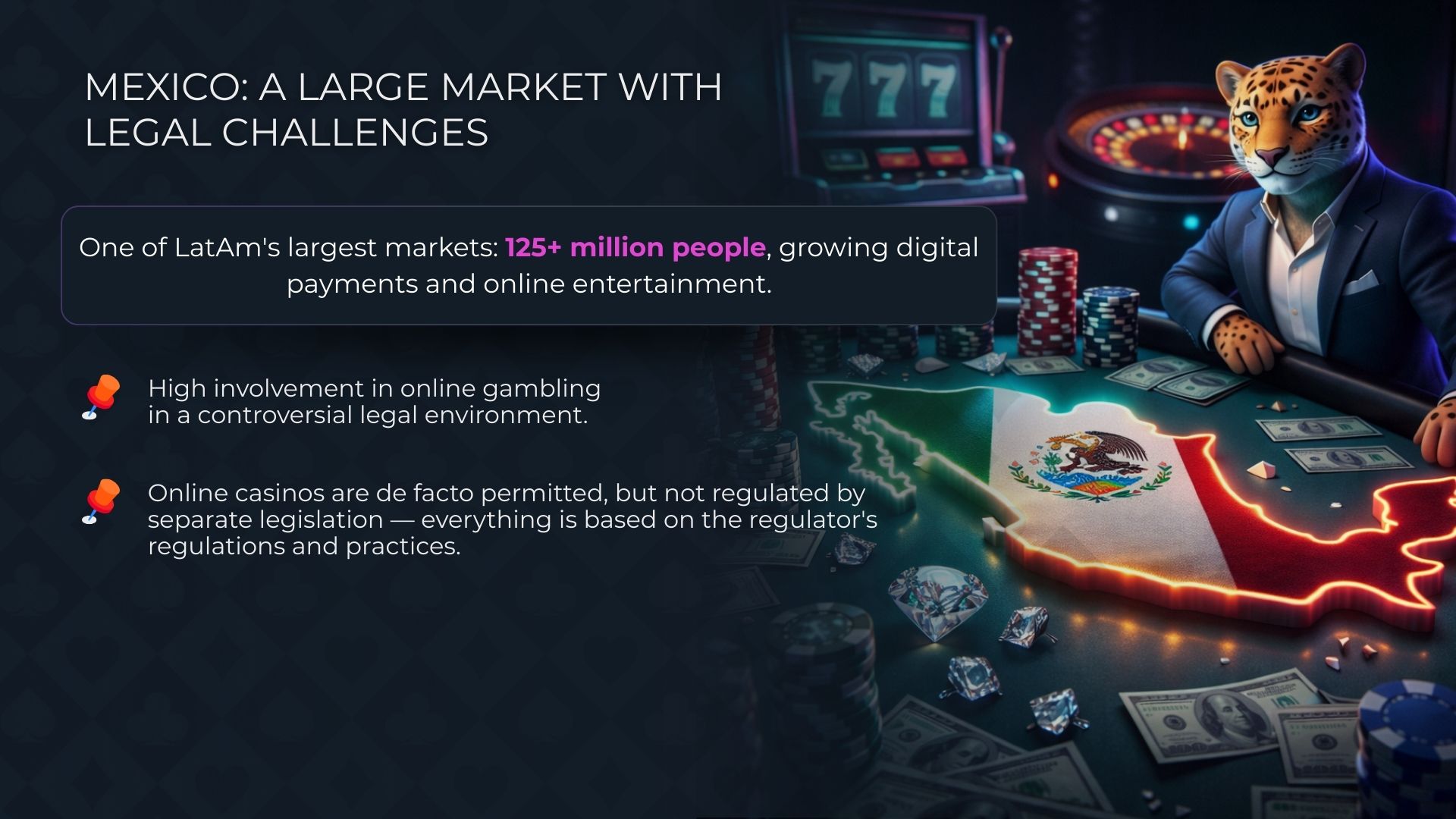 Mexico holds a special place on the global online gaming map. It is one of the largest markets in Latin America, with a population of more than 125 million, steady growth in digital payments and a highly engaged online entertainment audience. At the same time, the country pairs strong commercial potential with a complex and in many ways contradictory legal environment, which makes launching an online casino here both attractive and legally delicate.
The defining feature of the Mexican market is that online casinos are effectively allowed but are not regulated directly by a dedicated law. The main law was passed long before the internet existed and contains no provisions written specifically for online gambling. Instead, the sector is governed through secondary regulations, administrative practice and interpretations by the regulator, the Ministry of the Interior (SEGOB). As a result, online gaming is allowed only as an extension of licensed land-based activity, not as a stand-alone line of business.
In this article we look at how to launch an online casino in Mexico, how the model actually works, which legal restrictions you need to account for and which steps are really needed to enter the market.
Legal status of online casinos in Mexico
Are online casinos legal in Mexico?
The legality of online casinos in Mexico cannot be judged in simple “allowed or banned” terms. The Mexican gambling model works differently: online gambling is not regulated directly, but it is permitted through the regulator’s administrative practice.
The core law: Ley Federal de Juegos y Sorteos
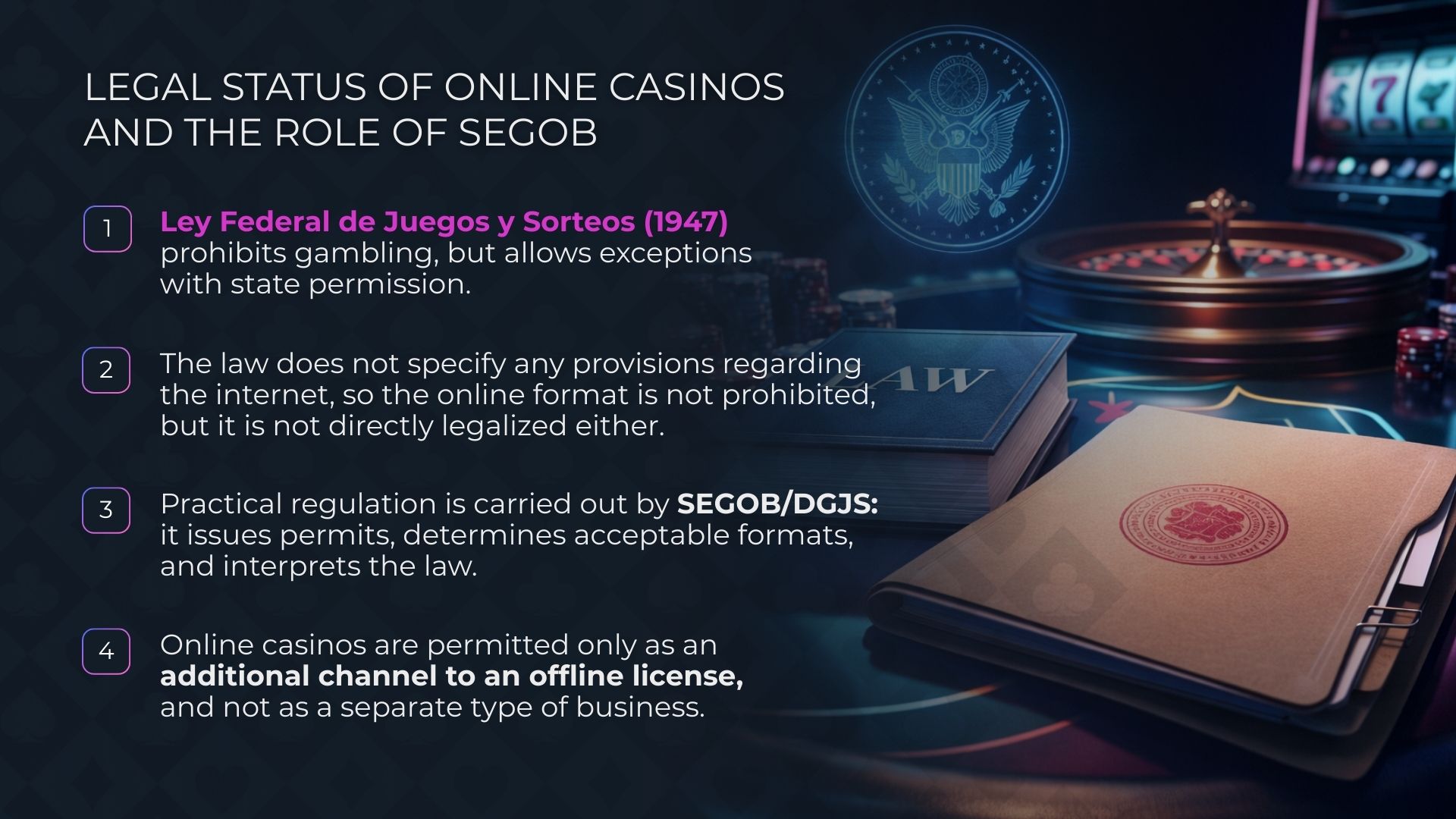
The federal law Ley Federal de Juegos y Sorteos was passed in 1947 and is still the foundation of gambling regulation in Mexico. Its key principle is a general ban on gambling with a list of permitted exceptions that the state can authorize.
The law was written for land-based formats and does not mention the internet, online platforms or remote betting even once. This means that online casinos are not directly prohibited, but no specific provision legalizes them either.
It is exactly this gap that allowed the regulator to build the current model for admitting online activity.
Regulations and the role of SEGOB
In practice, gambling is regulated not by the law itself but by its implementing regulations and by administrative decisions of the Ministry of the Interior of Mexico (Secretaría de Gobernación, SEGOB). Within SEGOB, the key body is the Dirección General de Juegos y Sorteos (DGJS), the office that issues permits, supervises operators and decides which business formats are allowed.
SEGOB acts as the central regulator for one reason: the law gives it exclusive authority to interpret and enforce gambling rules.
Online casino as an extension of a land-based license
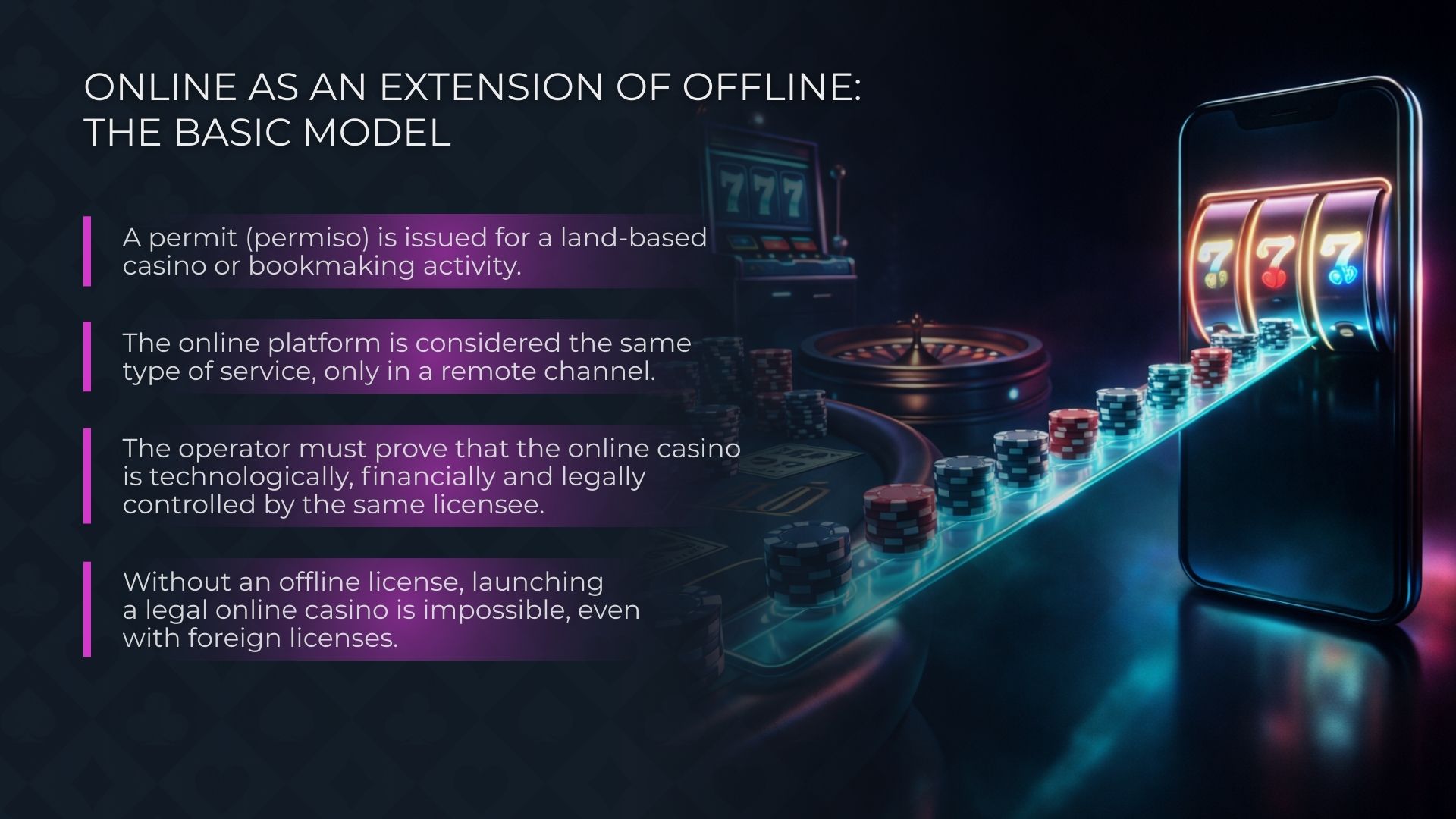
Online activity can only be carried out under a license issued for a land-based casino or a betting shop.
The legal logic of the model is as follows:
-
SEGOB issues a permit (permiso) for a specific type of gambling activity;
-
The online format is treated as an additional channel for delivering the same service, not as a new line of business;
-
The operator must prove that the online casino, the casino software and the casino infrastructure are controlled technically, financially and legally by the same licensee.
For this reason, an online casino in Mexico can be launched only through a licensed land-based operator. Without a land-based license of your own, legal online activity is ruled out automatically, whether or not you hold foreign licenses or have a company registered abroad.
Requirements for online casino operators in Mexico
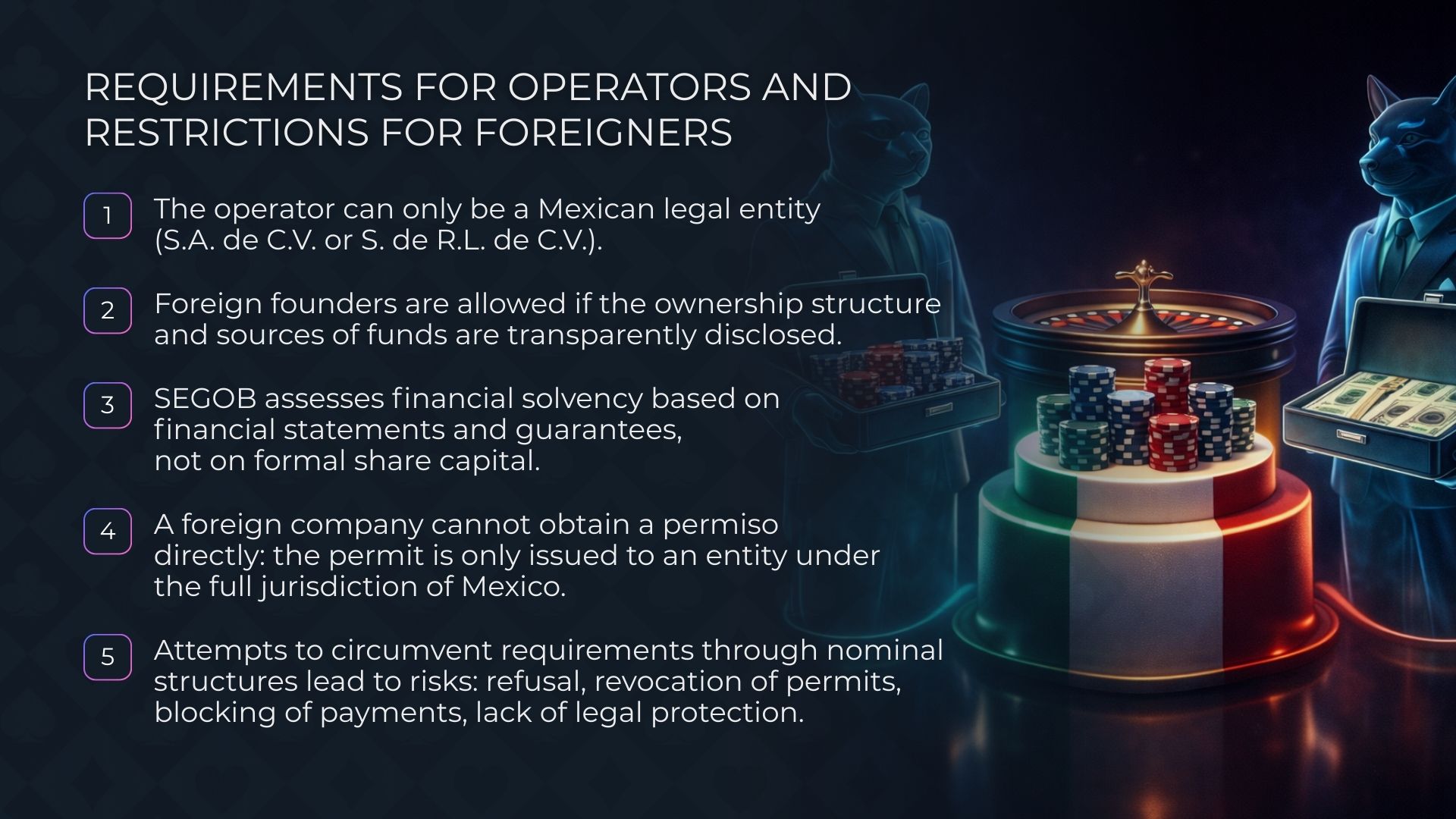
The regulator’s key requirement is that only a Mexican legal entity can act as the applicant and the gambling operator. This rule applies whether the project is a land-based casino or an online platform added to an existing license.
At the same time, Mexican law does not prohibit foreign ownership. Founders and beneficial owners can be foreign individuals or companies, provided the ownership structure is properly disclosed and tax and corporate law requirements are met.
In practice, the following legal forms are used most often:
-
SA de CV (Sociedad Anónima de Capital Variable): the equivalent of a joint-stock company and the most common format for iGaming projects running online casino software from a dedicated provider;
-
S. de RL de CV (Sociedad de Responsabilidad Limitada): the equivalent of a limited liability company, suitable for closely held structures with a small number of partners.
SEGOB accepts both forms for gambling activity. The law sets no minimum share capital; in practice, however, the regulator assesses the financial standing of the company based on its financial statements, sources of funding and bank guarantees.
Why a foreign operator cannot get a license directly
Although foreign companies may hold equity, a foreign company cannot obtain a SEGOB license directly. This comes down to a mix of legal and practical factors.
First, the Ley Federal de Juegos y Sorteos and its regulations assume that a permit is issued to an entity fully subject to Mexican jurisdiction. A foreign legal entity does not meet that test.
Second, for many years the administrative practice of the DGJS has been to refuse, consistently, to consider applications filed directly by foreign companies. Even with international licenses in hand, such applications are treated as inadmissible.
Third, attempts to get around these requirements through nominee structures or sham management agreements are classed as gray or illegal schemes. The main risks of such models include:
-
refusal to approve the online activity;
-
revocation of the partner’s existing permit;
-
blocked payment channels;
-
no legal protection in Mexico.
For this reason, any project without a full Mexican legal structure and without SEGOB approval is considered high risk.
Partnership model with a licensed operator
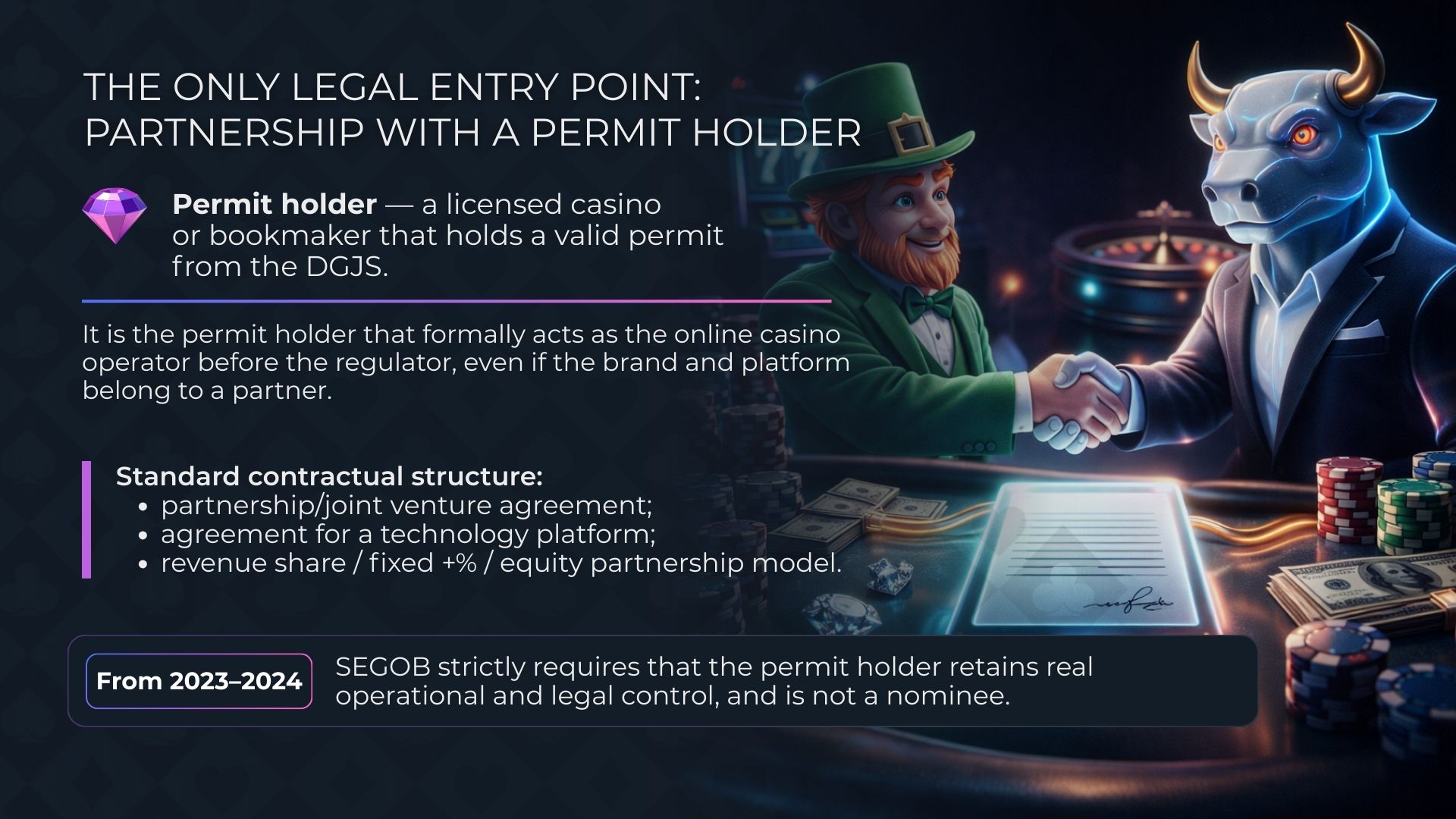
The only legal model for entering the Mexican online casino market is a partnership with a licensed operator that holds a valid SEGOB permit, the so-called permit holder.
The permit holder is a company licensed by the DGJS to run a land-based casino or betting shop. It is this company that formally acts as the online casino operator in front of the regulator, even if the actual platform, brand and casino software belong to the partner.
From a legal standpoint, the model is structured like this:
-
a joint venture or strategic partnership agreement;
-
an agreement for the supply of the casino platform or the gambling software provider’s technology;
-
an agreement on how revenue and obligations are split;
-
in some cases, the purchase of an equity stake in the permit holder.
In practice, several standard cooperation formats are used:
-
Revenue share: a percentage of gross or net revenue paid to the licensed operator;
-
Fixed fee + percentage: a combined model;
-
Equity partnership: buying a stake in the licensed business.
Note that since 2023-2024 SEGOB has tightened its oversight of such arrangements. The regulator requires the permit holder to keep real operational and legal control over the online casino software and platform instead of acting as a nominal party.
How to launch an online casino in Mexico: step-by-step guide
Launching an online casino in Mexico is a sequential process in which every step depends on the previous one. A mistake or omission at almost any stage usually leads to a refusal from the regulator or to serious delays.
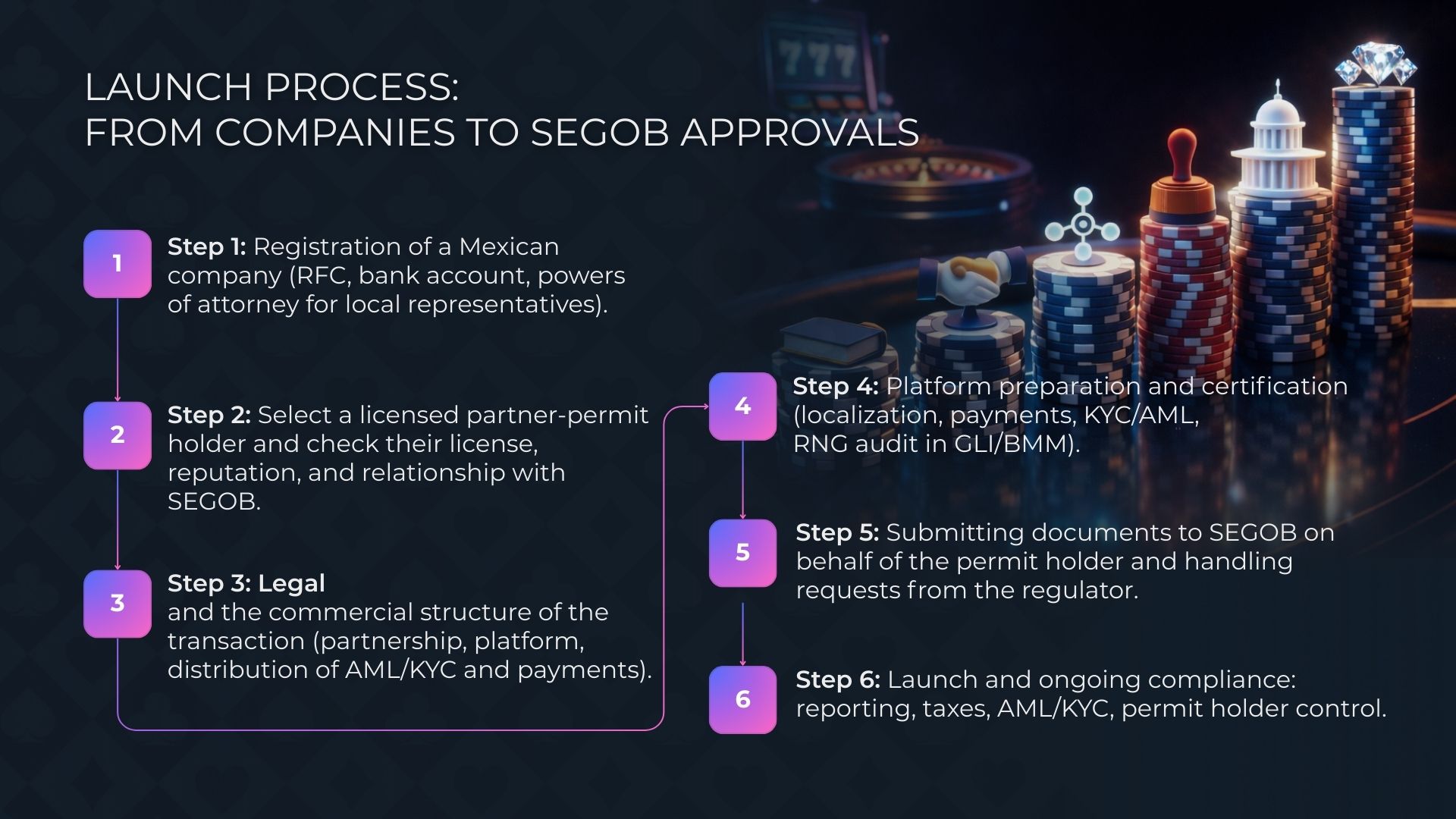
Step 1. Registering a company in Mexico
As a rule, the company is registered as an SA de CV or an S. de RL de CV with foreign shareholders. The procedure includes:
-
incorporating the company before a notary;
-
obtaining a tax ID (RFC) from the SAT;
-
opening a corporate bank account;
-
granting powers of attorney to local representatives.
The founders do not need to be physically present in Mexico: the whole process can be completed remotely through a legal representative.
Step 2. Choosing a licensed partner
The key stage of the whole project is choosing a permit holder with a valid SEGOB license. The partner’s status and reputation directly determine whether the online format can be approved.
At this stage you:
-
run legal due diligence on the license (term, restrictions, history);
-
review the partner’s relationship with the regulator;
-
assess its willingness to keep operational control.
Keep in mind that the regulator takes a dim view of partners who lend their licenses on a purely nominal basis. The permit holder has to be genuinely involved in the project.
Step 3. Legal and commercial structure of the deal
Once the partner is chosen, you build the contract architecture of the project. This is the part SEGOB examines most closely when making its decision.
As a rule, the structure includes:
-
a partnership or joint venture agreement;
-
an agreement on the use or management of the online casino platform;
-
the financial model (revenue share, fixed payments or a hybrid);
-
a split of responsibilities, including AML/KYC and payout obligations.
At this stage it is critical that the contract model matches how the business actually operates. The regulator treats any mismatch as a risk.
Step 4. Preparing and certifying the platform
The online casino platform must be technically ready before the documents are filed with SEGOB. The regulator does not review projects without confirmed certification. This is worth planning for early if you intend to buy casino software.
Preparation includes:
-
configuring the platform for the Mexican market;
-
integrating payment solutions;
-
implementing KYC and AML systems;
-
setting up reporting and transaction logging.
A mandatory requirement is an audit of the random number generator and core systems by an accredited lab (for example, GLI or BMM Testlabs). The certificates are attached to the application and reviewed by the regulator.
Step 5. Filing documents with SEGOB
The application to the Dirección General de Juegos y Sorteos is filed only by the permit holder. The document package includes:
-
the licensee’s corporate documents;
-
agreements with partners;
-
technical documentation for the platform;
-
audit certificates;
-
financial guarantees and proof of funding sources.
The regulator may send additional requests at this stage. Answering them quickly and precisely is critical for staying on schedule.
Step 6. Launch and operation
Once SEGOB approves the project, the online casino can go live commercially. Regulatory oversight does not end there, however.
The operator must:
-
submit reports on a regular basis;
-
comply with tax and anti-money laundering requirements;
-
ensure that the permit holder keeps control over the platform;
-
respond promptly to requests from the regulator.
Any material change to the project structure, the platform or the partnership requires additional approval.
Taxes and the financial model of an online casino in Mexico
The economics of an online casino in Mexico are shaped by federal law, regional rules and the commercial agreements with the license holder. Understanding the tax burden and the revenue structure is essential for judging project profitability and planning the investment.
Federal taxes
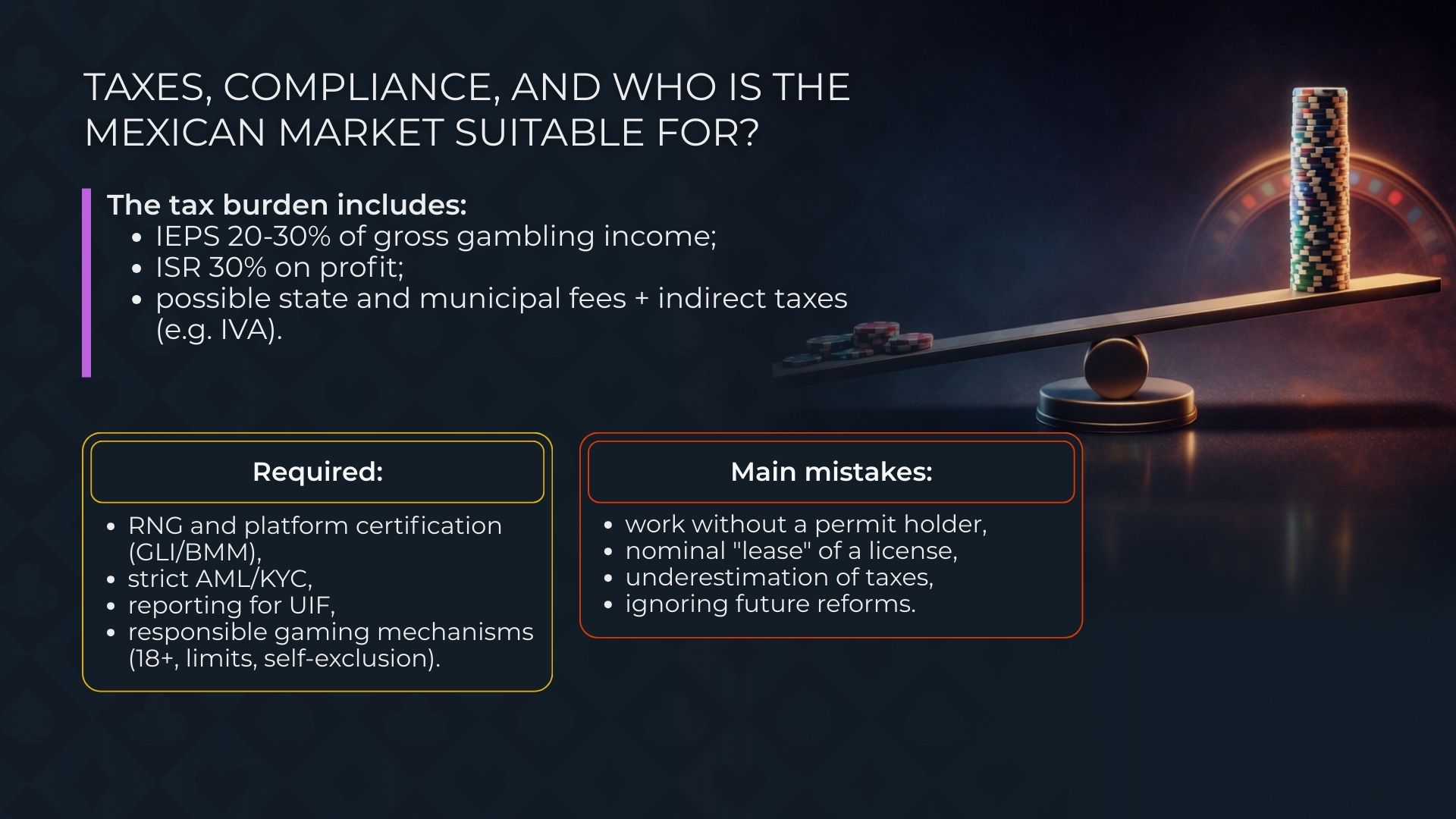
The main federal taxes for an online casino are:
1. IEPS (Impuesto Especial sobre Producción y Servicios)
-
A special tax on production and services that applies to gambling and betting.
-
Rates vary by type of activity but average 20-30% of the operator’s gross revenue.
-
The tax is paid by the permit holder, who then distributes income under the partnership model.
2. Corporate income tax (ISR, Impuesto sobre la Renta)
-
The standard corporate income tax.
-
The rate is 30% for legal entities, including income from gambling.
-
ISR is calculated on net profit after expenses, including payments to partners and operating costs.
Regional and indirect charges
In Mexico, federal rules are supplemented by state and municipal taxes, which can vary a lot:
-
The role of the states: each Mexican state has the right to levy charges on gambling, including license fees, permit fees and turnover taxes.
-
Possible differences: in some states the rate can reach 5-10% of revenue, while in others it may be limited to fixed payments.
-
For an online casino, the location of the license holder matters, because that state’s jurisdiction determines the regional charges.
In addition, if payment systems or service providers are based in Mexico, indirect taxes such as VAT may apply.
Technical and regulatory requirements for online casinos
To operate an online casino in Mexico, you have to meet strict technical, compliance and social responsibility standards. These requirements build user trust and keep the operator within the law.
Platform certification
The random number generator (RNG) is a core element of the platform. SEGOB requires proof that game outcomes are fair and unpredictable. Compliance is confirmed against international standards:
-
GLI (Gaming Laboratories International): audits of random number generators and platforms;
-
BMM Testlabs: an alternative lab for certifying games and betting management systems.
Platform certification includes:
-
testing the random number generator;
-
testing games for compliance with the rules and payouts;
-
checking payment system integration and reporting.
When a license is extended to online activity, only a certified platform can be submitted to SEGOB.
Anti-money laundering, know your customer and financial controls
Mexican law requires strict compliance with anti-money laundering (AML) and customer identification (KYC) rules:
-
Oversight is carried out by the Financial Intelligence Unit (UIF), which tracks suspicious transactions and works with banks;
-
All payment methods, including cards, e-wallets and cryptocurrencies (where allowed), must be integrated with AML/KYC processes;
-
The platform must keep complete financial records and provide them to the regulator on request.
These measures are meant to prevent financial abuse and fraud and to keep revenue transparent.
Responsible gambling and restrictions
SEGOB and international practice require operators to put in place tools for responsible gambling:
-
Minimum player age: 18. The platform must block minors;
-
Bet and deposit limits: players can set personal limits;
-
Self-exclusion: players must be able to exclude themselves temporarily or permanently;
-
Marketing restrictions: targeting gambling ads at vulnerable groups is prohibited.
Common mistakes when launching an online casino in Mexico
Despite the apparent “gray zone” around online gambling, SEGOB actively monitors violations and has built up a steady practice of refusals. Looking at real cases, we can single out four key mistakes that most often lead to problems.
1. Operating without a licensed partner
Trying to launch an online casino without the proper permit is a violation of the law. Even if the company is registered in Mexico and holds a foreign license, the project will be treated as illegal. The consequences include blocked payments and a risk of criminal liability for the company’s management.
2. Using “rented” licenses
Some operators try to use third-party licenses on a nominal basis (“renting” them). The regulator reacts very strictly: it checks that the license holder has real control over the online platform. Any mismatch can lead to:
-
revocation of the permit;
-
fines;
-
a ban on working with other projects.
3. Underestimating the tax burden
The mistake is failing to fully account for IEPS, ISR and regional charges, as well as payments to the permit holder under the partnership arrangement. Wrong calculations:
-
cut project profit;
-
create a risk of tax audits;
-
can affect approval of a license extension.
4. Ignoring upcoming reforms
Mexico is currently updating its gambling legislation. Operators should not ignore:
-
possible changes to the Ley Federal de Juegos y Sorteos;
-
tighter oversight by SEGOB;
-
AML/KYC and certification requirements.
This can lead to unexpected additional requirements or refusals when the license is renewed.
Conclusion
Mexico remains a strategically attractive market for online gambling. The limited number of licensed operators and strict regulatory control create both a barrier for newcomers and high revenue potential for those who operate legally and with a sound structure.
Who Mexico is a good fit for:
-
Companies with sufficient capital that are ready to partner with a licensed permit holder;
-
Operators focused on long-term, stable income rather than a quick entry into the “gray” market;
-
Projects that can ensure technical and financial transparency, AML/KYC compliance and responsible gambling.
When it makes sense to enter now:
-
The market remains concentrated, with a limited number of permit holders, which raises the strategic value of partnerships;
-
Tighter regulatory control makes timely and correct structuring a decisive success factor;
-
Ongoing legislative reforms still let new players plan a safe market entry through existing license holders.
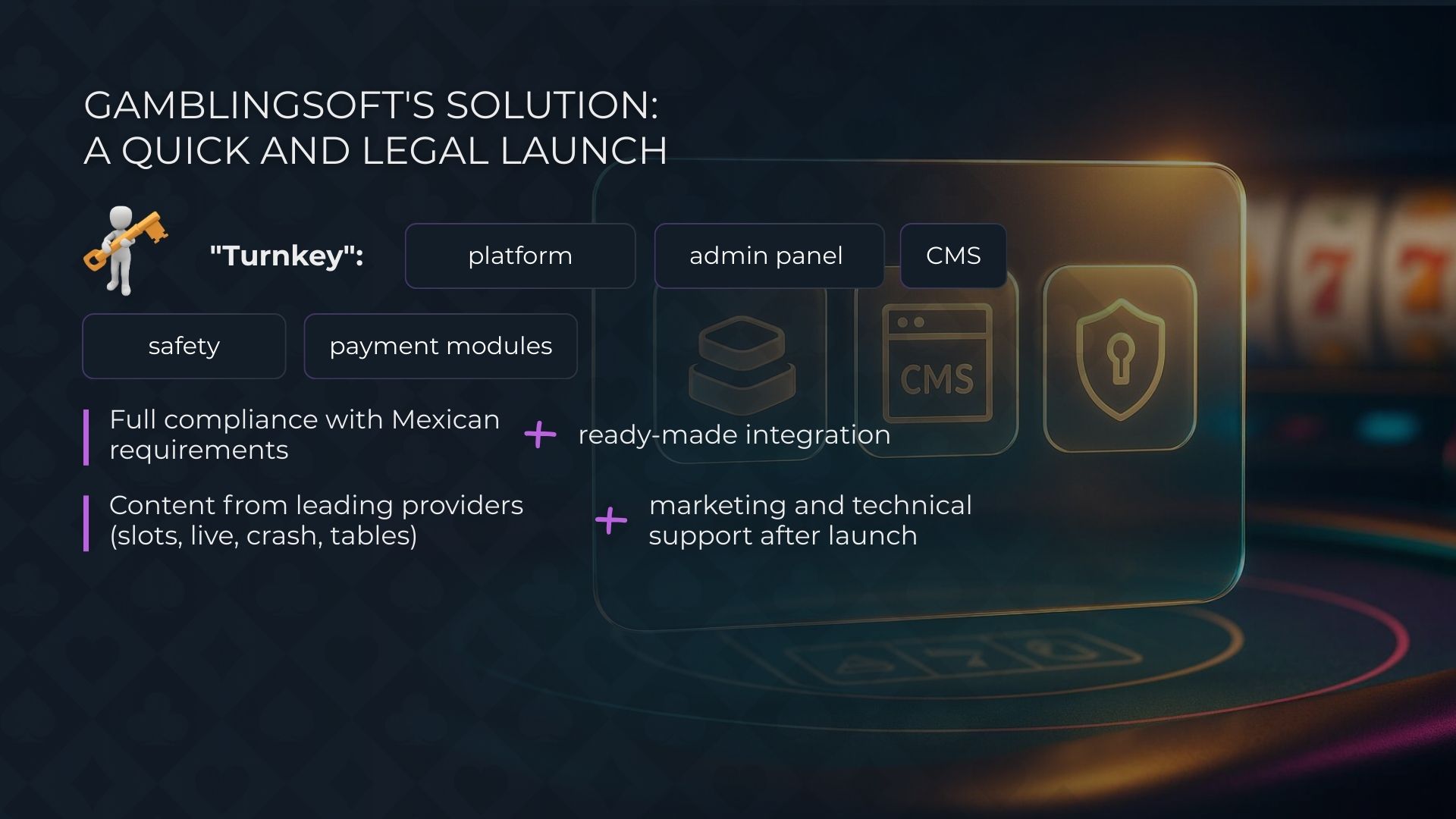
Related: turnkey online casino software, White Label solutions, gambling licences, casino promotion.
FAQ
Is online gambling legal in Mexico?
There is no dedicated online gambling law. The Ley Federal de Juegos y Sorteos dates from 1947 and does not mention the internet, so SEGOB allows online casinos through administrative practice, and only as an extension of a licensed land-based casino or betting shop.
Can a foreign company get a SEGOB license directly?
No. Only a Mexican legal entity can apply and act as the operator, and the DGJS consistently rejects applications filed directly by foreign companies. Foreign individuals and companies can still own shares in the Mexican entity if the ownership structure is properly disclosed.
Who files the application with SEGOB?
The permit holder, a company already licensed by the DGJS for a land-based casino or betting shop. The package includes its corporate documents, the partner agreements, technical documentation for the platform, lab certificates and proof of funding.
What taxes does an online casino pay in Mexico?
IEPS, which averages 20-30% of the operator’s gross revenue, and ISR corporate income tax at 30% on net profit. States can add their own charges, in some cases up to 5-10% of revenue, and VAT may apply to services provided in Mexico.
How much does the software cost and how fast can it be launched?
The Gambling Soft platform starts at $7,500 and ready-made casinos cost $8,500-$47,500. The technical launch takes 7 business days; SEGOB approval through the permit holder is a separate process, and the platform needs RNG certification from a lab such as GLI or BMM Testlabs before filing.
