


Updated 29 September 2026. Author: Gambling Soft team.
Short answer: The team depends on the launch model. A white label casino needs marketing, an affiliate manager and one person for operations; turnkey adds CRM, analytics, compliance and sometimes a small tech unit; an in-house platform adds developers, QA and DevOps. Start with a compact team and hire as revenue grows. A ready Gambling Soft platform starts from $7,500 and launches in 7 business days, so the first budget goes to marketing and CRM rather than a large development team (see prices).
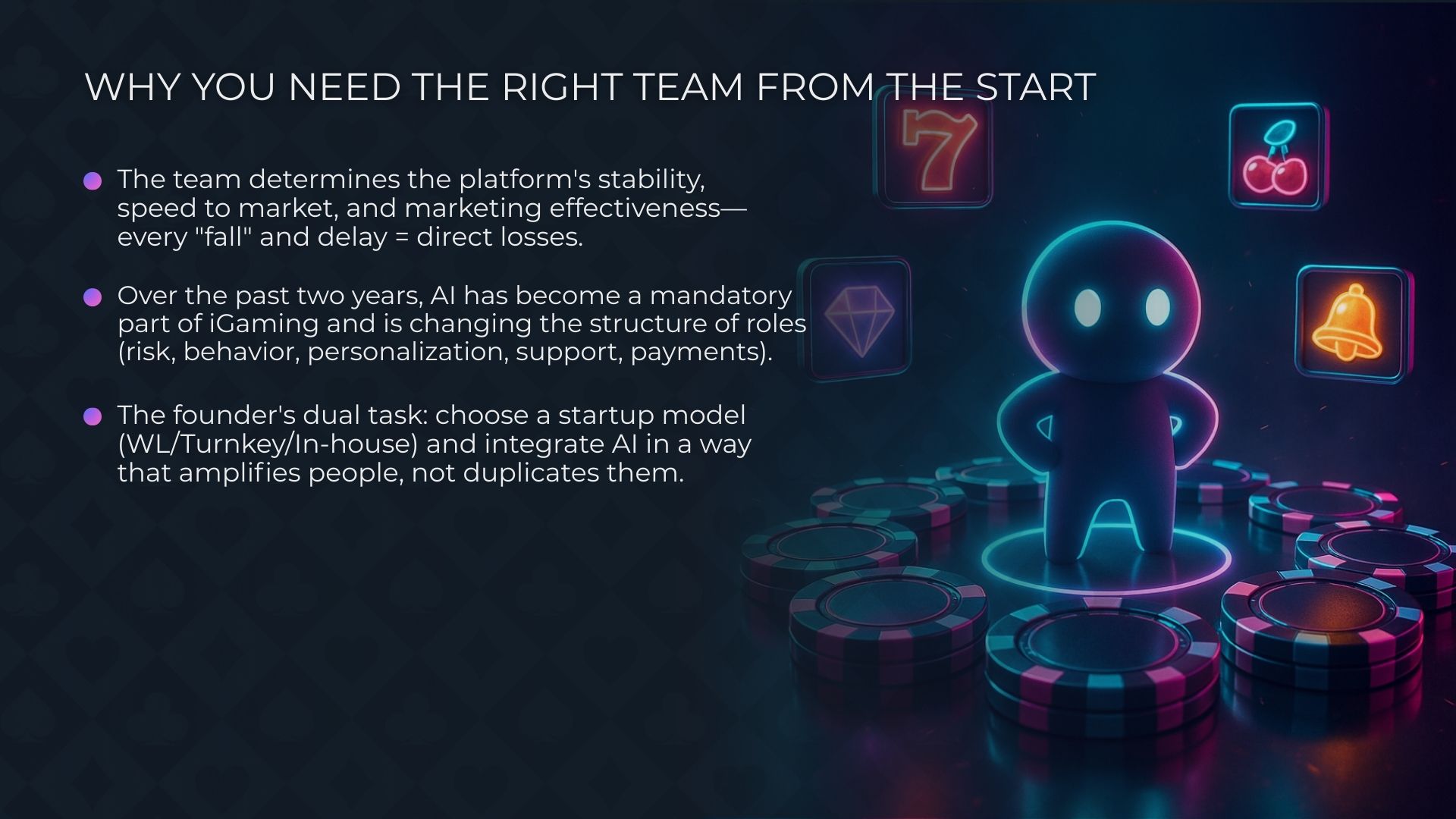 Building a team is one of the key factors that determines the success of an online casino. The quality of management and operational processes directly influences the stability of the online casino platform, the speed of bringing the project to market, marketing efficiency, and the operator’s ability to retain players in a highly competitive environment.
In an industry where every delay, malfunction, or error results in financial losses, a competent team becomes the foundation of operational resilience.
Over the last two years, AI has become an essential part of the iGaming business and has transformed the approach to team formation. The role of technology now goes far beyond automation: AI tools are used in risk assessment, player behavior analysis, marketing personalization, customer support operations, and payment control.
As a result, entrepreneurs face a dual challenge:
-
assembling an effective team based on the chosen launch model (White Label, Turnkey, or an in-house online casino software platform),
-
integrating AI solutions in a way that enhances specialists rather than duplicating their work.
Related topic: Artificial Intelligence in Online Casinos
A successful casino project requires a team capable of working with analytics, AI tools, workflow automation, anti-fraud systems, ML algorithms, and personalized mechanics. Companies that adopt such approaches early gain a significant advantage: they launch faster and scale more easily.
Comparative Overview of Online Casino Launch Models
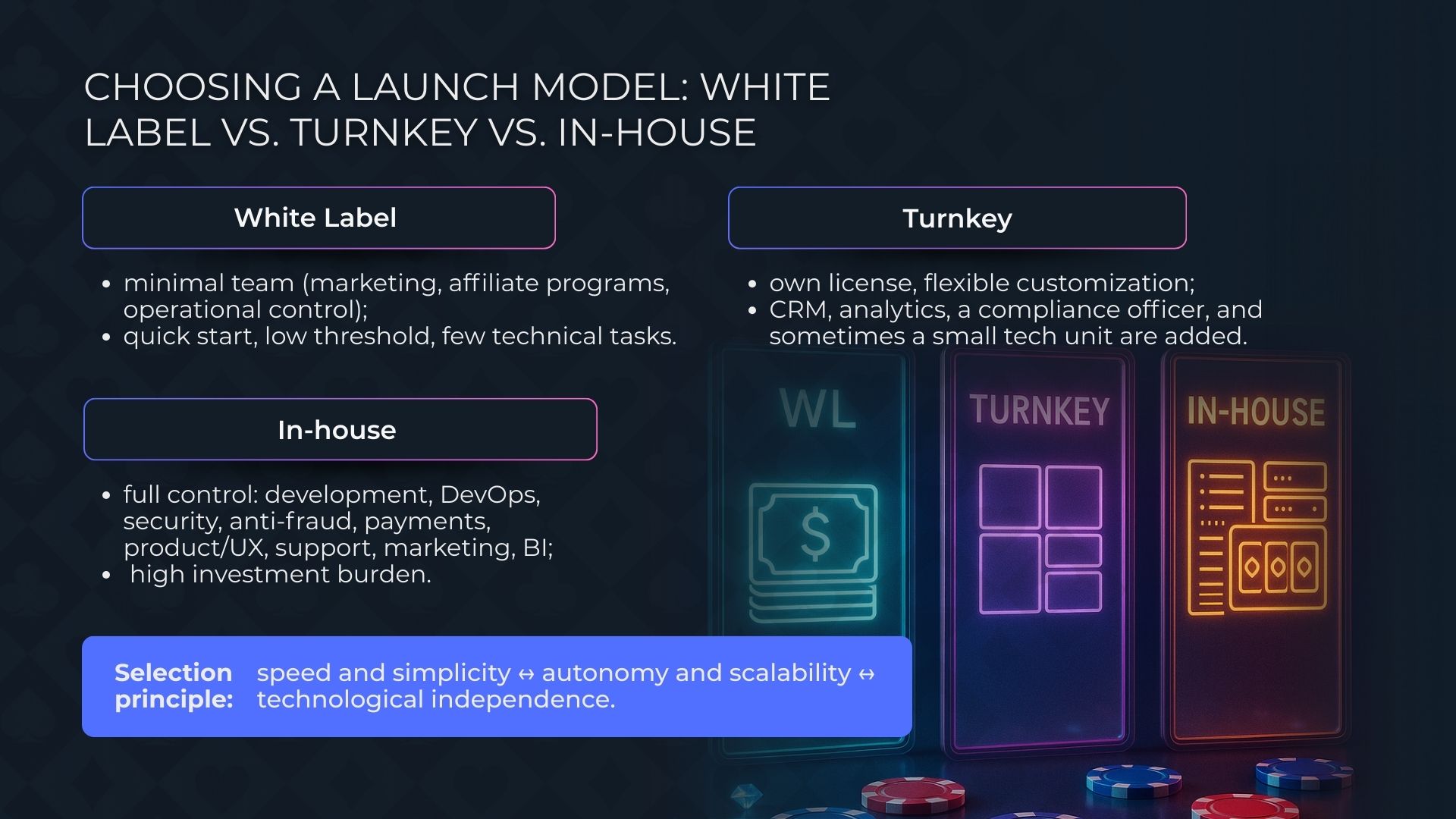
White Label is the fastest and simplest entry into the market, where the main infrastructure and technical support are provided by the gambling software provider. The operator’s team is minimal: marketing, affiliate managers, and a specialist overseeing operational processes are usually sufficient. This format suits companies that prioritize speed, a low entry threshold, and the absence of complex technical tasks, making it one of the most accessible white label online casino solutions available.
Related topic: How to Launch an Online Casino Using the White Label Model: 2025 Guide
Turnkey provides greater autonomy: the project receives its own license, extended customization capabilities, and flexible product configuration. The team is larger: marketing, CRM, operational management, analytics, a compliance officer for regulatory communication, and sometimes a small technical unit for improvements. This model is chosen by projects aiming for scalability and unique user mechanics, making it a suitable turnkey online casino solution for long-term growth.
Related topic: What Does “Turnkey Casino Development” Include?
In-house is a fully independent model where the operator develops its own platform, payment architecture, security systems, anti-fraud modules, and customer support. The team includes developers, QA, DevOps, product managers, UX/UI designers, legal specialists, compliance, risk management, support, marketing, and BI analytics. This model requires significant investment and suits companies focused on long-term technological strategy and full control over their casino software and product environment.
Related topic: Online Casino Development: Key Stages, Technologies, and Pitfalls
Key C-level Roles: Who Shapes Strategy and Ensures Performance
Managing an online casino requires a clearly defined top-management structure. The C-level team establishes strategic direction, defines the financial model, oversees risk, and drives product development. In mature projects, this level of management becomes the central link between investors, the operational team, and external partners.
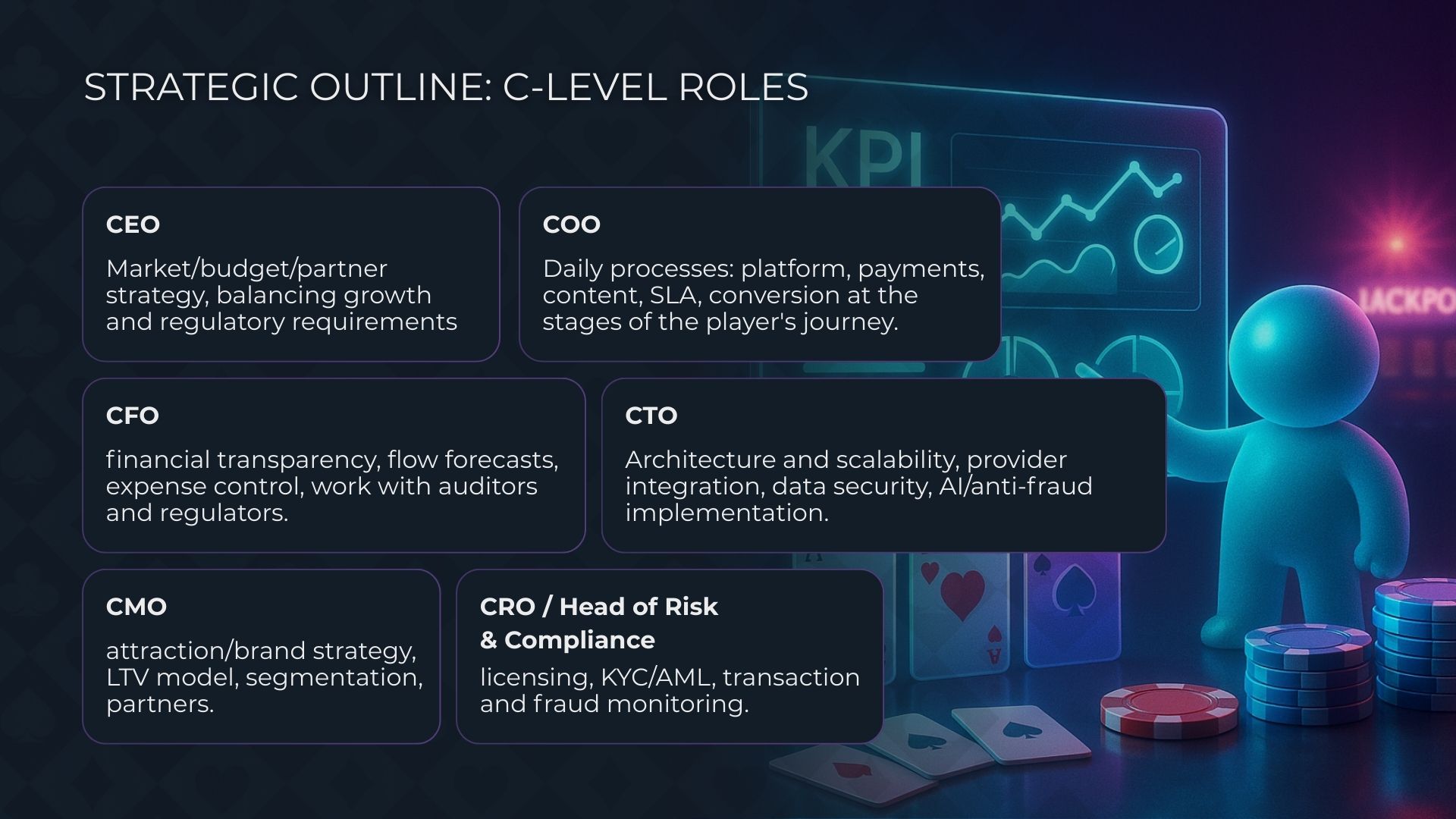
CEO (Chief Executive Officer) defines the strategic direction and is responsible for the overall performance of the project. The CEO makes key decisions regarding markets, budgets, partners, licensing formats, and the overarching business model. They ensure a balance between growth, security, and regulatory requirements, acting as both a development driver and a point of accountability for investors.
COO (Chief Operating Officer) manages day-to-day processes: platform operations, payment flows, customer support, content management, and operational metrics. The COO ensures the project’s stability by controlling service quality, SLA, conversion at every stage of the user journey, and timely responses to operational risks.
CFO (Chief Financial Officer) ensures financial transparency and sustainability: forecasting cash flows, optimizing profit retention models, managing expenses, and coordinating with auditors and regulators. Given the industry’s high dependency on payment systems and anti-fraud measures, the CFO is crucial to maintaining financial stability.
CTO (Chief Technology Officer) defines the technological strategy: architecture choices, platform reliability, casino software providers integration, data protection, and system scalability. The CTO oversees development, AI module implementation, anti-fraud systems, marketing automation, and infrastructure efficiency: the technical core of any online casino platform.
CMO (Chief Marketing Officer) manages marketing strategy, traffic growth, player retention, and brand positioning. The CMO defines acquisition strategies, affiliate management approaches, funnels, LTV modeling, audience segmentation, and allocation of marketing budgets.
CRO / Head of Risk and Compliance is responsible for regulatory compliance, licensing, KYC/AML procedures, transaction monitoring, and fraud prevention. This role is critically important in mature markets and jurisdictions with strict regulation.
This set of leadership roles ensures stability, scalability, and predictability, allowing the casino project to grow effectively even in competitive environments.
Operational Team: Functions Without Which a Platform Cannot Retain Players
The stability of an online casino is not defined by the number of roles but by how daily processes are organized. When a player makes a deposit, launches a slot, receives a bonus, or contacts support, they interact with the operational team. The speed and quality of these processes determine loyalty and long-term retention.
Marketing and affiliate management drive growth: they forecast traffic, build funnels, evaluate channel quality, and manage bonus policies. Their decisions shape audience structure and acquisition cost, directly influencing the financial stability of the casino platform.
Next comes the CRM unit, which turns a one-time deposit into repeated activity. This is where retention scenarios, segmentation, communications, personalized offers, and automated triggers are created. Effective CRM increases LTV and reduces marketing budget pressure, something no advertising can fully compensate for.
Risk management runs in parallel. It monitors every transaction, evaluates behavioral patterns, blocks fraudulent schemes, and maintains relationships with payment providers. Any mistake in this area can lead to financial losses or reputational damage and, consequently,, player churn.
Regulatory processes (KYC and AML) ensure legality and trust. Verification speed, accuracy of document checks, and correct procedures determine both user comfort and the safety of running an online casino business.
At the product and content level, the team determines what the player sees. Game updates, lobby logic, provider settings, UX improvements: this daily work influences session duration, engagement depth, and conversion into deposits.
The frontline is the support team. Their performance determines whether the player feels valued. Quick and competent responses increase trust, while delays can cause even loyal users to switch to competitors.
Finally, the entire operational ecosystem relies on analytics. Timely reports, accurate metrics, cohort analysis, anomaly detection, and forecasting enable data-driven decision-making. Without analytics, retention management, segmentation, or traffic quality control becomes impossible.
This creates a system where every function affects player behavior. A well-coordinated operational team transforms the casino platform into a stable, predictable, and profitable product, providing a true competitive advantage.
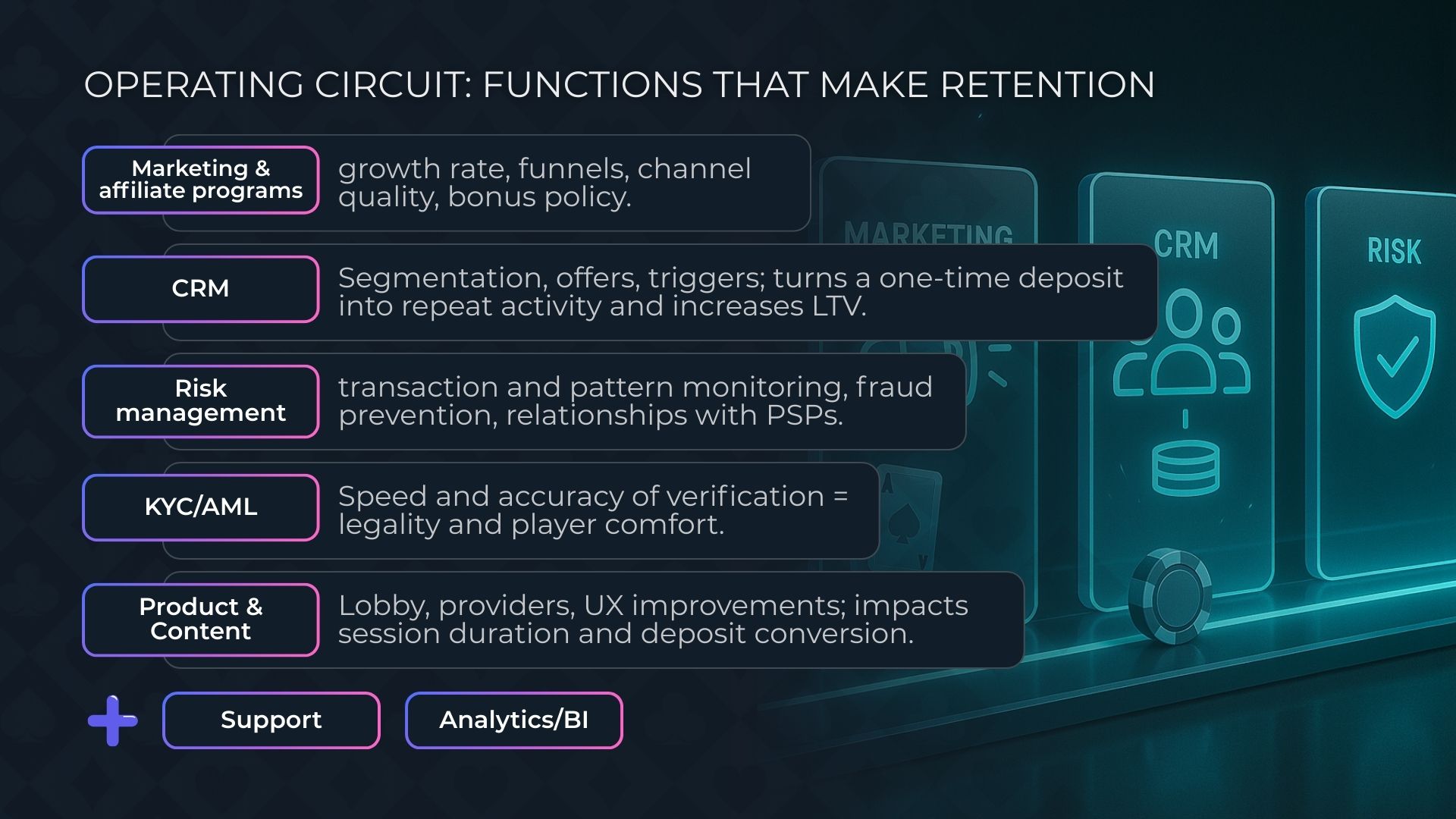
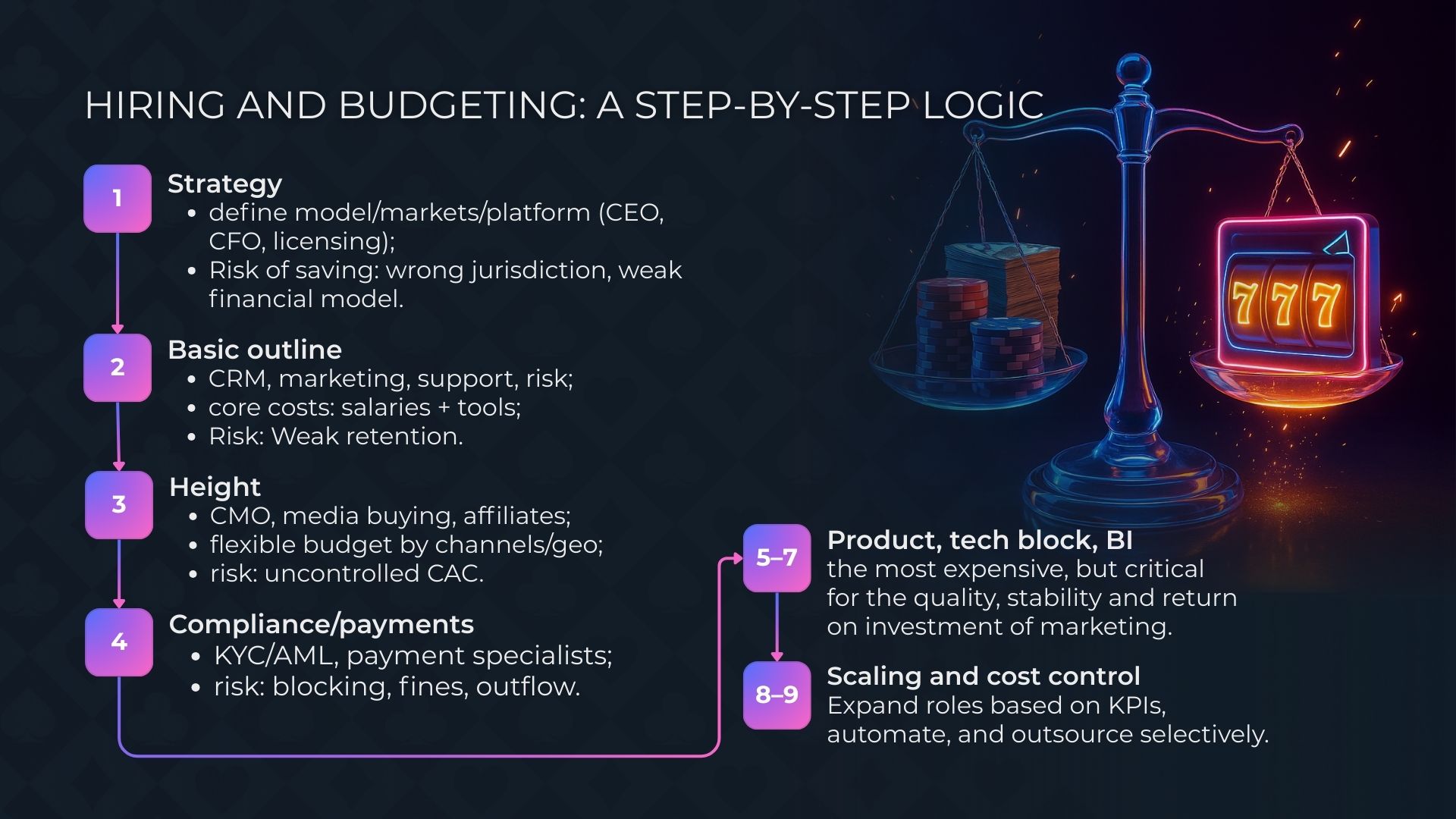
Table: Hiring Logic and Team Budgeting When Launching an Online Casino
|
Stage / Objective |
Key Roles |
Budget Focus |
Risks of Cost-Cutting |
|---|---|---|---|
|
Strategy Preparation Define the launch model (WL/Turnkey/In-house), markets, licensing, and technological casino platform |
CEO, CFO, licensing expert |
Minimal expenses, involvement of consultants instead of full-time roles |
Wrong jurisdiction choice, unsuitable financial model |
|
Basic Operational Framework Ensure the online casino software platform operates from day one |
CRM, marketing, support, risk manager |
The “core” of expenses: salaries + tools |
Lack of resources leads to poor retention and high refunds |
| Marketing and Growth
Attract quality traffic and build a stable player flow |
CMO, media buyer, affiliate manager |
Flexible budget depending on channels, geos, and rate models |
Uncontrolled CAC, wasting budget on ineffective partners |
| Compliance and Payments
Ensure regulatory compliance and reduce risks of payment blocks |
KYC/AML, payment specialist |
Moderate fixed expenses + verification services |
Payment blocks, regulatory fines, player churn |
| Product and Content
Configure lobby, providers, bonuses, UX |
Product manager, content manager |
Mid-level budget depending on integration count and content volume |
Drop in conversion and low engagement |
| Technical Division (for Turnkey and In-house)
Development, support, integrations, security |
CTO, developers, QA, DevOps |
The largest expense category; constant growth with scaling |
Insufficient platform stability, vulnerabilities, downtime |
| Analytics and BI
Metrics management, forecasting, segmentation |
BI analyst, data specialist |
Medium expenses; crucial for optimizing marketing budget |
The project becomes “blind”, decisions are made intuitively |
| Team Scaling
Expanding functions after reaching stable revenue |
Additional CRM specialists, marketing, support |
Budget grows proportionally to retention KPI and traffic |
Support delays, weak quality control |
| Cost Management
Optimize expenses without compromising quality |
CFO, department heads |
Budget redistribution, automation, outsourcing specific roles |
Unpredictable expenses, reduced efficiency |
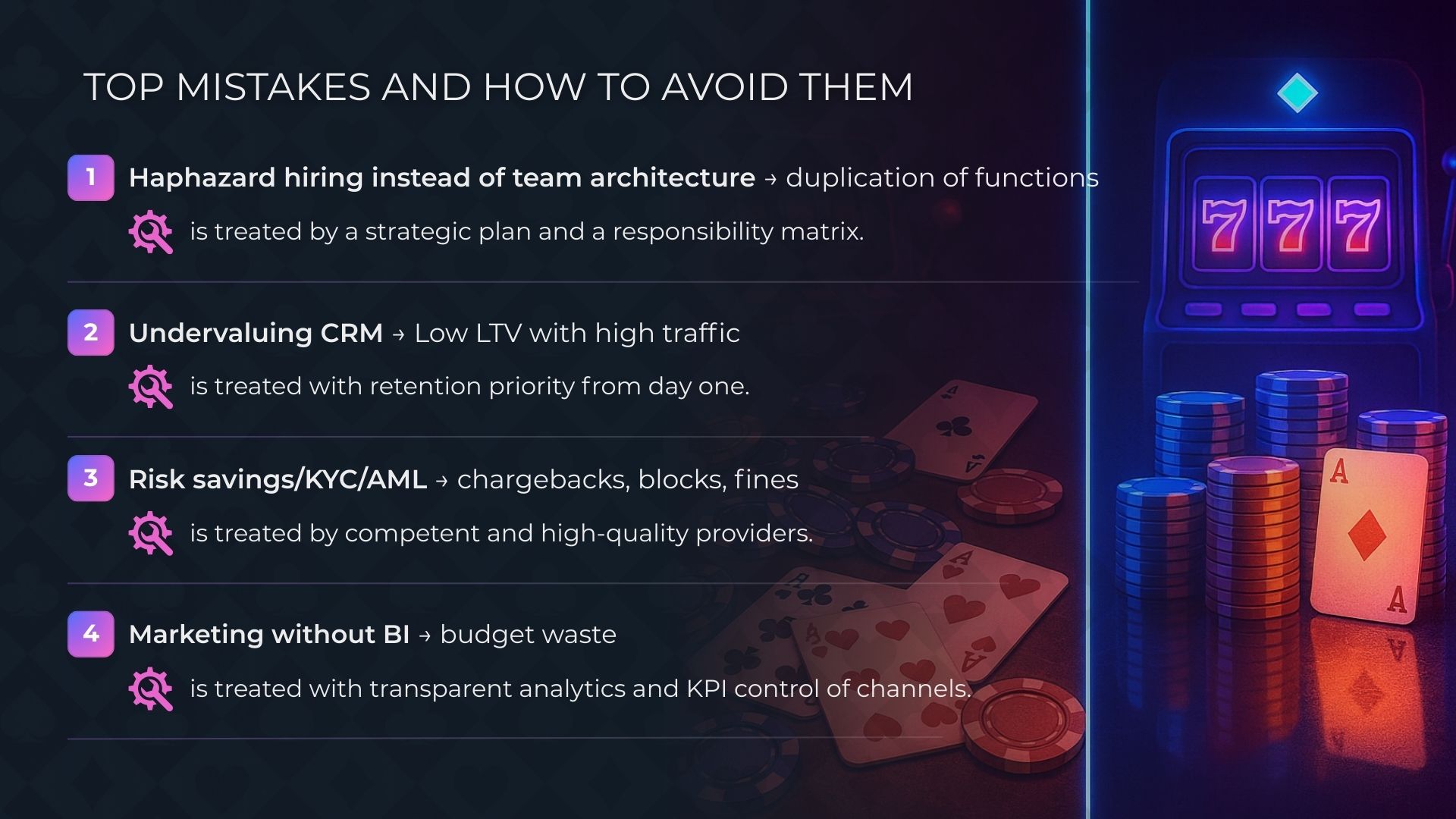
Top 5 Mistakes When Forming an Online Casino Team
1. Focusing on fast hiring instead of strategic planning
Many projects hire specialists chaotically, as tasks appear. As a result, functions overlap, responsibility becomes blurred, and key areas lack ownership. The correct approach is to start with team architecture, linking roles to the launch model and selected markets.
2. Underestimating CRM and retention
A weak CRM division is one of the most common reasons for low LTV. Even with strong traffic, the project loses most players after their first deposit. Retention must be a priority from day one; otherwise, acquisition cost quickly makes the business model unprofitable.
3. Mistakes in risk management and KYC/AML
Cost-cutting in anti-fraud or verification leads to chargebacks, account blocks, conflicts with payment providers, and regulatory issues. This is a critical area where insufficient expertise results in direct financial losses.
4. Overloaded marketing with no analytics
Some teams increase the marketing budget without having a transparent BI system. Without traffic quality control, cohort analysis, and correct KPIs, funds are spent inefficiently, and channels are managed intuitively. Analytics is a profitability management tool, not a secondary function.
5. Complete lack of technical expertise on the operator’s side
Even with a White Label casino or Turnkey casino setup, a minimum level of technical expertise is required: understanding integrations, game flow, bonus logic, and notification systems. Without any technical division, the operator cannot react quickly to issues and becomes dependent on the casino software provider in every minor detail, directly impacting growth speed and service quality.
Conclusion
A successful online casino launch requires more than a platform, license, or marketing strategy. In the long run, the project succeeds due to a team capable of managing the product, retaining players, handling risks, and ensuring stability across all operational processes.
It is important to understand that a large staff is not necessary from day one. A project can start with a well-designed compact team where each specialist performs essential functions, and then scale strategically as traffic, revenue, and market presence grow. This approach helps control expenses, accelerate decision-making, and build a sustainable operational model.
The chosen launch model determines the depth of required expertise, but in any format the team must remain structured: strategic management, operations, retention, compliance, risk management, support, and analytics. Ignoring even one of these functions leads to higher costs, reduced LTV, and vulnerability to competitors.
Companies that approach team formation consciously and scale it step by step gain predictable growth, resilience to operational risks, and the ability to expand into new markets. This structured manageability becomes the key factor that positions the project among industry leaders.
FAQ
What is the minimum team to launch an online casino?
For a white label launch, marketing, an affiliate manager and a specialist who oversees operations are usually enough. Turnkey and in-house models need more people: CRM, analytics, compliance and technical staff.
Which C-level roles does an online casino need?
CEO, COO, CFO, CTO, CMO and a head of risk and compliance. In a compact team at the start, some of these functions can be combined and split later as traffic and revenue grow.
Do I need developers if I buy a ready casino platform?
You do not need a full development team, but someone on your side should understand integrations, game flow and bonus logic. The Gambling Soft platform comes with a 12-month warranty on the software.
How much does the software cost compared with the team budget?
The Gambling Soft platform starts from $7,500, ready branded casinos cost from $8,500 (Violet) to $47,500 (Velvet), and the platform source code costs $19,000. The software is a one-time cost, while salaries and marketing are recurring.
How soon can the team start working with players?
The technical launch of the platform takes 7 business days. The license is arranged in parallel: through Gambling Soft, Anjouan costs $28,000 and Curacao $75,000 including company registration.
