


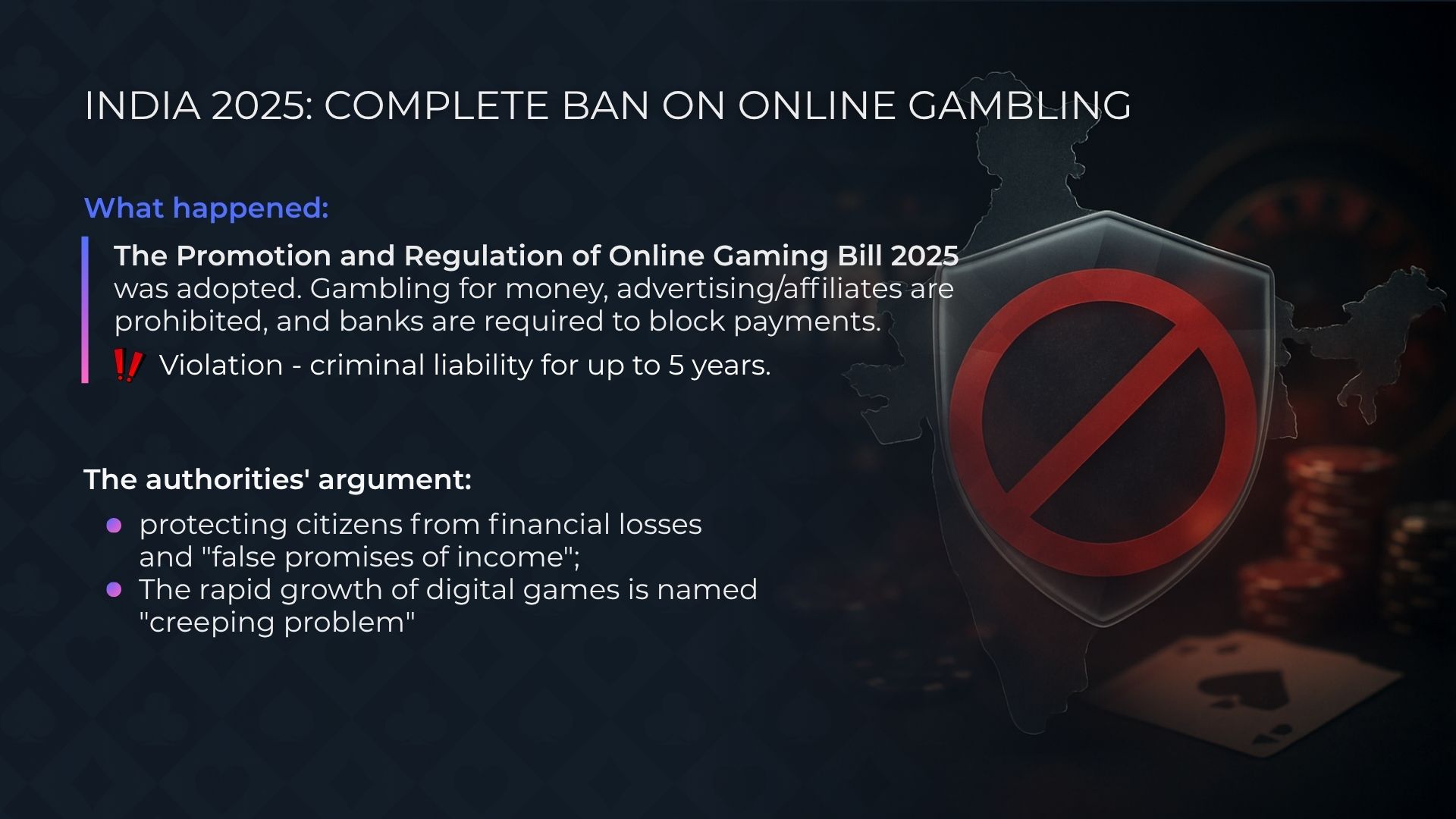
On September 18, 2025, the Parliament of India passed the Promotion and Regulation of Online Gaming Bill, 2025, which completely prohibits online real-money gaming, its promotion, and advertising. The new legal framework introduces strict sanctions for both operators and users. However, experts and industry representatives believe that such measures may destroy the legal sector and only strengthen the unlicensed market.
Essence of the Law
The document establishes a complete ban on organizing and participating in online games involving real money. In addition to operators, the law also applies to advertising campaigns, affiliate programs, and any form of service promotion. Banks and payment systems are required to block transactions related to such services.
Violation of the rules is treated as a criminal offense: significant fines and imprisonment for up to five years are envisaged. Thus, the law effectively cuts off all legal channels of access to online gambling within the country.
Government’s Arguments
According to the Minister of Electronics and Information Technology, Ashwini Vaishnaw, the new law is a response to the social risks caused by the rapid growth of digital gaming. The minister described online gambling as a “creeping problem” that is already having a tangible negative impact on society.
The government’s main argument is the protection of citizens from financial losses and from “false promises of income.” Vaishnaw emphasized that many companies deliberately create the illusion of stable earnings, whereas most users ultimately suffer losses. According to him, state intervention is necessary to prevent large-scale social consequences.
Industry Reaction
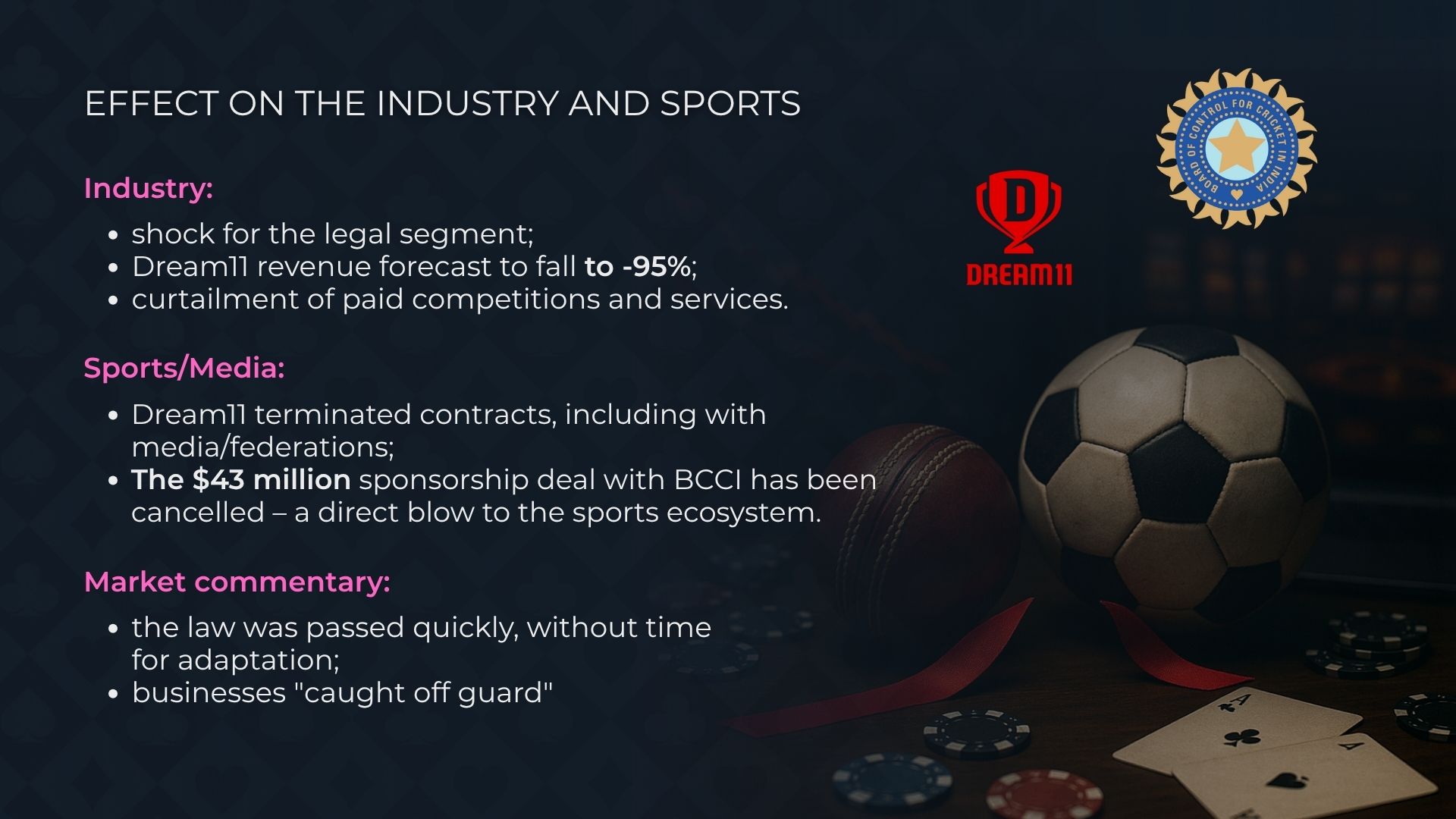
For the legal sector, the new law came as both unexpected and devastating. The company most affected is Dream11, the leader in the fantasy sports segment. According to management estimates, its revenues may fall by 95%. This will result in a radical business contraction, as the overwhelming majority of income was generated from paid competitions and related services.
The consequences have already impacted the sports ecosystem: Dream11 terminated its $43 million sponsorship contract with the Board of Control for Cricket in India. This step demonstrates the direct influence of the law on adjacent industries — from sports to media and advertising.
Dream11 CEO Harsh Jain stated that the industry was “caught off guard.” According to him, the speed of the bill’s passage through Parliament left companies with no time to adapt or prepare alternative business models.
Criticism and Expert Opinions
Lawyers and researchers question the constitutionality of the law. In particular, concerns are raised about a potential violation of Article 19(1)(g) of the Constitution of India, which guarantees the right to conduct business.
Meghna Bal, Director at the Esya Centre, emphasizes that the law does not comply with the principle of proportionality: it eliminates the operations of legitimate companies but does not remove access to illegal services, which will ultimately gain a competitive advantage.
Rohit Kumar, Partner at the consulting firm Quantum Hub, notes that the bill was pushed through Parliament without proper debate or consultation with stakeholders. In his view, this undermines trust in the regulatory environment and reduces the attractiveness of the Indian market for investors.
Possible Consequences
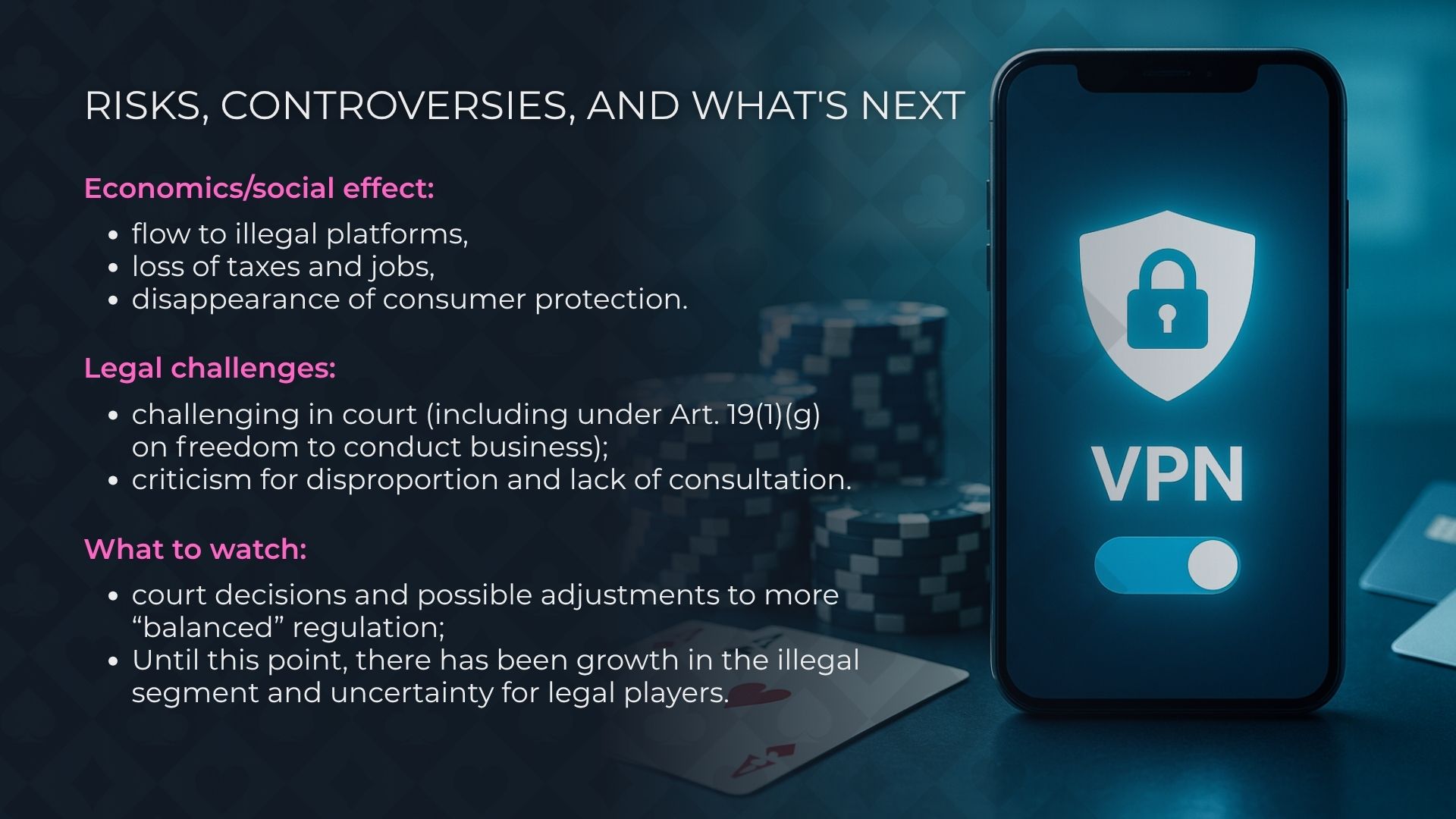
The main risk lies in users turning to unlicensed foreign platforms. Experts predict an increase in the use of VPN services, proxy servers, and virtual cards that enable circumvention of the bans. As a result, the state risks losing control over financial flows, while players lose access to consumer protection mechanisms.
The decline in revenues of legal companies will inevitably lead to job cuts, reduced tax revenues, and the collapse of advertising contracts. The impact on the sports industry has already been seen in the cancellation of major deals, but the scope could extend much wider — from the IT sector to the media market.
Some companies, including A23, have already filed lawsuits challenging the provisions of the law. Lawyers predict that litigation will become the central issue in the near-term agenda. The outcome of these proceedings will determine whether the law remains in its current form or undergoes revisions.
Conclusion
The adopted law reshapes the architecture of India’s online entertainment market. Supporters argue that it protects citizens from financial and social harm. Opponents believe that the government is achieving the opposite result: destroying the legal sector while simultaneously creating incentives for illegal operators.
In the coming months, the development of the situation will depend on court rulings and whether the government can devise a more balanced regulatory model. Until then, the future of the legal industry in India remains uncertain, while illegal platforms gain an additional opportunity to strengthen their positions.
Related: turnkey online casino software, White Label solutions, gambling licences, casino promotion.
