


Updated 29 September 2026. Author: Gambling Soft team.
Short answer: The most expensive myths are that you need a million-dollar budget, that a license is a formality and that marketing alone makes a casino profitable. The Gambling Soft platform starts from $7,500, ready-made casinos cost from $8,500 (Violet) to $47,500 (Velvet) and launch takes 7 business days (see our pricing page). The real spending comes later: license, marketing and player retention.
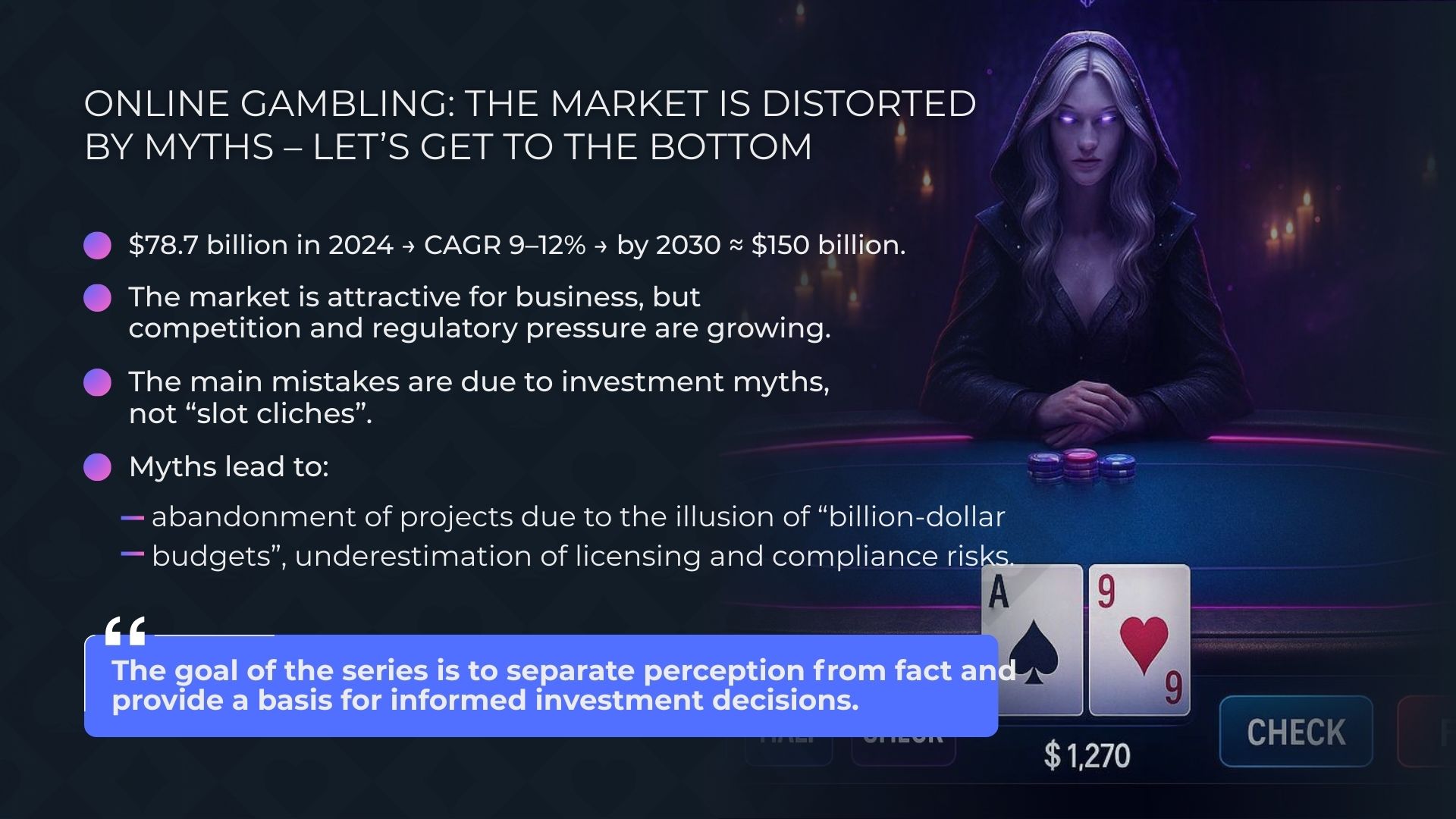
Online gambling has long moved beyond the entertainment industry and has become one of the key segments of the digital economy. According to Grand View Research, in 2024 the global market volume amounted to approximately $78.7 billion and continues to grow at an average rate of 9-12% per year. By 2030, it is projected to double and reach $150 billion. This growth makes the market attractive to entrepreneurs and investors while simultaneously increasing competition and regulatory pressure.
It is investment myths, not everyday clichés about “rigged slots”, that often become the source of mistakes. Misconceptions distort perception: some refuse a promising project because of the illusion of “billion-dollar budgets,” while others underestimate the role of licensing and lose the business after the first regulatory inspection.
The purpose of this article is to examine the key myths that genuinely affect investment decisions and online casino management strategy, and to show where the boundary lies between perception and facts.
Myth 1. “You need a million-dollar budget to launch an online casino”
This myth is frequently repeated among novice investors and is primarily linked to the illusion of scale: the information space is dominated by stories of giants like PokerStars, Flutter, or Bet365, whose turnover is measured in billions. It seems that without comparable investment the market is closed to newcomers.
The facts suggest the opposite.
-
White-label and turnkey models allow you to launch with a budget starting from $30-80k. The price includes everything needed: the engine, payment integrations, and a basic game package.
-
A fully customized solution with licensing, platform, and marketing will cost more, starting from $500k to $1M and above. This is closer to a “standalone brand” format with a long-term horizon and a strategy for entering international markets.
-
There are also “ultra-budget” options from $10-30k, but they are often limited in functionality and are more suitable for hypothesis testing than for building a full-scale business.
Thus, the entry barrier is much lower than it seems. The real expenses are not in the launch but in scaling: marketing, player retention, compliance, and product development.
Learn more: How much does it cost to open an online casino in 2025?

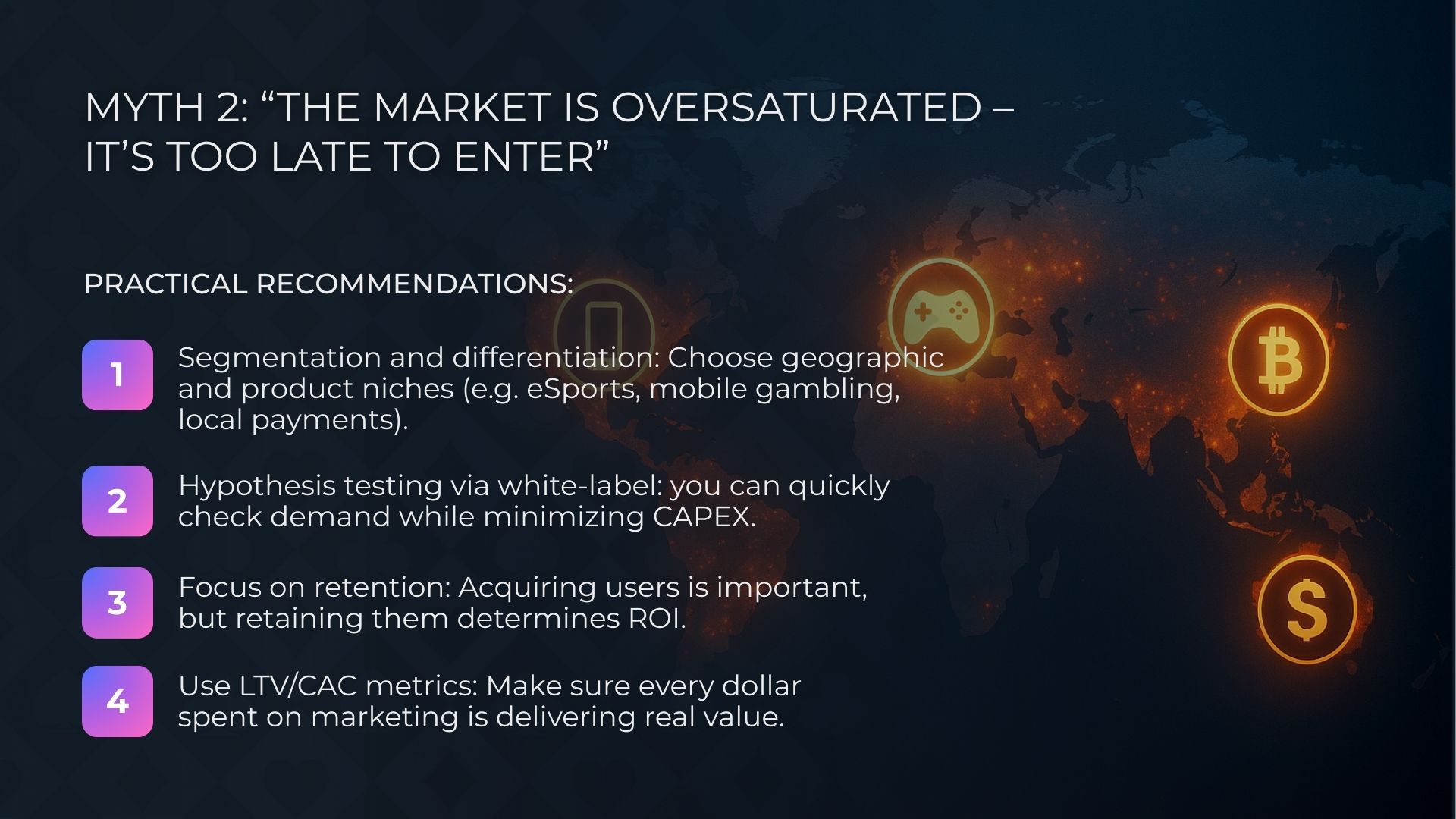
Myth 2. “The market is oversaturated, it’s too late to enter”
There is a common misconception that all promising niches are already occupied by major players and the online casino market is supposedly “oversaturated.” At first glance, it seems new projects are doomed to fail.
-
The global online gambling market continues to grow: a 9-12% CAGR, according to Grand View Research and H2 Gambling Capital. In 2024, volume reached $78.7 billion, with a projected doubling by 2030.
-
At the same time, the market structure is changing: mobile betting, VR/AR games, eSports betting, and crypto casinos are expanding. These segments remain comparatively under-served by large brands. For example, crypto gambling saw a sharp increase in GGR to $81.4 billion in 2024 (FT).
-
Competition is intense in the classic segment (slots, traditional online casinos), but niche positioning remains an effective go-to-market tool.
Takeaway for investors: the market is not oversaturated overall: it is being redistributed. The key to success is choosing the right niche, managing the product with agility, and building long-term unit economics.
Learn more: Gambling market in 2025: how to choose a segment and launch a successful online casino
Myth 3. “Licensing is just a formality”
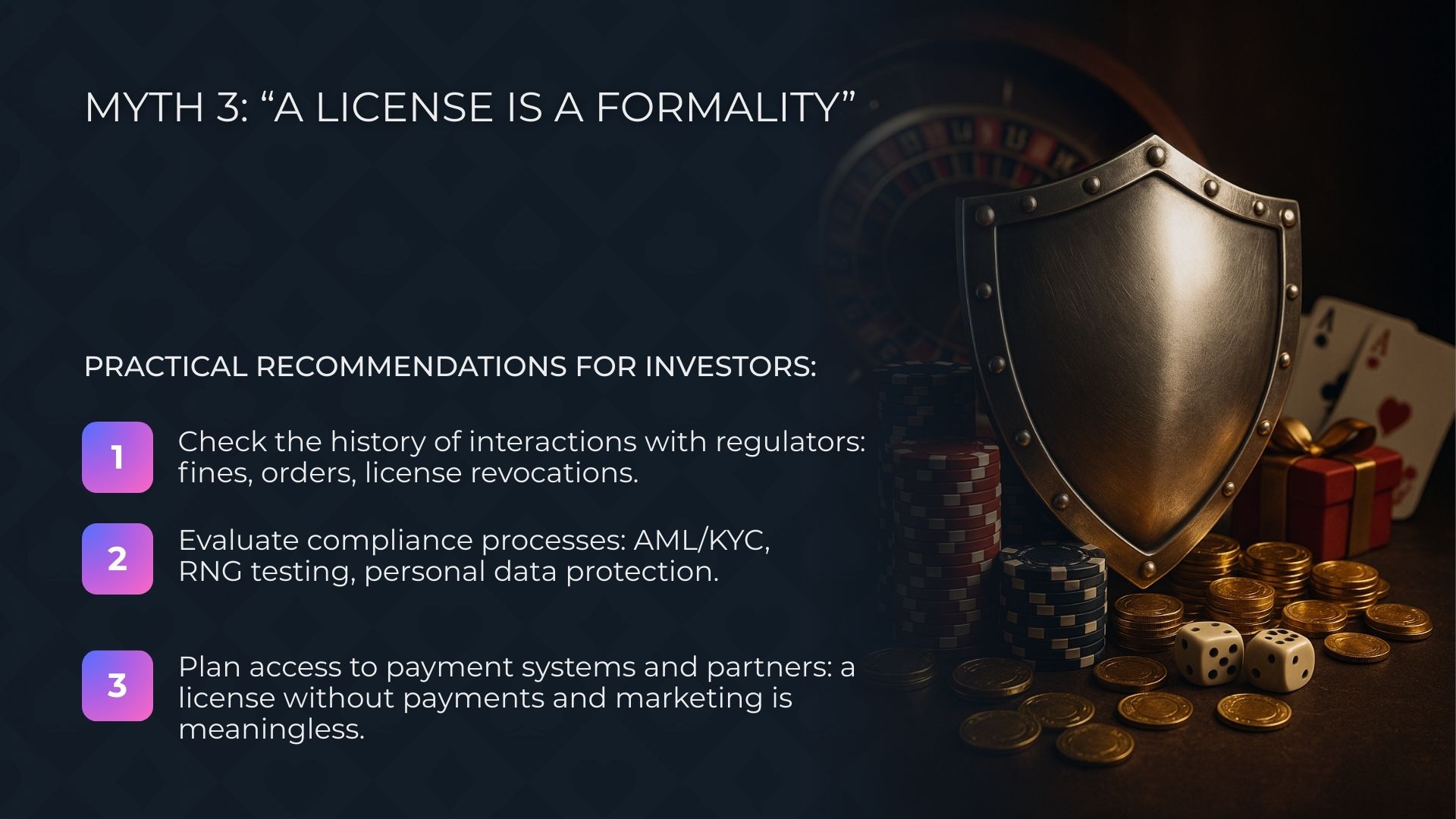
Many novice investors and entrepreneurs mistakenly believe that a license is a formality, a document you “need to have” that barely affects day-to-day operations. This is one of the most dangerous misconceptions in the industry.
-
Having a license directly impacts access to payment gateways, affiliate programs, and the ability to advertise in regulated jurisdictions. Without it, many markets are closed.
-
Investors assess not only the presence of a license but also the quality of compliance, audit history, and AML/KYC procedures. A poor licensing record can reduce business valuation by an order of magnitude.
- Regulators do impose fines and revoke licenses: for example, the UK Gambling Commission imposed a £9.4 million fine on 888 for AML/KYC violations and misleading advertising. The MGA has revoked licenses from operators failing to meet compliance requirements, leading to platform closures and loss of access to payment systems.
Why this myth is dangerous:
-
Underestimating the role of a license can lead to losses at the very first regulatory inspection.
-
Some operators launch in “grey” jurisdictions, saving money at the start but increasing the risk of blocks, sanctions, and reputational damage.
Conclusion: a license is not bureaucracy. It builds the foundation of trust among players and investors, provides market access, and reduces legal and financial risks. Ignoring licensing can cost far more than the initial savings.
Learn more: Where and how to obtain an online casino license in Europe?
Myth 4. “Marketing solves everything”
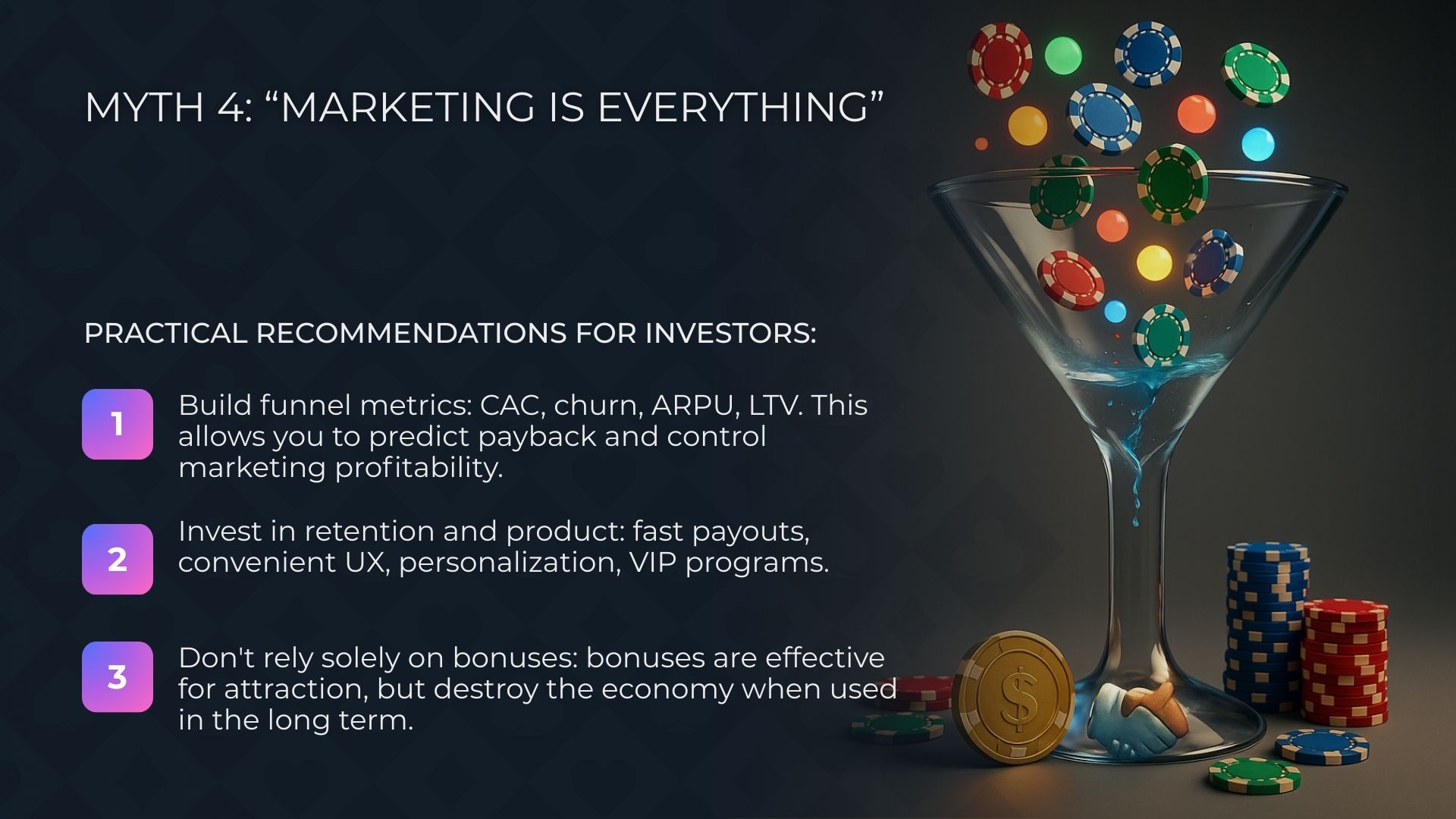
Many investors and industry newcomers mistakenly assume that it is enough to “pour traffic” into ads and the casino will become profitable. In practice, this leads to significant losses, especially when unit economics are ignored.
-
CAC (Customer Acquisition Cost) is rising: paid channels (Google Ads, affiliates, social networks) are getting more expensive due to competition and regulatory restrictions.
-
LTV (Lifetime Value) depends on player retention rather than initial acquisition. Industry benchmarks recommend LTV:CAC ≥ 3:1.
-
Studies show that projects focused solely on acquisition without retention lose up to 70% of acquired players within the first three months.
Why this myth is dangerous:
-
Focusing on marketing without retention leads to a “burned budget”: acquisition costs exceed player revenue.
-
Without retention tools (CRM, personalization, trigger-based campaigns, VIP programs), even aggressive marketing cannot save the project.
Learn more: How to acquire and retain players in your casino?
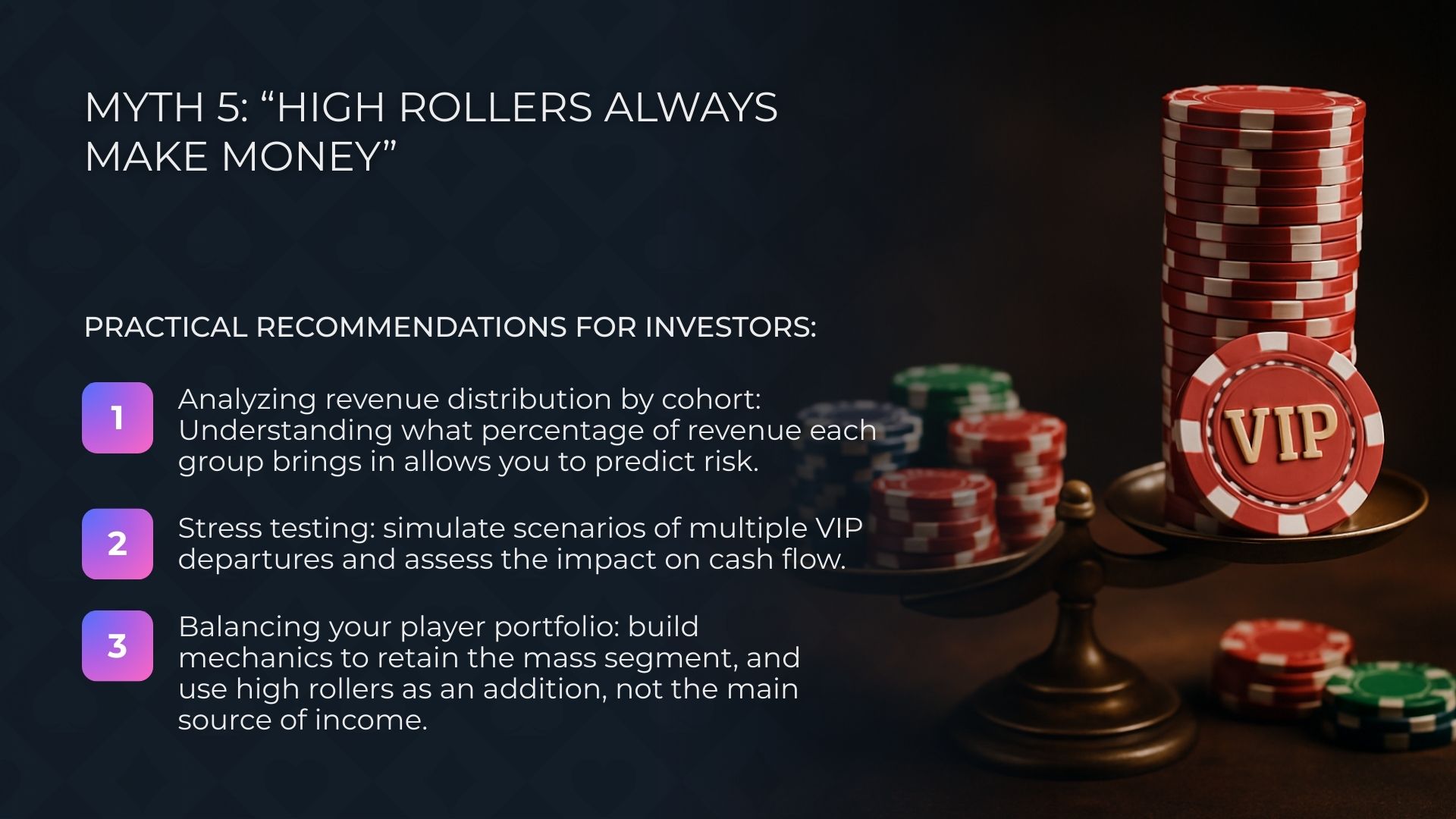
Myth 5. “High-rollers always generate profit”
There is a persistent belief that a few big players can “save” the platform and drive the bulk of profits. In practice, this is only partially true and is associated with high volatility and business risk.
-
Research and operating statistics show that 1-5% of players can generate up to 40-50% of revenue.
-
Dependence on a small group makes the business vulnerable: the departure of several key VIPs can cause a sharp drop in revenue.
-
Revenue concentration increases volatility and complicates financial planning and investor assessment.
Conclusion: high-rollers are valuable for revenue, but their role should be limited and balanced. An investor must understand concentration risks and plan for audience diversification.
Learn more: How VIP players shape online casino revenues
Myth 6. “The main threat is competitors”
Many believe that the main risk for a casino is market rivals. In practice, competition matters, but the primary threats come from regulatory and technological domains, not only from the fight for users.
-
Regulatory changes can instantly alter project economics: higher taxes, advertising restrictions, new KYC/AML requirements. For example, public reports from Entain and Flutter show that tax changes in the UK and Europe significantly affect margins.
-
Technological risks include hacks, data leaks, and DDoS attacks that directly impact platform availability and player trust.
-
Competitors mainly affect new user acquisition and do not offset systemic threats.
Why this myth is dangerous:
-
Focusing solely on competitive battles makes investors underestimate real compliance and security risks.
-
A company unprepared for regulatory change can lose its license, partners, and revenue even with a successful marketing strategy.
Myth 7. “Crypto casinos are a grey segment with no future”
Many investors believe that crypto casinos are an unreliable and illegal segment with no growth prospects. The reality is far more nuanced: crypto platforms are actively developing and already occupy a notable market share, albeit with elevated risks.
-
In 2024, the global GGR of crypto casinos was estimated at $81.4 billion (Financial Times).
-
Crypto platforms attract users with fast withdrawals, anonymity, and lower transaction costs.
-
Regulation lags behind, so many projects operate outside strict jurisdictions, increasing legal risks and the risk of blocks.
Conclusion: crypto casinos are not a “grey corner” but a segment with high growth potential. They require caution and robust legal and operational structuring but can become a driver of long-term strategy.
Learn more: A new stage of iGaming: how and why to launch a crypto casino today
Myth 8. “Players choose a casino solely for bonuses”
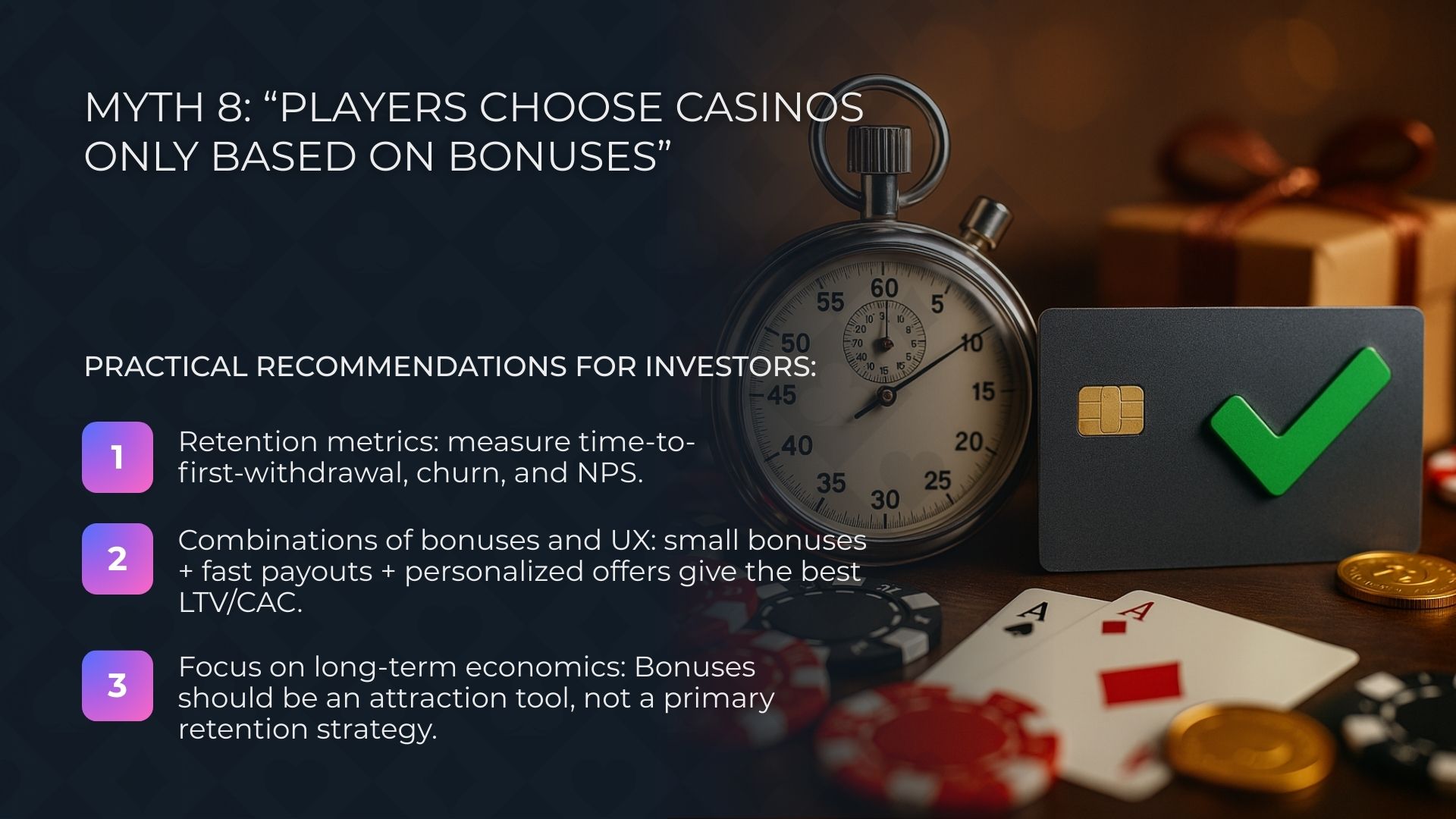
There is an opinion that a platform only needs to offer large bonuses and promotions to succeed. In practice, this is an outdated concept that can harm unit economics.
-
Research and operational analytics show that payout speed, convenience of payment methods, and UX quality influence retention much more than bonuses.
-
Small but consistent bonuses can stimulate acquisition, but players stay because of trust and service reliability.
-
Players more often choose a platform with fast verification and instant withdrawals than one with one-off high bonuses.
Why this myth is dangerous:
-
Overestimating a bonus strategy leads to a “burned marketing budget.”
-
Players quickly churn if basic service expectations are not met, regardless of generous promotions.
Myth 9. “An online casino scales easily to any country”
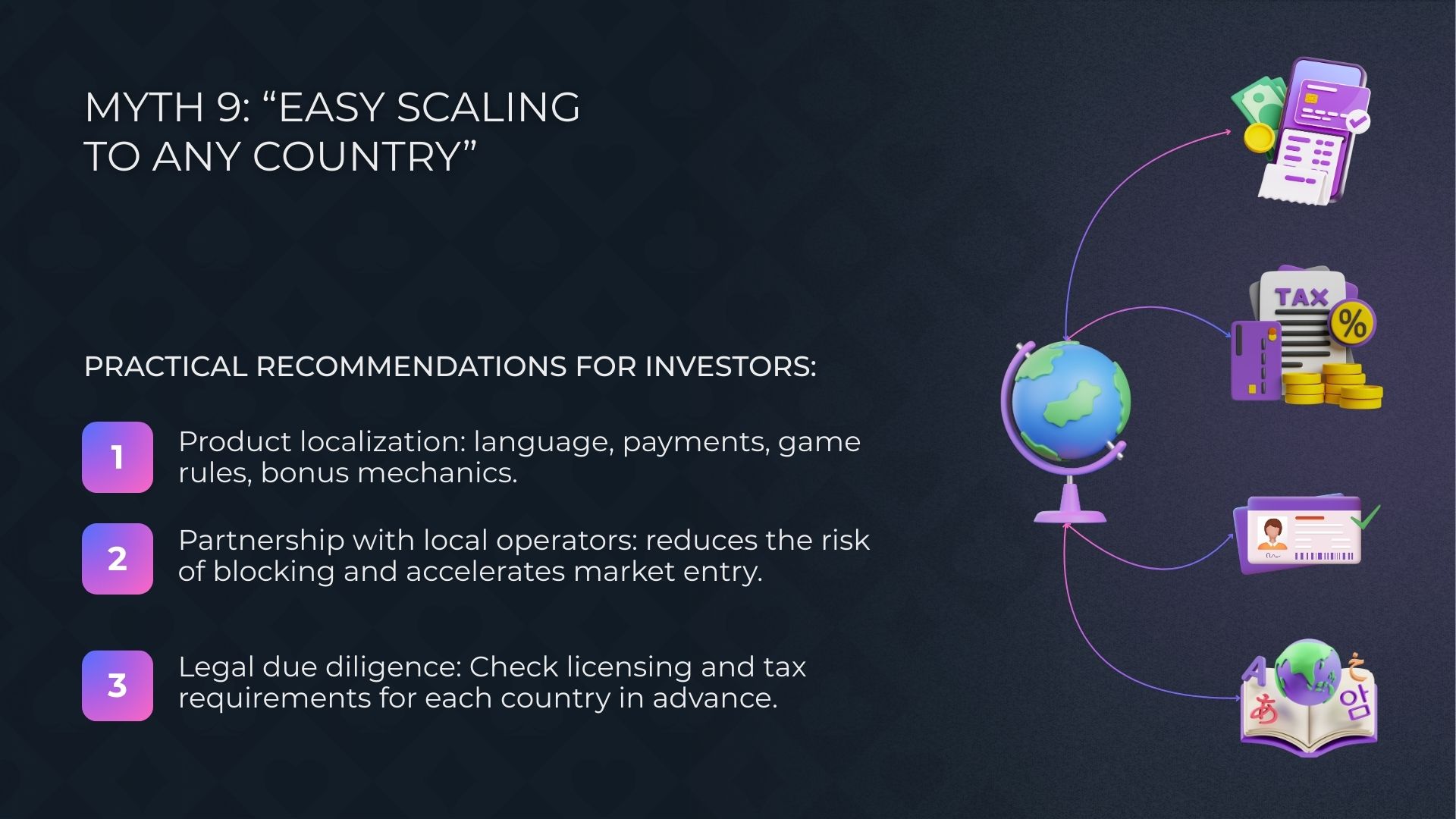
Many think it is enough to launch a platform and it will automatically work in any jurisdiction. In reality, this is far from true: international expansion requires thorough localization and compliance with regulatory requirements.
-
Every country has unique licensing, taxation, and advertising requirements.
-
Lack of localization can lead to platform blocks, fines, and traffic loss.
-
Local payment systems, interface language, and player cultural preferences critically affect retention and LTV.
Why this myth is dangerous:
-
Misjudging the regulatory landscape leads to legal and financial risks.
-
Ignoring local specifics can reduce revenue even if the product is high quality.
Learn more: Where to launch a casino in 2025: top GEOs with high potential
Myth 10. “Investments in casinos deliver quick ROI”
Many investors expect immediate returns, focusing on the success stories of industry giants. In practice, fast ROI is rare; payback is more often spread over years.
-
Professional benchmarks show that full monetization and positive cash generation take 2-3 years, depending on the jurisdiction, initial CAPEX, and the quality of retention.
-
Payback scenarios strongly depend on LTV/CAC, tax burden, and marketing efficiency. Stress tests that include VIP churn or regulatory changes can extend payback by another 6-12 months.
-
Even in niche projects with white-label setups, investments rarely return faster than 12-18 months without additional spending on marketing and retention.
Conclusion: rapid ROI is the exception rather than the rule. Success depends on long-term strategy, retention efficiency, and adaptation to the regulatory environment.
Learn more: Which performance metrics matter for online casinos?
Conclusion
The analysis of ten key myths shows that success in online gambling depends not on luck, random high-rollers, or aggressive marketing, but on a systematic approach to launching, managing, and scaling the project.
-
Strategic planning. Investors should assess not only initial investment but also long-term CAPEX, marketing spend, retention, and LTV. Myths about “billion-dollar budgets” and quick ROI create an illusion of easy profit and can lead to miscalculations.
-
Regulatory and legal resilience. A license is not a formality. It shapes access to markets, payment systems, and partner channels, while adherence to compliance processes reduces the risk of fines and loss of trust.
-
Player economics and retention. The market values platforms that retain a mass audience, while high-rollers and bonuses are only complementary. Personalization tools, CRM, and quality UX directly influence LTV/CAC and investment payback.
-
Technological and operational readiness. Without a well-designed IT infrastructure, DDoS protection, and security monitoring, growth can be quickly derailed by external factors despite marketing success.
-
Niche positioning and international strategy. The market is not overcrowded but requires proper segmentation, product localization, and understanding of regulatory differences. Crypto platforms, mobile, and live games open new opportunities but come with elevated risks.
Final recommendation for investors: the approach to launching and managing an online casino must be intellectually disciplined, analytically grounded, and strategically flexible. Mistakes stemming from common myths lead to financial losses and reputational risks. Sustainable profit arises from a balance of compliance, player economics, technological resilience, and a well-thought-out marketing strategy.
FAQ
How much money do you really need to launch an online casino?
Software is no longer the main cost. The Gambling Soft platform starts from $7,500 and ready-made casinos cost from $8,500 to $47,500. Budget separately for a license, for example Anjouan at $28,000 or Curacao at $75,000, and for marketing.
Is it too late to enter the online casino market?
No. According to Grand View Research the market was about $78.7 billion in 2024 and grows 9-12% per year. Mobile, crypto and eSports betting are less crowded than classic slots.
Can an online casino work without a license?
Without a license you lose access to most payment providers, affiliate programs and regulated markets. Through Gambling Soft a license costs from $28,000 (Anjouan) to $75,000 (Curacao).
How fast does an online casino pay back?
Rarely fast. Industry benchmarks give 2-3 years to full monetization, and even white-label projects seldom return the investment in less than 12-18 months.
How long does it take to launch a casino on Gambling Soft?
The platform is launched in 7 business days and comes with a 12-month guarantee. The full source code is available for $19,000.
