


Updated 29 September 2026. Author: Gambling Soft team.
Short answer: New operators usually fail because of five mistakes: no business plan, a license that does not fit the target market, the wrong market, a weak platform and marketing without retention. The first 18-24 months decide whether the project survives. The Gambling Soft platform starts from $7,500, launches in 7 business days and comes with a 12-month guarantee (see our pricing page).
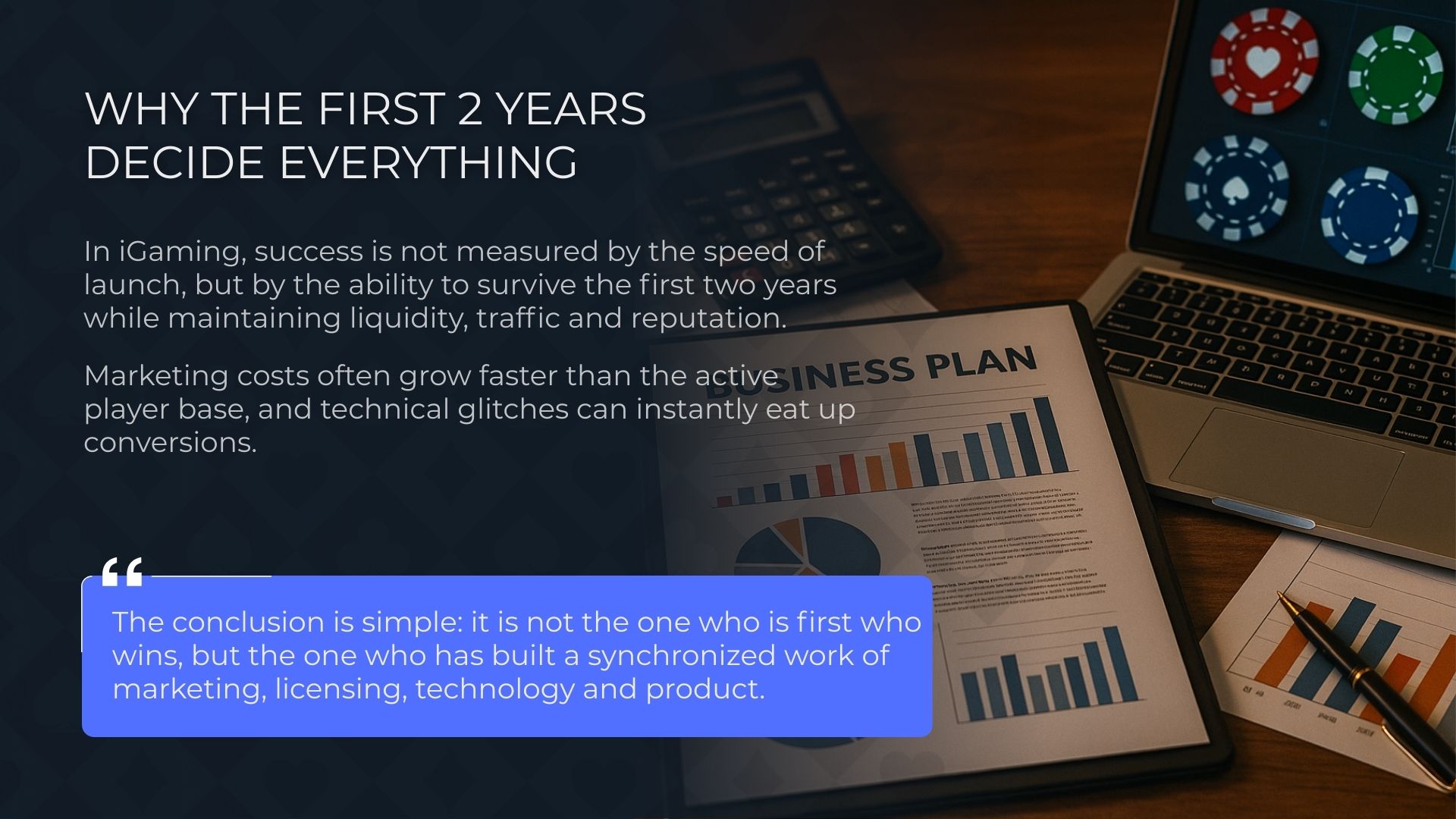
There’s no such thing as a “lucky start” in iGaming in the classic sense. The winner isn’t the one who entered the market first, but the one who managed to endure the first 18-24 months while maintaining liquidity, traffic, and reputation. This period is the most dangerous for an operator: marketing starts “eating” the budget faster than the base of active players grows, and technical glitches plus mistakes in the product lineup instantly hit conversion and retention.
The cause of failure is almost always the same: an inability to think the business through in advance. At the start, many focus on potential revenue figures and forget that every decision, from choosing a license to designing a bonus policy, lays the groundwork for future costs. For example, picking the wrong jurisdiction can double operating expenses, and targeting the wrong market can zero out ROI before you even reach break-even.
iGaming isn’t about a quick launch; it’s about building a system where marketing, the platform, the license, and the product work in sync. Ignoring even one element of this system turns the project into a casino with a countdown timer, where the only question is when it will shut down.
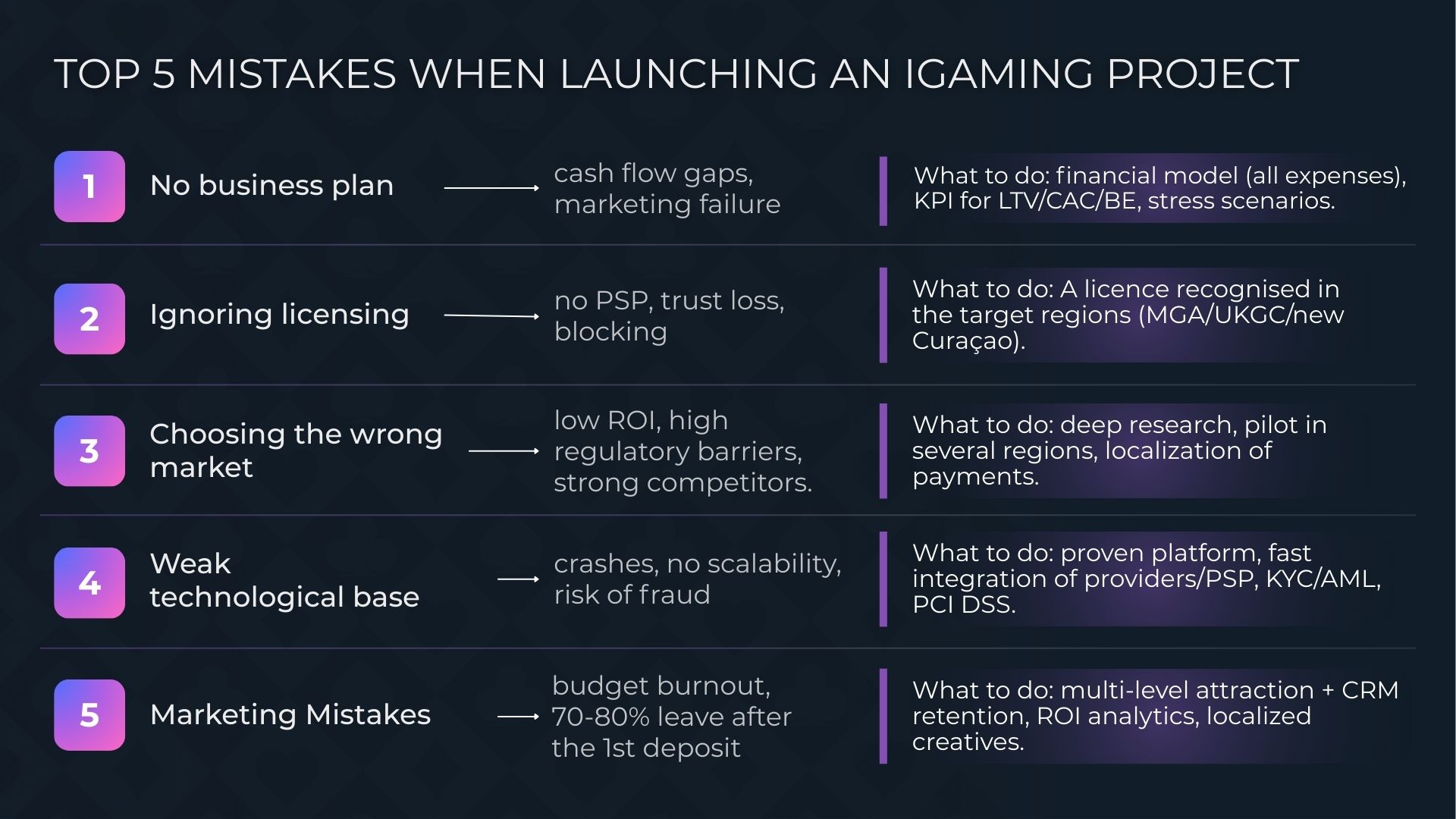
Mistake 1: No Clear Business Plan
In iGaming, the absence of a business plan isn’t just a formal mistake; it’s a direct threat to the project’s survival. Most operators who “burn out” in the first two years start the same way: they launch a site, connect game providers, and run an ad campaign without a clear understanding of how they will scale, retain players, and control costs.
A solid business plan for an online casino isn’t a downloaded template or a file with a revenue forecast. It’s a working tool that includes:
-
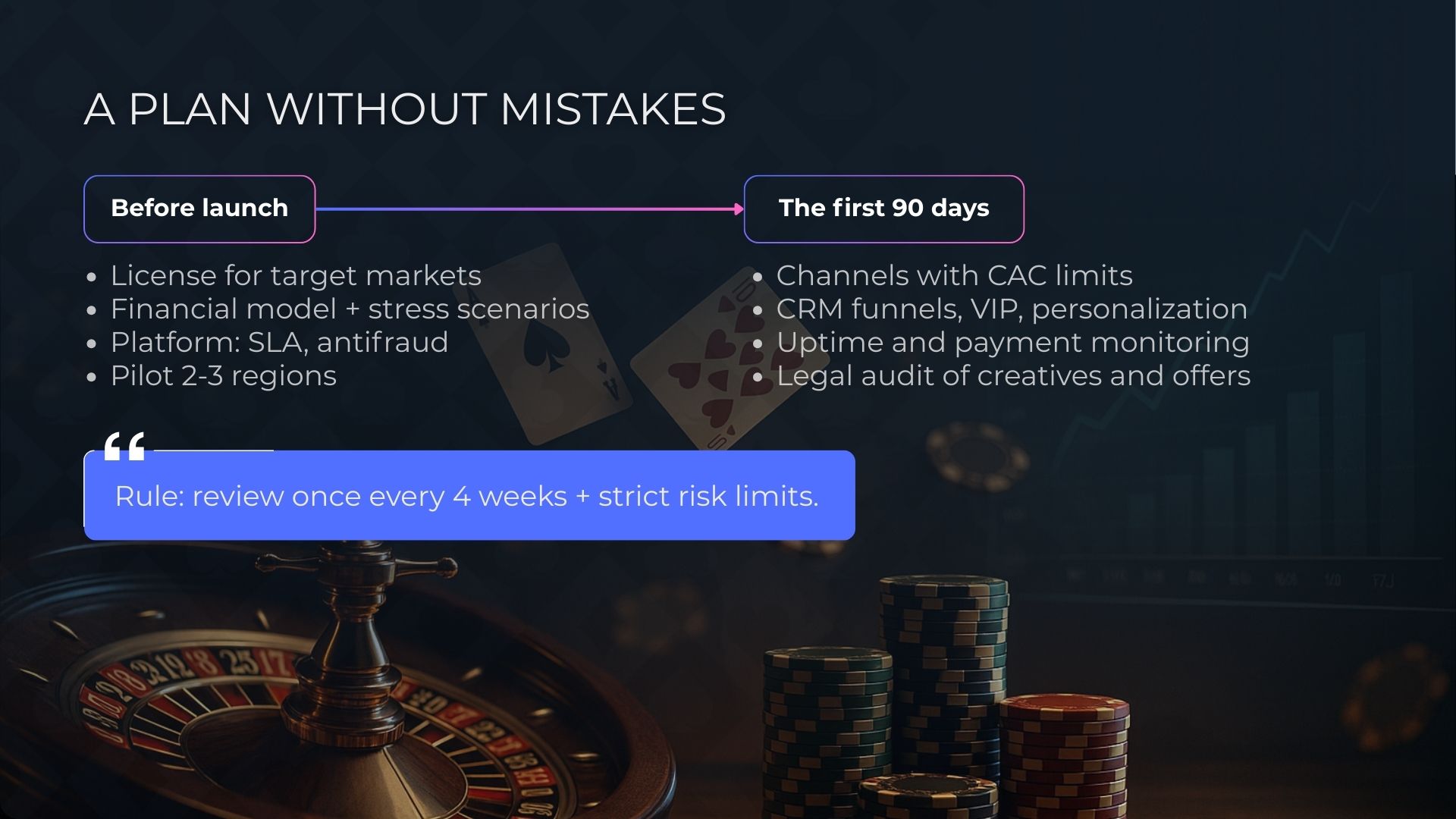
Financial model that factors in not only betting revenue but all operating costs, from PSP fees and taxes to bonus liabilities.
-
KPIs by development stage with specific retention metrics, LTV, CAC, and a plan for reaching break-even.
-
Scenario planning that models not only an optimistic case but also stress scenarios (traffic drop, regulatory changes, payment gateway blocks).
In practice, the lack of such structure leads to three critical consequences:
-
Cash flow gaps: when operating expenses outpace the inflow of deposits.
-
Disrupted marketing campaigns: due to a lack of funds for planned promotion.
-
Chaotic scaling: for example, entering a new market without accounting for its regulatory specifics and payment habits.
Unlike traditional business, in iGaming the cost of a mistake isn’t a partial loss of profit; it’s a complete wipeout of the project. Here, the business plan is not a bureaucratic formality but a survival map.
Mistake 2: Ignoring Licensing
In iGaming, a license is not just formal permission to operate; it’s a key element of trust, access to payment solutions, and the ability to scale. The mistake newcomers make is treating licensing as a one-off “checkbox” procedure or trying to bypass it with offshore registrations that don’t match their target markets.
In practice, this leads to a number of problems:
-
No access to payment service providers (PSPs)
Banks and payment gateways in most jurisdictions only work with licensed operators. If your license isn’t recognized by international financial institutions, you’ll be left with a limited set of high-risk PSPs and inflated fees.
-
Reputational risks and low player conversion
Experienced players check the jurisdiction where a casino is licensed. The absence of a well-known regulator (MGA, UKGC, Curaçao in its new framework) reduces trust and sharply increases churn after first deposits.
-
Legal vulnerability
Operating without a license or with a license that doesn’t fit the market can lead to domain blocks, fines, and even criminal prosecution in tightly regulated countries (e.g., Germany or the Netherlands).
A common mistake is choosing a “cheap” jurisdiction without analyzing target regions. For example, a license recognized in Latin America may be completely useless for European traffic. Even worse is spending a marketing budget in a country where your license doesn’t apply at all.
Licensing in iGaming is a strategic asset that influences everything: from marketing geography to the terms of working with game providers. Cutting costs at this stage almost always results in losses that far exceed the initial “savings.”
Learn more: License costs across different jurisdictions

Mistake 3: Entering the Wrong Market
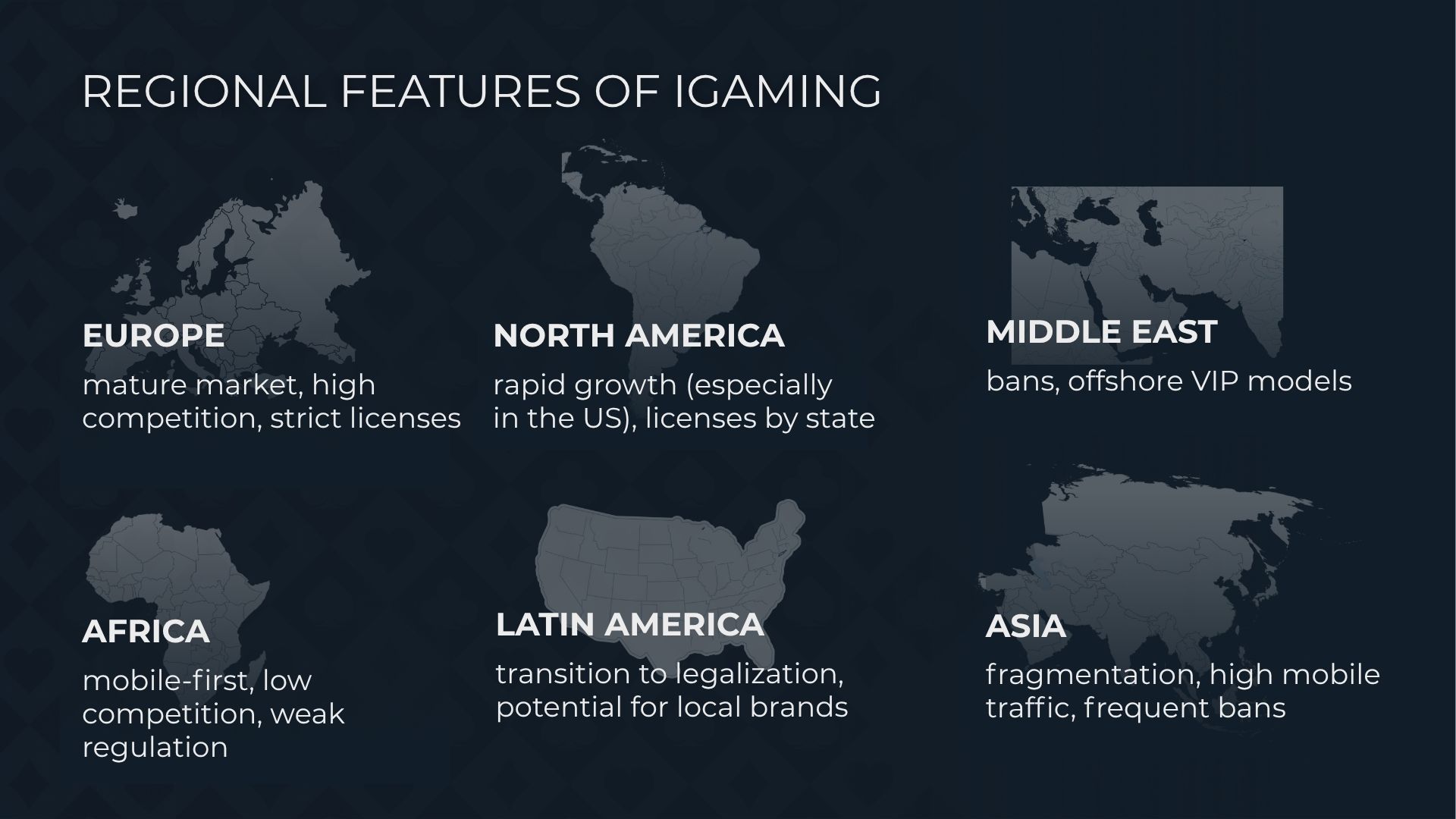
In iGaming, a market isn’t just a geography. It’s a mix of the regulatory environment, payment habits, players’ cultural preferences, and the competitive landscape. The mistake many startups make is choosing a market based on “there’s a lot of traffic” or “our competitors are succeeding there,” without in-depth analysis.
How this plays out in practice:
-
Low ROI from the first months
Even with high traffic volumes, conversion to deposits can be minimal if payment methods are inconvenient or localization is missing.
-
Regulatory barriers
High-potential countries often have strict rules: licenses, mandatory game certification, data-storage requirements. Without readiness to comply, an operator loses access to the market at the very start.
-
Competitive pressure
Entering a market with dozens of established brands requires large marketing budgets and unique positioning. A newcomer without a clear strategy quickly loses visibility.
Example:
An operator launches a casino under a Curaçao license and targets the German market. The result: the domain is blocked by ISPs at the regulator’s request, payment gateways refuse service, and the entire ad budget is wasted.
How to do it right:
-
Before entering a new market, whether with a turnkey online casino or a white label casino solution, conduct in-depth market research with analysis of demand, competition, legal conditions, and players’ LTV by region.
-
Choose a market where legal, financial, and cultural factors allow you to reach break-even quickly.
-
Test several regions in a pilot mode before a large-scale rollout.
In iGaming, choosing the right market at the start can save months of work and hundreds of thousands of dollars. The wrong choice, by contrast, wipes out the project before it even gets a chance to grow.
Learn more: Where to launch a casino in 2025: Top GEOs with high potential
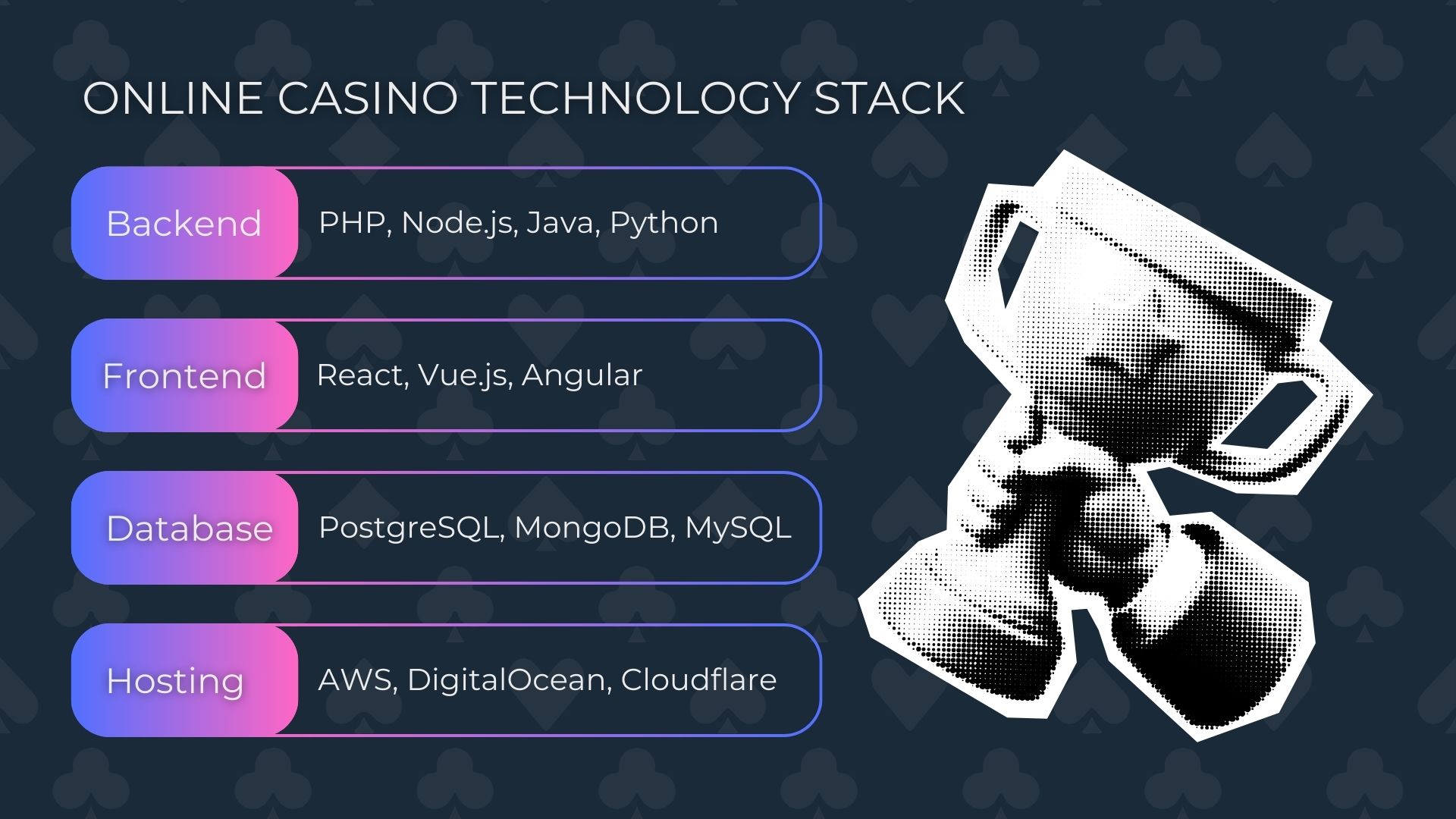
Mistake 4: Weak Technology Stack
In online casinos, technology isn’t a “background” element; it’s the foundation the entire business stands on. Even with great marketing and a license, the project is doomed if the platform is unstable, integrations are unreliable, and the user experience (UX) annoys players.
What a weak tech base leads to:
-
Player loss due to technical failures
In iGaming, conversion to repeat deposits directly depends on the stability of your casino platform and the quality of your online casino software. Long game load times, transaction errors, or server crashes during peak hours hit retention and reputation head-on.
-
Limited scalability
A platform that isn’t designed for rapid onboarding of new providers, payment solutions, or markets turns growth into a long and expensive process.
-
Fraud vulnerability
Weak KYC, anti-fraud, and data protection mechanisms increase the risk of chargebacks, bonus abuse, and regulator fines.
A classic mistake is choosing a platform by price rather than by functionality and stability. Saving at the start often turns into an expensive migration to another engine, data loss, and a temporary shutdown.
How to do it right:
-
Choose an igaming software provider with a proven record of stable operation and certified integrations from leading game providers.
-
Assess scalability: the ability to quickly add new markets, languages, currencies, and payment methods.
-
Ensure a high level of security: KYC, AML, anti-fraud, and data protection to PCI DSS standards.
In iGaming, the casino platform is not just a technology tool; it’s part of the brand, and the foundation of your online casino software strategy. For a player, a stable site and instant transactions matter more than an aggressive bonus program.
Learn more: What is a ready-made online casino script
Mistake 5: Marketing Missteps
In iGaming, marketing isn’t just about acquiring traffic; it’s a comprehensive system that must simultaneously ensure brand visibility, attract target players, and retain them throughout the entire lifecycle. The mistake many new operators make is focusing on a single promotion channel or launching campaigns without factoring in player economics (LTV) and acquisition cost (CAC).
What this leads to:
-
Budget burn-out
Running large campaigns without audience segmentation results in expensive traffic and low conversion to deposits.
-
Retention neglect
70-80% of new online-casino players don’t return after the first deposit unless they have a compelling reason to stay: unique promos, a loyalty program, personalized content.
-
Reputational damage
Aggressive ads that ignore jurisdictional specifics can trigger complaints, social-media account blocks, and sanctions from regulators.
Frequent miscalculations:
-
Betting on brand campaigns before the brand is known.
-
Ignoring SEO and organic traffic in favor of paid ads only.
-
Lack of analytics to track the true profitability of channels.
How to do it right:
-
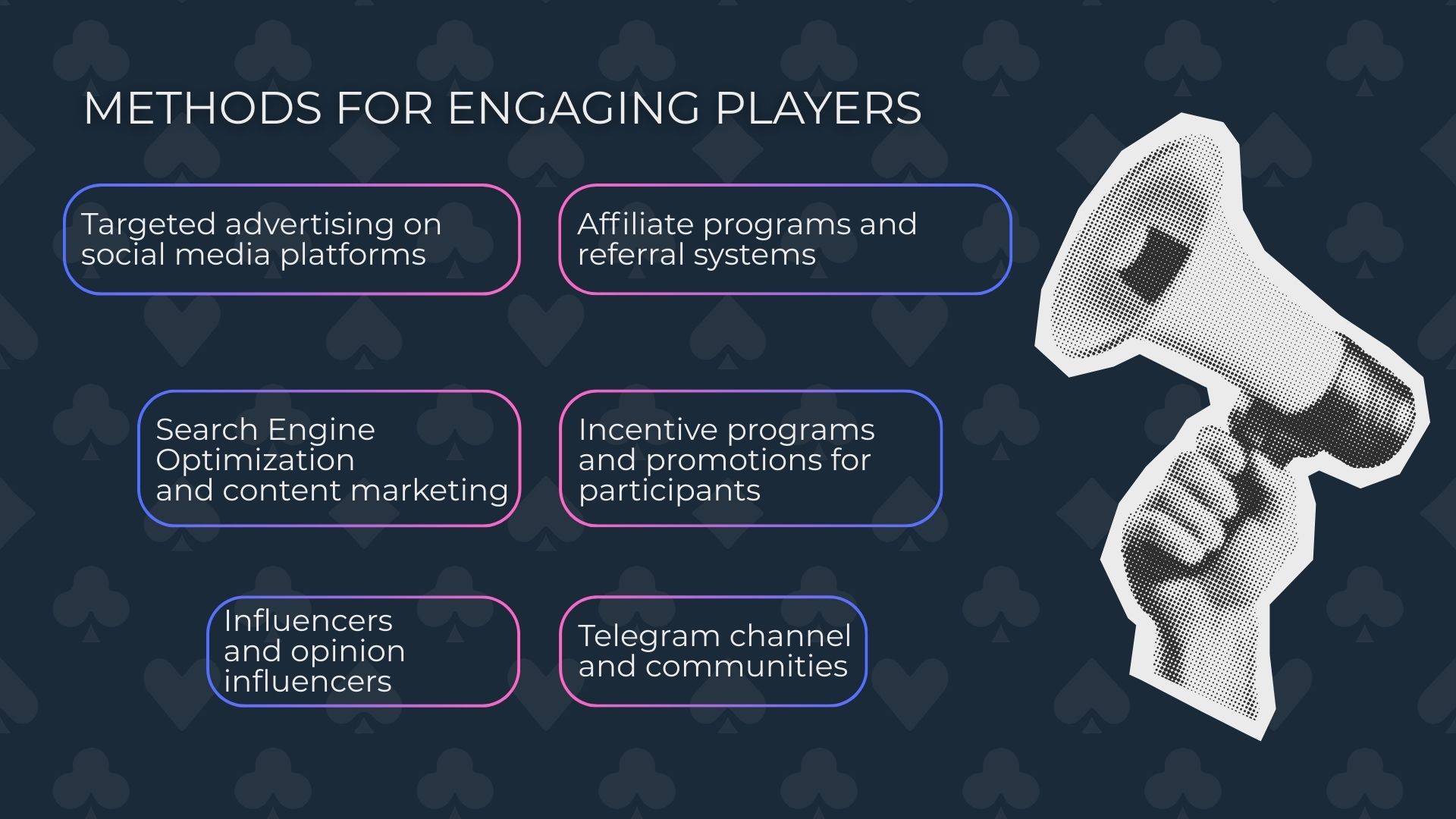
Build a marketing strategy where channels are mapped to the funnel stages: from initial acquisition (SEO, content, affiliate programs) to retention (CRM marketing, VIP programs).
-
Calculate player economics and adjust budgets based on ROI for each channel.
-
Localize creatives and offers for specific markets rather than using universal templates.
In iGaming, the winner isn’t the one who spends the most on advertising, but the one who can turn acquired players into long-term customers with high LTV.
Learn more: How to attract and retain players in your casino?
Brief Summary of the Five Strategic Mistakes
|
Mistake |
Essence of the Problem |
Main Consequences |
How to Do It Right |
|---|---|---|---|
|
No clear business plan |
Lack of a financial model, KPIs, and scenario planning |
Cash flow gaps, disrupted marketing, chaotic scaling |
Develop a detailed business plan with financial forecasts, KPIs, and stress scenarios |
|
Ignoring licensing |
Choosing an unsuitable or cheap jurisdiction without considering target markets |
No access to PSPs, loss of player trust, legal risks |
Analyze target markets; choose licenses recognized in key regions |
|
Entering the wrong market |
Choosing a region without analyzing regulations, competition, and payment habits |
Low ROI, blocks, inability to operate |
Conduct market research; pilot several regions before scaling |
|
Weak technology base |
Unstable platform, limited integrations, weak security |
Player loss, inability to scale, growth in fraud |
Choose proven platforms; ensure scalability and a high level of protection |
|
Marketing mistakes |
Monolithic channels, neglecting retention, lack of analytics |
Rapid budget burn, low conversion, reputational damage |
Build a strategy spanning acquisition and retention; localize marketing; track ROI |
Learn more: How to choose software for an online casino in 2025
Conclusion
Launching an online casino in today’s iGaming landscape offers high potential returns alongside equally high risk. Most failures aren’t due to a lack of capital or marketing resources, but stem from strategic missteps made at the planning stage.
A clear business plan, the right license, a justified market choice, a reliable technology base, and a calibrated marketing strategy aren’t competitive advantages; they’re the minimum conditions for survival in the industry. Ignoring even one of these elements creates a chain of problems that accumulates and ultimately leads to the project’s closure.
For entrepreneurs and investors, the key recommendation is simple: treat iGaming not as a “quick startup” but as a long-term business with a comprehensive strategy. That means investing in analytical preparation, proven solutions, and controlled growth. In this industry, the winner isn’t the one who entered first, but the one who made it through the first two years while preserving stability, reputation, and control over the project’s economics.
FAQ
What is the most common mistake when launching an online casino?
Launching without a financial model. Without KPIs, cash flow planning and stress scenarios, marketing burns the budget before the player base grows.
Which license should a new online casino choose?
One that is accepted in your target markets and by your payment providers. Through Gambling Soft, Anjouan costs $28,000, Kahnawake $60,000, Malta $70,000 and Curacao $75,000.
How much does a reliable casino platform cost?
The Gambling Soft platform starts from $7,500, ready-made casinos cost from $8,500 (Violet) to $47,500 (Velvet) and the full source code costs $19,000.
Why do players leave a new online casino?
70-80% of new players do not return after the first deposit unless they have a reason to stay, such as a loyalty program, personal offers or fast payouts.
How long does it take to launch a casino with Gambling Soft?
The platform launches in 7 business days with a 12-month guarantee. Plan the budget for the first 18-24 months, the most dangerous period for a new operator.
